



Should Couples Compromise on Mattress Firmness?
07 Sep 2026
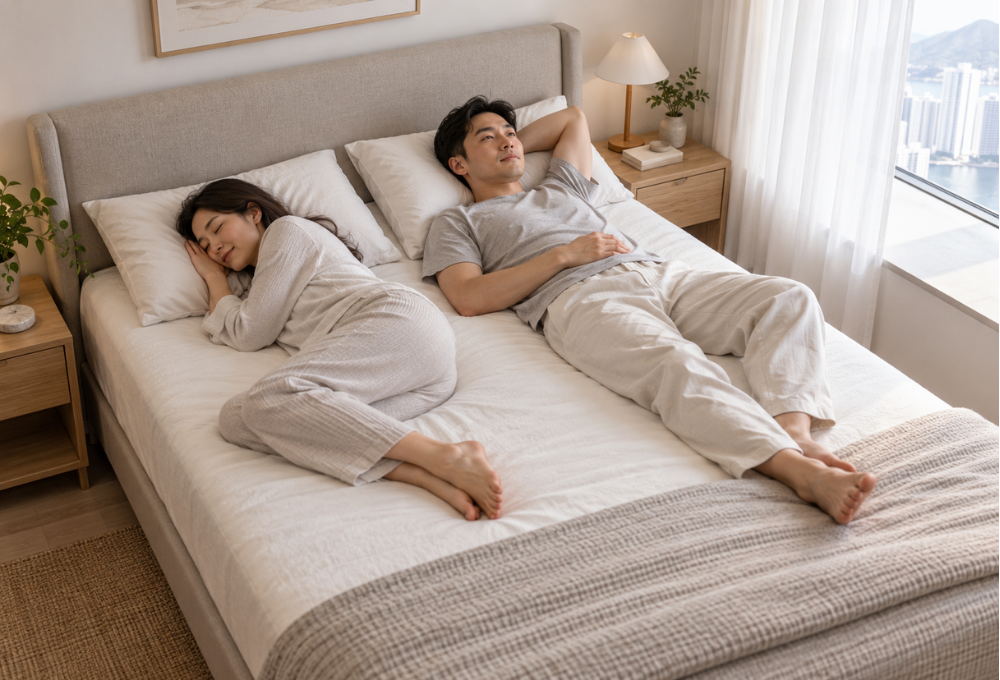
Couples should compromise on mattress firmness only when the shared result remains genuinely comfortable for both sleepers. If a medium or medium-firm mattress gives each person suitable cushioning, stability and support, compromise can be simple and sensible.
However, if choosing the middle leaves one person feeling excessive pressure and the other sinking more deeply than they like, the compromise has not solved the problem. It has simply distributed the dissatisfaction between two people.
When partners’ needs are far apart, independent firmness on each side may be more practical than asking either person to tolerate an unsuitable sleep surface.
A successful compromise gives both sleepers an acceptable—and preferably comfortable—result.
If one partner consistently sleeps worse, it is not a fair or effective compromise.
Mattress compromise can describe several very different outcomes.
One person prefers medium and the other prefers medium-firm, so they choose a balanced option between the two.
If both remain comfortable, this is a genuine shared solution.
One person chooses the mattress they want, while their partner agrees despite being less comfortable.
This is not really a middle ground—it is one person giving up their preference.
A couple may select medium-firm simply because it sounds neutral.
If one still finds it too hard and the other still finds it too soft, the label has created compromise without comfort.
The aim should not be to make the decision look equal. It should be to produce a bed on which both people can sleep well.
A mattress does not have one universal feel. How it responds depends on the sleeper.
A heavier person generally compresses the comfort layers more deeply. A lighter person engages less of the material, which can make the same surface feel firmer.
Side sleeping concentrates more pressure around the shoulders and hips. Back and stomach sleepers distribute weight differently and may prefer greater resistance beneath the torso or pelvis.
Shoulder width, hip shape and weight distribution can change how deeply different parts of the body settle into the mattress.
Some people enjoy a deeply cushioning sensation, while others prefer feeling stable and closer to the top of the mattress.
The Hong Kong Consumer Council has similarly noted that mattress firmness has no single standard and that the same mattress can perform differently according to the sleeper’s weight and position.
A shared firmness is more likely to work when the partners’ needs already overlap.
One partner wants a deeply plush surface while the other strongly prefers a very firm mattress.
In that situation, finding one shared setting that genuinely satisfies both sleepers may be much harder.
Compromise becomes less appropriate when the shared firmness repeatedly creates a problem for either sleeper.
Warning signs include:
A mattress is used every night for years. “Manageable” is a low standard for such a frequent and long-term purchase.
Greater discomfort deserves attention, but it should not automatically give one person complete control over the whole mattress.
If one person is comfortable and the other is not, the first step is to identify why.
The issue may be surface pressure, sinkage, movement, heat, insufficient space or a bed-frame problem rather than firmness alone.
Once other causes have been considered, the couple can decide whether the entire mattress needs to change or only that sleeper’s side.
Before discussing the mattress together, each person should write down their preferred firmness, usual sleeping position, desired amount of cushioning and any recurring discomfort.
This prevents the more decisive person from unintentionally setting the starting point for both partners.
“I like firm” is less useful than “I dislike my pelvis sinking deeply and want a stable surface.”
Likewise, “I like soft” may actually mean “I need more cushioning around my shoulder when I sleep on my side.”
If both people can comfortably use medium-firm, the decision may already be solved.
There is no benefit in adding complexity when one shared firmness works.
Both partners should lie down simultaneously in their normal positions for more than a few minutes.
Test turning, getting out of bed and using the edges.
If the middle does not work, let each partner test their preferred comfort level independently.
Compare whether individual settings produce a meaningful improvement—not merely a small difference that does not justify a specialised mattress.
Ask whether firmness is permanently fixed, adjustable at home or dependent on replacement components.
Also distinguish between a mattress-return trial, a firmness-adjustment programme and a product warranty.
If either person is already waiting to get off the mattress during a showroom test, the middle setting is unlikely to become suitable simply because it was labelled a compromise.
This is the simplest and often most economical option when both partners’ needs are close.
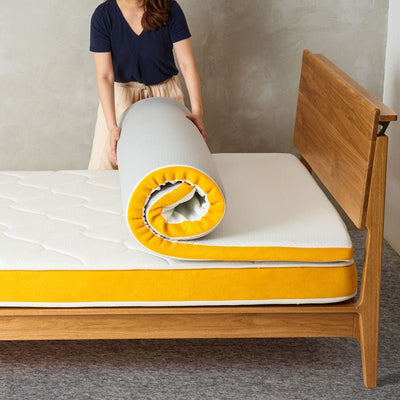
A topper can make an otherwise supportive mattress feel softer, but a standard full-width topper changes both sides.
It cannot usually make one side firmer.
One half is manufactured softer and the other firmer.
This can solve an established mismatch but offers less flexibility if either person’s needs change.
Each side can be configured for its own sleeper and adjusted later, depending on the product design.
Two separate mattresses provide greater physical independence and can work with separately adjustable bases.
They also create a more noticeable centre division.
See our detailed guide to dual-firmness mattresses versus Split King beds →
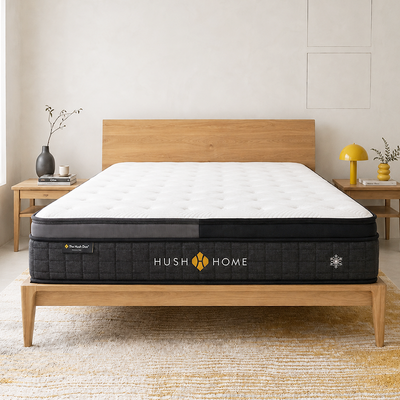
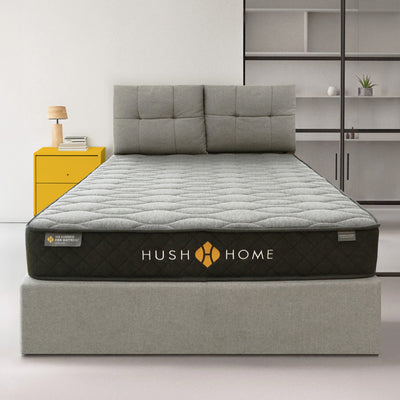
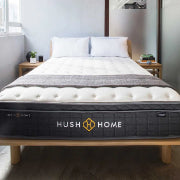
The 11-inch Hush Duo Mattress™ is designed for couples whose comfort needs do not fit one shared firmness.
Each partner can choose from four firmness profiles spanning approximately 4.0 to 9.0, from medium-soft to firm.
Each side contains two interchangeable Comfort or Support Inserts that can be configured independently.
One continuous cushioned outer cover preserves a smooth shared sleeping surface without an exposed centre gap.
Eligible customers can request additional replacement inserts during the first 365 nights, subject to the published terms.
Each side contains two interchangeable Comfort or Support Inserts. By changing their combination and order, each partner can choose from four firmness profiles spanning approximately 4.0 to 9.0, from medium-soft to firm.
The internal comfort zones are separate, but one continuous cushioned outer cover preserves a smooth shared sleeping surface without an exposed centre gap.
A five-zone pocket-coil base helps provide targeted hybrid support and reduce partner movement. ArcticFlow™ supports airflow, while EdgeSupport™ reinforces the perimeter.
Explore the Hush Duo Mattress™
Couples do not need identical mattress preferences, but they do need a solution that treats both sleepers’ comfort as equally important.
Compromise is appropriate when both people sleep comfortably on the result.
It is not appropriate when one partner has to tolerate pressure, sinkage or disturbed sleep simply because one mattress traditionally comes with one firmness.
When the middle genuinely works, choose it confidently. When it does not, independent comfort is a more precise answer than deciding who should lose.
Explore the Hush Duo Mattress™
No. Medium-firm is a sensible starting point when both partners have similar needs, but it is not automatically ideal for every body weight, sleeping position or comfort preference.
Not necessarily. The couple should identify why that person is uncomfortable and whether the issue can be solved on their side without making the other partner less comfortable.
Yes. Fixed split-firmness and adjustable dual-firmness mattresses can provide different comfort levels on the left and right sides.
A topper can help when both sleepers want slightly more cushioning. A standard topper changes the entire surface, so it is less useful when only one partner wants a softer side.
Test whether both remain comfortable on a middle setting. If not, consider independent firmness rather than forcing either partner to use an unsuitable surface.