


Solid Wood Bed Frame Guide: Pros, Cons, Wood Types & Buying Tips
29 Sep 2026
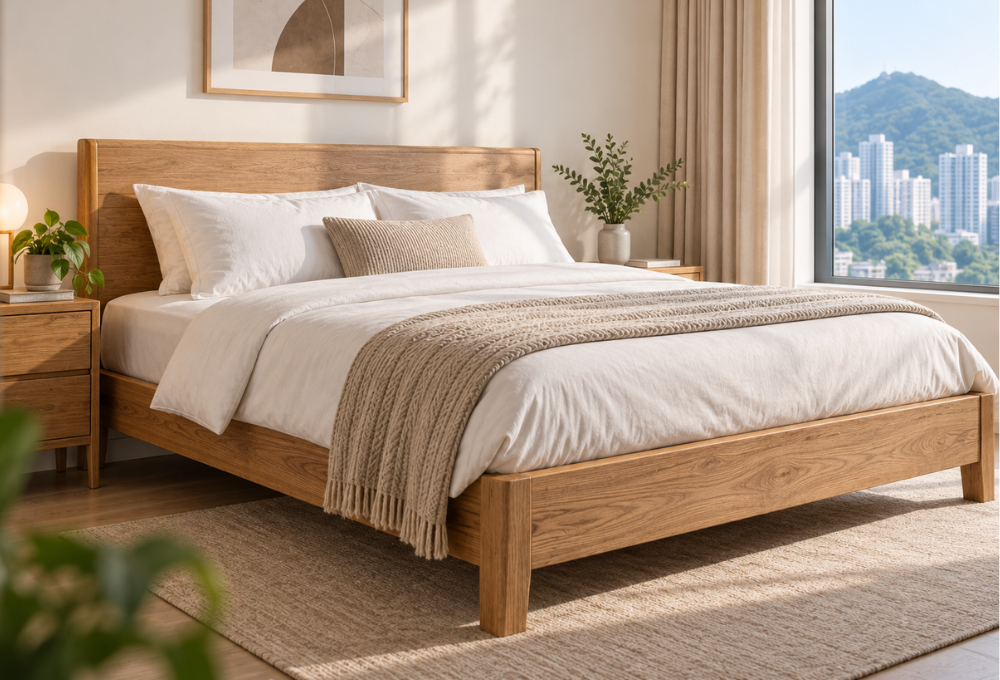
A solid wood bed frame is often marketed as the premium choice, but the material label should be the beginning of your evaluation—not the end.
A well-made solid wood bed can feel stable, age attractively and often be repaired or refinished. A poorly designed one can still wobble, squeak, crack at weak joints or provide the wrong support for your mattress. The quality of the whole structure matters more than simply asking whether the frame contains solid wood.
QUICK ANSWER
For many shoppers, yes—particularly if you value a rigid structure, natural grain, long-term repairability and a design you expect to keep for years. Hardwood species such as oak, ash, maple and walnut are widely used in furniture because they can combine strength, attractive grain and good finishing properties.
But solid wood is not automatically better in every situation. It is usually heavier, often more expensive, can move slightly as humidity changes and may provide less built-in storage than an upholstered hydraulic bed. In a small Hong Kong apartment, delivery access and room layout can be just as important as the wood species.
The best solid wood bed frame is therefore one that uses suitable, properly dried timber within a stable structure, supports your mattress correctly, fits your room and access route, and comes with clear information about finish, care, warranty and replacement parts.
In furniture, solid wood generally means the structural wooden parts are cut from timber rather than made primarily from reconstituted fibres or particles pressed into panels. Natural grain continues through the wood rather than existing only as a decorative printed pattern.
However, do not assume every component of a product labelled “solid wood bed” must be one continuous piece of timber. Bed frames may still use metal fasteners, brackets, adhesives at joints, protective coatings, fabric components or other materials where appropriate. The important question is which parts are solid wood and which are not.
If a retailer simply says “wood bed” or “wooden bed”, ask for the actual construction. Those words can describe solid timber, plywood, MDF, particleboard, laminated components, veneer-faced panels or combinations of several materials.
A common furniture misconception is that “veneer” is another word for MDF. It is not.
Wood veneer is a thin layer of real wood. It can be bonded to a range of substrates, including plywood, MDF or other panels, to create a real-wood surface appearance with a more dimensionally controlled core.
MDF is an engineered panel made from wood fibres bonded together with resin. Particleboard uses wood particles rather than fibres. Plywood is made from multiple thin wood veneers bonded in layers, usually with the grain direction alternating between plies.
These engineered materials are not automatically “bad”. Properly designed wood composites can provide consistent dimensions, efficient material use and good mechanical performance. The correct comparison is not simply “natural equals good, engineered equals bad”; it is whether the specific material and construction are appropriate for the part of the bed where they are used.
Composite wood products can use adhesive resins, and formaldehyde emissions are regulated in markets such as the United States. That does not mean every MDF or plywood product is automatically unsafe, nor does it mean every solid wood product is literally chemical-free. If emissions are a concern, look for the relevant product-specific compliance or certification rather than relying on the material name alone.
Hardwood and softwood are botanical categories, not universal hardness rankings. Hardwood generally comes from broad-leaved flowering trees, while softwood generally comes from conifers. Some hardwoods are relatively soft, and some softwoods can be strong and structurally useful.
For furniture, hardwoods are popular because many species combine good wear resistance, attractive grain and strong machining or finishing characteristics. Softwoods such as pine can also make practical bed frames, particularly where lower weight, cost or a softer rustic appearance is preferred.
The species, board grade, section thickness, joint design and support layout often matter more than the simple hardwood/softwood label.
Solid timber can provide a rigid structure with strong rails, legs and joints. For a bed, that matters because the frame must repeatedly handle static weight, people getting in and out, turning during sleep and forces transferred through the mattress.
Material alone does not guarantee stability, however. A solid wood frame with weak joints, insufficient centre support or loose hardware can still wobble.
Real timber varies in grain, colour, mineral streaks and figure. Many shoppers value this variation because two pieces do not look exactly identical.
That variation is also something to accept before purchasing. If you need every panel to match a sample photograph perfectly, natural solid wood may be less predictable than a printed or highly controlled engineered surface.
Scratches, worn finish or small surface damage on many solid wood pieces can sometimes be sanded, touched up or refinished by a competent furniture specialist. That is harder with a very thin decorative surface because aggressive sanding can break through the veneer or laminate.
Repairability still depends on finish type, damage location and how the bed was assembled, so do not assume every solid wood frame can be restored indefinitely.
Natural wood tends to work across minimalist, Scandinavian, Japanese-inspired, contemporary and more traditional interiors. A simple frame can often survive several changes of bedding, wall colour or bedroom décor without looking out of place.
An exposed wood frame has fewer fabric-covered surfaces than an upholstered bed. For households that dislike vacuuming padded headboards or worry about staining fabric, that can simplify routine cleaning.
Hardwood furniture can be substantial. That is useful for stability, but less convenient if you move frequently, rearrange the bedroom often or live somewhere with difficult lift or stair access.
Wood is hygroscopic: it exchanges moisture with surrounding air. As moisture content changes, wood can expand or contract slightly. Correct drying, construction and finishing help manage this movement but do not turn real wood into a completely inert material.
This matters in Hong Kong because the Hong Kong Observatory’s 1991–2020 climate normals show an annual mean relative humidity of 78%, with monthly means reaching 82–83% from March to June.
Large sections of graded hardwood cost more to source, dry, machine and finish than many mass-produced panel products. A solid wood bed therefore often sits higher in the market, although price alone still does not prove quality.
Knots, colour variation, ray fleck, mineral streaks and grain changes may be natural characteristics depending on species and grade. Buyers who want a perfectly uniform pattern should ask what variation is considered normal before ordering.
A raised wooden bed can provide useful open space underneath, but a hydraulic storage bed encloses almost the entire footprint as storage. In very small Hong Kong bedrooms, that difference can matter more than the choice of timber.
There is no single “best wood for a bed frame”. The best choice depends on the design, budget, desired colour and grain, weight, finishing system and how the timber has been dried and constructed.
Oak is one of the best-known furniture hardwoods. American white oak is hard, relatively heavy, strong and popular for furniture and flooring. American red oak is also hard and widely used for furniture. Both have visible grain, but their colour and pore structure differ.
Do not assume a bed described simply as “oak” is automatically white oak or red oak. Ask the retailer if the exact species matters to you.
American ash is light coloured, usually straight grained and known for good strength relative to weight. It machines and finishes well and is widely used in furniture, flooring and joinery.
Its strong grain contrast can create a more active visual pattern than very fine-grained woods, which is a style preference rather than a quality difference.
Hard maple is known for hardness, fine grain and a light, clean colour. It can produce a smoother, quieter visual appearance than coarse-grained oak or ash and is widely used for furniture and cabinetry.
“Soft maple” is a different commercial grouping and, despite the name, is not necessarily a very soft wood. Again, exact species matters more than the broad label.
American walnut is prized for its darker brown heartwood and distinctive figure. It is tough, hard and medium-density, and is widely used for higher-end furniture and interior joinery.
Walnut is often chosen as much for appearance as for engineering performance, and it typically commands a premium because of supply and design demand.
Pine can be lighter and more economical than many hardwoods. A well-designed pine bed can still be stable, but softer surfaces may dent or mark more easily depending on species and finish.
Do not reject a bed solely because it uses softwood, and do not buy one solely because it uses hardwood. Look at the complete structure.
Yes. Oak is a sensible bed-frame material because many oak species provide strong mechanical properties, good wear resistance and attractive grain. It also takes finishes well.
However, “oak” alone still tells you little about joint quality, board grade, drying, dimensions or support structure. A well-built oak bed is not the same thing as every product that uses a small amount of oak somewhere in the frame.
Fresh wood contains substantial moisture. Furniture timber is dried before manufacture so its moisture content is closer to the conditions expected during use.
The USDA Forest Products Laboratory explains that correct drying, handling and storage minimise unwanted moisture-content changes and dimensional movement. Protective finishes can slow moisture exchange, but they do not stop it completely.
In Hong Kong, furniture can experience humid outdoor air, air-conditioned interiors and seasonal changes. Properly dried timber and a construction that allows normal movement are therefore more meaningful than marketing claims that wood is “humidity-proof”.
No. Kiln drying reduces and controls moisture before manufacture; it does not permanently lock the timber at one moisture content. Wood continues to exchange moisture with air throughout its service life.
Good drying, sensible board selection, stable joinery, protective finishes and appropriate indoor conditions all work together. Small seasonal movement can be normal; significant splitting, severe warping or structural instability is a different issue and should be assessed.
A wood finish can affect appearance, stain resistance, cleanability and how quickly moisture moves in and out of the surface. Common systems include oils, waxes, lacquers, varnishes and other protective coatings.
A coating does not make indoor furniture waterproof. Spills should still be wiped promptly, and prolonged contact with standing water, steam or high heat should be avoided unless the manufacturer specifically says otherwise.
If you are sensitive to finishes or concerned about emissions, ask what finishing system was used and whether the manufacturer has relevant testing or compliance documentation.
A bed frame is a repeatedly loaded structure. The side rails must connect firmly to the headboard and footboard, the base must stay level and larger beds often benefit from effective centre support.
Look for substantial joints, secure fasteners and a design that can be tightened or serviced if necessary. A beautifully grained piece of timber cannot compensate for loose connectors.
If a showroom frame squeaks, do not immediately assume the wood species is the problem. Noise often comes from movement between joints, bolts, slats, centre supports or contact points.
For signs that an existing frame may need attention, see 5 Signs You Need to Replace Your Bed Frame.
The material of the outer frame and the design of the mattress support are separate questions. A solid wood frame may use a flat platform, rigid slats or flexible/sprung slats.
Different mattresses have different foundation requirements. A flat, stable platform can provide very consistent support, while properly designed slats can improve airflow. Flexible slats can also change the feel of the sleep system because the base itself moves.
Always follow your mattress manufacturer’s base and slat-spacing requirements. Hush Home currently advises that its mattresses should be placed on a flat, stable surface and, for slatted bases, uses a maximum slat-gap recommendation of 7 cm.
A “Queen bed frame” does not necessarily measure exactly the same as a Queen mattress. Side rails, headboards and footboards add to the footprint.
This is especially important in Hong Kong bedrooms where a few centimetres can affect wardrobe doors, bedside access and walking space. Always compare the frame’s external width and length—not only the mattress size—with your room plan.
For example, Hush Home’s current King mattress size is 183 × 198 cm, while the King Solid Wood Bed™ has stated outer dimensions of approximately 184 × 206 cm. The current size guide also notes that finished bed-frame measurements can vary slightly.
You can compare current frame dimensions in Hush Home’s Bed Frame Size Guide.
An elevated solid wood frame can make a small room feel visually lighter because you can see floor beneath the bed. It can also leave space for shallow storage boxes and make some cleaning tasks easier.
But open clearance is not the same as dedicated storage capacity. Boxes must fit between legs and supports, remain accessible, and may collect dust.
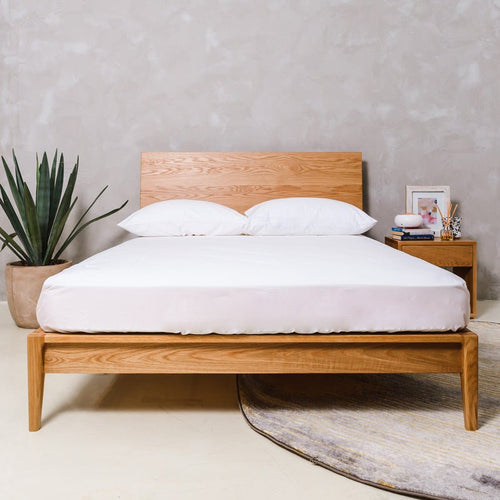
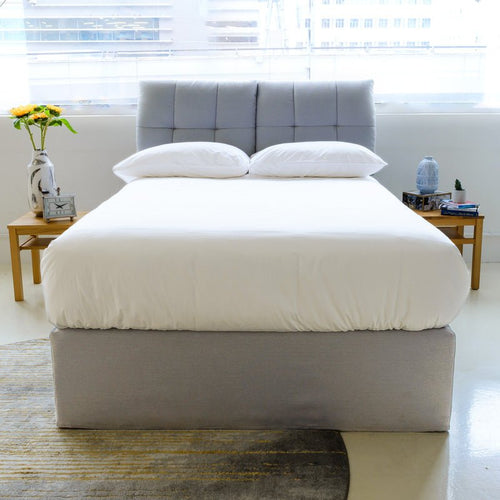
Hush Home’s Solid Wood Bed™ currently provides about 7 inches of clearance between frame and floor. Its Hydraulic Storage Bed™ uses the space differently, providing an enclosed 30 cm-high storage compartment beneath the mattress platform.
Neither is universally better. Choose based on whether you prioritise an open, visually lighter frame or maximum enclosed storage.
Choose solid wood if you prioritise natural grain, exposed timber, simpler surface cleaning, open under-bed clearance and potential long-term refinishing.
Choose an upholstered hydraulic storage bed if you prioritise hidden storage, a padded headboard and softer visual styling.
Do not treat one as inherently more supportive. Support depends on the base design and condition. Both a stable platform and properly spaced rigid slats can support a mattress well if they meet the mattress manufacturer’s requirements.
Any bed frame can develop noise. Squeaking is usually caused by movement and friction somewhere in the structure rather than by the simple fact that the frame is made of wood.
Common sources include loose bolts, rail connections, centre supports, slats rubbing against their seats, a headboard touching the wall or an uneven floor causing the frame to rock.
A good buying question is therefore not “Does solid wood squeak?” but “How is the frame joined, how is the base supported, and can the hardware be tightened later?”
The National Hardwood Lumber Association maintains North American hardwood lumber grading rules. FAS is one of the highest standard grades and is designed around the yield of large, clear cuttings from a board.
That is useful information about the raw hardwood lumber, but it should not be misunderstood as a complete finished-furniture certification. FAS does not by itself tell you whether the final bed has strong joints, suitable centre support, a good finish or responsible forest sourcing.
“Solid wood”, “hardwood”, “North American wood” and “FAS grade” are not sustainability certifications on their own.
If responsible sourcing matters to you, ask whether the product carries a recognised certification such as FSC, whether the company can identify the forest-sourcing system, and whether chain-of-custody evidence applies to the actual product being sold.
FSC certification, for example, distinguishes between forest-management certification and chain-of-custody certification. Product labels also differ, including FSC 100%, FSC Mix and FSC Recycled.
A retailer may also use other sourcing frameworks. The key is not to upgrade a general sustainability statement into a specific certification claim unless documentation supports it.
There is no universal household number that every bed must support. Capacity depends on frame size, design, centre supports, slats or platform, joints and manufacturer testing.
When comparing specifications, ask whether the stated limit includes the mattress as well as sleepers, whether it is a static or tested dynamic load, and whether the limit changes by bed size.
Hush Home’s current FAQ states that its bed frames support up to 200 kg. Because published weight-limit wording can be interpreted differently, shoppers with a specific capacity requirement should confirm directly what the figure includes before purchasing.
Solid wood bed components can be long, rigid and heavy. Even if the mattress fits into your lift, the headboard, side rails or platform sections may follow a different route geometry.
Before ordering, check your building entrance, lift door, lift-car dimensions, corridors, corners, apartment doorway and bedroom turning space. Ask the retailer for the largest packaged or assembled component dimensions if access is tight.
A bed frame that is perfect on paper is not useful if it cannot reach the bedroom.
For a broader frame-selection checklist, see Hush Home’s Bed Frame Buying Guide.
Follow the manufacturer’s finish-specific instructions first. Different coatings tolerate water and cleaning products differently.
As a general rule, remove dust with a soft cloth, wipe small marks with a lightly damp cloth if permitted, then dry the surface promptly. Avoid leaving standing water, steam or wet laundry against the wood.
Keep the bed away from persistent water leaks and prolonged intense heat or direct sunlight where practical. If you use a dehumidifier, the goal is normal indoor moisture control rather than making the room extremely dry.
Recheck bolts or serviceable joints if the bed begins to loosen or develop noise. Do not repeatedly tighten hardware beyond the manufacturer’s instructions, because overtightening can also damage threads or timber around fasteners.
For more detailed care instructions, see Wooden Bed Frame Product Guide: Tips on How to Clean Wood Furniture.
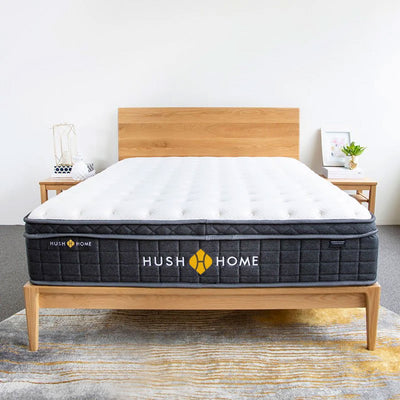
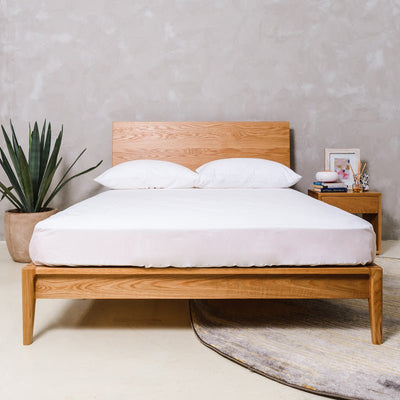
Hush Home’s current Solid Wood Bed™ is an oak solid-hardwood platform bed designed for Hong Kong homes. Hush states that the oak is top-graded North American hardwood, NHLA-inspected and FAS-graded.
The wood is double kiln dried and the finished frame receives three protective coating layers. This is relevant in Hong Kong because drying and finishing help manage moisture exchange, although no natural wood should be described as completely immune to humidity.
The bed uses a flat platform base, has approximately 7 inches of open clearance below the frame, and includes an adjustable headboard intended for mattresses up to about 28 cm / 11 inches thick.
| Solid Wood Bed™ Size | Approx. External Dimensions |
|---|---|
| 單人床 | 93 × 191 cm |
| 標準雙人床 | 124 × 191 cm |
| 加大雙人床 (L) | 139 × 198 cm |
| 女王雙人床 | 154 × 198 cm |
| 女王雙人床 (L) | 154 × 206 cm |
| 國王雙人床 | 184 × 206 cm |
Hush currently provides professional in-home assembly and a 1-year HushCare warranty for bedroom furniture, subject to the latest terms. The FAQ also notes that natural colour and grain vary from piece to piece, which is normal for solid wood furniture.
False. Wood changes moisture content as the surrounding environment changes. Good drying and construction reduce risk; they do not eliminate natural movement.
False. Hardwood and softwood are botanical categories. Actual hardness varies by species.
False. Veneer is a thin layer of real wood. MDF is a fibre-based engineered panel. Veneer can be applied over MDF, plywood or other substrates, but the terms are not interchangeable.
Not necessarily. A finished bed can still use coatings, adhesives at joints and metal hardware. Evaluate actual material and emissions information rather than relying on a marketing shortcut.
No. FAS is a hardwood lumber grade. Finished-bed strength, safety, sustainability and craftsmanship are separate questions.
Weight can reflect dense materials, but strength and stability depend on design, dimensions, joinery and support layout as well.
Routine dusting, sensible moisture control and occasional hardware checks still matter.
Solid wood offers natural grain, repairability and the potential for very durable structural components, but MDF has different advantages such as uniformity and dimensional consistency. The final bed should be judged by the complete construction, not material name alone. If MDF or another composite is used structurally, check thickness, support design, fasteners and relevant emissions compliance.
There is no single best species. Oak, ash, maple and walnut are all established furniture hardwoods, while pine and other softwoods can also work well in properly designed frames. Choose based on structural design, drying, finish, appearance, weight, budget and availability.
Oak can perform well indoors, but no natural wood is humidity-proof. Proper drying, sensible construction, finish and indoor moisture control matter. American white oak, for example, is strong and stable when dry, but authoritative species guidance still notes that it can move under humid conditions.
There is no responsible universal lifespan. A good frame may last many years or decades, but service life depends on timber quality, design, joints, loading, moves, moisture exposure, accidental damage and maintenance. Replace or repair based on structural condition rather than age alone.
Any organic surface can develop mould when moisture conditions allow it. Protective finishes and good ventilation reduce risk, but persistent dampness, condensation or leaks should be addressed at the source. If mould is extensive or repeatedly returns, investigate the moisture problem rather than only cleaning the visible surface.
Not necessarily. Weight is more of a moving and access consideration than a room-size issue. Check whether the components fit through the lift, corridor and bedroom door, and consider how often you expect to relocate or rearrange the bed.
It depends on the base design and mattress. A platform bed may be designed to support the mattress directly, while some traditional frames require an additional foundation. Follow the mattress and bed-frame manufacturer’s instructions rather than adding a box spring automatically.
There is no universal gap for every mattress. Follow your mattress manufacturer’s requirement because foam, hybrid and spring constructions can need different support. Hush Home currently specifies no more than 7 cm between slats for its mattresses.
Not universally. A stable platform gives continuous support; rigid slats can provide support with more airflow. The important factors are stability, spacing, centre support and compatibility with your mattress. Flexible sprung slats are a different category because they intentionally move under load.
Often, yes, if the problem comes from loose hardware or serviceable joints. Identify the source first. Tightening a connector, levelling the frame or isolating a rubbing contact point may solve the issue, but cracks or damaged structural parts should be professionally assessed.
No. FAS is a hardwood lumber grade under NHLA rules. Sustainability certification is separate. If responsible forestry matters to you, look for the specific sourcing or certification evidence attached to the product.
A solid wood bed frame can be an excellent long-term purchase, but the smartest buying decision goes beyond the words “solid wood”. Ask what species is used, how the timber was dried, how the rails and centre supports are joined, what base supports the mattress, how the surface is finished and whether the frame actually fits your bedroom and delivery route.
For Hong Kong homes, moisture management is particularly important. Wood naturally exchanges moisture with air, and Hong Kong’s annual mean relative humidity is high. Proper kiln drying and protective finishing help manage that reality, but sensible indoor care remains necessary.
At Hush Home, the Solid Wood Bed™ uses North American oak hardwood, a flat platform base, double kiln drying, three protective coating layers, adjustable headboard positioning and open under-bed clearance. It is best viewed as one example of how material, drying and structural design come together—not as proof that every solid wood bed is automatically superior to every alternative.