


What Is Mattress Edge Support—and Why Does It Matter?
30 Sep 2026
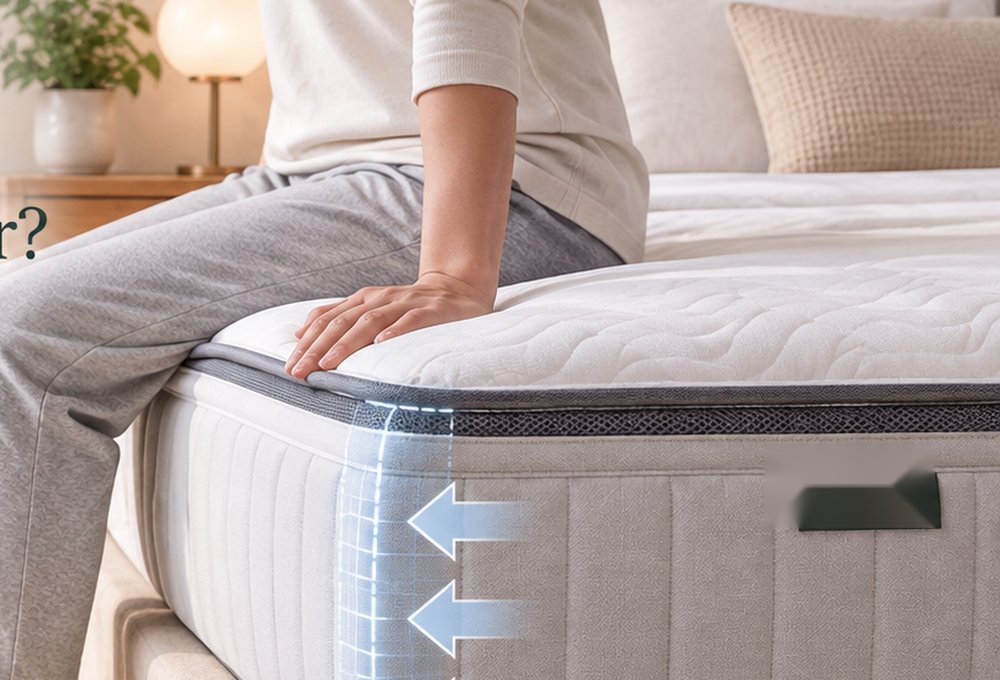
Edge support is one of those mattress features that can sound highly technical until you actually experience a weak edge. Sit near the side of a mattress that compresses heavily and you may feel yourself sliding outward. Lie close to that same edge and you may instinctively move back toward the centre because the perimeter feels less secure.
A supportive edge does not physically make the mattress wider. Instead, it can make more of the mattress's existing width feel comfortably usable by keeping the perimeter closer to the support level of the centre.
Quick Answer
Mattress edge support is the stability of the mattress around its outer perimeter. A mattress with strong edge support compresses in a controlled way when you sit or lie near the side, rather than collapsing so deeply that you feel unstable.
The term can also describe a physical reinforcement system built into the mattress—for example, firmer perimeter coils, a dense foam encasement or a steel-reinforced edge. These components are different ways of creating the same performance goal: a more stable perimeter.
Independent mattress testing organisations such as Sleep Foundation assess edge support by looking at how much the perimeter sinks and whether a sleeper feels stable while sitting, lying or moving near the edge. This is more useful than assuming that any particular material automatically guarantees strong edge support.
There are two ways people use the phrase “edge support”.
The first is a performance description: how firm, stable or resistant to collapse the mattress feels at its perimeter. The second is a construction description: the specific component used to reinforce that perimeter.
Those are related but not identical. A mattress can have a visible foam border but still feel relatively soft at the edge if the foam is flexible. Another mattress may use reinforced coils with no thick foam wall and still feel very stable.
For shoppers, the performance matters more than the label. Ask how the edge is reinforced, then test whether the result actually feels stable for your body.
Mattress manufacturers can strengthen the perimeter in several ways. None is automatically best in every mattress because the result depends on material strength, dimensions and how the reinforcement connects to the rest of the support system.
Hybrid and innerspring mattresses may use firmer, thicker or differently tensioned coils around the perimeter than in the centre. These coils resist compression when weight is placed close to the edge while the main coil system continues to support the rest of the body.
This approach can preserve airflow through much of the support core because the perimeter remains spring-based rather than being completely enclosed in foam.
Another common hybrid construction is a dense foam wall around the coil unit. The foam acts as a structural border that resists sideways deformation and provides a more consistent surface when sitting or lying near the side.
Foam encasement is not automatically stronger or weaker than reinforced coils. Density, firmness, thickness and long-term resilience all matter.
Some mattresses use steel reinforcement around or alongside the coil perimeter. Traditional innerspring systems may use border rods or edge wires, while other hybrid designs use proprietary steel-encased systems.
The goal is to stabilise the outer structure so the edge does not spread or collapse excessively under load.
Some foam and latex mattresses create perimeter stability without a separate visible border by changing material density, firmness or zoning near the sides. Responsive latex can also feel naturally more supportive at the edge than very soft slow-recovery foam, although construction still matters more than the material name alone.
A mattress always has the same physical width regardless of edge support. What changes is how much of that width feels comfortable to use.
If the final few centimetres near each side compress sharply, sleepers may naturally avoid those areas. The practical sleeping zone then feels narrower than the specification suggests.
Strong perimeter support reduces that drop-off effect. This is why edge support is often described as increasing “usable sleep surface”—it does not add centimetres to the mattress, but it can allow sleepers to use more of the area that is already there.
Two sleepers have to divide the same mattress width. That naturally pushes each person closer to an outer edge than when one person sleeps alone in the centre.
This is why strong edge support and good motion isolation solve different but complementary problems for couples. Edge support helps both people use more of the width comfortably; motion isolation helps prevent one person's movement from disturbing the other.
A couple should therefore test both. A mattress can have excellent motion isolation but weak edges, or strong edges but noticeable movement transfer.
In Hong Kong, bedroom size often limits how large a mattress you can reasonably fit. If you are choosing a Double, Full or another compact shared-bed size, losing confidence in the outer edges can feel more significant than on a very wide mattress.
This does not mean a small mattress with strong edge support becomes equivalent to a larger mattress. Width is still width. But when room constraints prevent you from simply upgrading to a King, strong perimeter stability can help you make better use of the size that actually fits your bedroom.
Many people sit on the side of the bed when putting on shoes, getting dressed, standing up in the morning or preparing to lie down. That creates a concentrated load close to the perimeter.
A stronger edge provides a more stable platform under the thighs and hips. A weak edge may compress deeply, which can make the sitting surface feel lower, softer and less secure than the middle of the mattress.
This can be particularly relevant for people who routinely use the bed edge as part of getting in and out of bed. It is not a substitute for choosing a safe overall bed height or seeking mobility advice when needed, but it is a practical mattress characteristic worth testing.
Yes. Edge support is a load-dependent characteristic. A perimeter that feels very firm under one person may compress much more under someone heavier, while a very light sleeper may barely challenge the same edge.
That is why showroom testing should use your own body rather than relying only on a salesperson pressing the edge with a hand. Sit where you normally sit and lie as close to the side as you realistically would at home.
Edge-support ratings from reviewers are useful for comparison, but perceived stability still changes with body weight, mattress firmness and the way each person loads the edge.
不一定。
Edge support describes the perimeter. Overall mattress firmness describes how resistant the main sleeping surface feels under your body. A mattress can have a soft or medium comfort layer with a firm reinforced perimeter.
In fact, a deliberately reinforced edge often feels firmer than the centre when you sit on it because the mattress is designed to resist concentrated perimeter loading.
Do not choose a mattress firmness based only on its edge. Lie in your normal sleeping position and assess the centre as well.
Weak edge support can look like sagging when weight is applied near the side, but true mattress sagging refers to a lasting loss of support or visible indentation that remains beyond normal temporary compression.
A mattress may have soft edges from the day it is new without being structurally damaged. Conversely, a mattress that once had strong edges can deteriorate over time if perimeter foam softens, coils deform or the supporting bed base fails.
If edge support changes noticeably after months or years of use, inspect both the mattress and the bed frame before deciding what needs replacement.
It can reinforce one vulnerable part of the mattress, but it cannot guarantee that the whole mattress will never sag.
Long-term durability depends on the comfort layers, support core, coil quality, foam resilience, foundation, loading, rotation requirements and how the mattress is used. A reinforced perimeter does not compensate for weak materials in the centre.
Edge support is therefore best understood as one part of mattress durability rather than a complete anti-sag system.
These features are often mentioned together for couples, but they measure different things.
Edge support asks: does the perimeter stay stable when weight is placed near the side?
Motion isolation asks: how much movement travels from one area of the mattress to another?
A mattress with individually wrapped pocket coils may perform well at motion isolation because the springs respond more independently, while reinforced perimeter coils or foam provide edge stability. The two systems can coexist, but neither automatically guarantees the other.
Yes. Edge support is not exclusive to spring mattresses.
An all-foam mattress can use denser foam around its perimeter or a supportive foam architecture that limits compression near the side. However, very soft foam mattresses without perimeter reinforcement may show more edge compression because there is no coil or firm border resisting the load.
You should therefore compare actual edge performance instead of assuming “foam equals weak edges” or “springs equal strong edges”.
They can be designed for excellent edge support, but the presence of pocket springs alone is not enough.
If the outer row uses the same relatively soft coils as the rest of the mattress and there is no other reinforcement, the edge may still compress significantly. Conversely, stronger perimeter coils, foam encasement or steel reinforcement can make a hybrid edge much more stable.
It may matter less.
A solo sleeper who rarely sits on the bed edge and naturally stays in the centre may not benefit as much from heavy perimeter reinforcement as a couple who uses almost the whole width.
That does not make edge support irrelevant. You still use the edge when getting in and out, and perimeter stability can contribute to the overall structural feel. But it may rank below pressure relief, firmness, temperature regulation or another feature that affects you all night.
Do more than press the side with your hand. Use the mattress the way you would at home.
Hush Home's existing mattress-testing guide similarly recommends sitting on the edge, shifting weight and checking for sagging or instability rather than judging the edge visually.
A home trial gives you a more realistic test because you can evaluate the mattress with your actual bed frame, bedding, partner and nightly routine.
Pay attention to repeated behaviours rather than one impression. Do you keep moving away from the side at night? Does the edge feel stable when you sit down each morning? Does one partner feel pushed inward because the outer section feels too soft?
Also confirm that the bed frame or foundation is level and supportive. A broken slat, bowed base or incorrect foundation can make a good mattress feel unstable near the perimeter.
Good edge support does not mean the perimeter must feel rock hard or refuse to compress.
A well-designed edge should compress progressively under weight while still feeling controlled. When sitting, you should feel supported rather than as though the edge is folding underneath you. When lying near the side, you should be able to relax without constantly bracing yourself against rolling outward.
The ideal amount of compression is personal. A very firm mattress may have almost no edge sink, while a plush mattress can compress more and still feel secure if the perimeter rebounds and contains the body effectively.
Common signs include:
A soft edge is not automatically defective. Compare the behaviour with the mattress's design, age and warranty conditions before deciding it is damaged.
For some sleepers, it should be a major decision factor. For others, it can be secondary.
Prioritise edge support more highly if you share a smaller bed, sleep near the edge, regularly sit on the side, want to maximise usable width or dislike the sensation of perimeter collapse.
It may matter less if you sleep alone in the centre, rarely sit on the edge and have a mattress wide enough that you never use the perimeter during sleep.
Do not let one feature override the whole mattress. Firmness, pressure relief, spinal support, breathability, motion isolation, size, trial policy and foundation compatibility still need to work together.
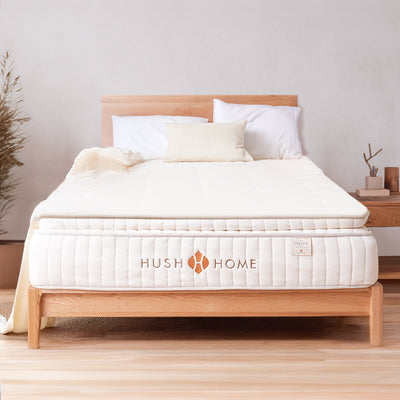
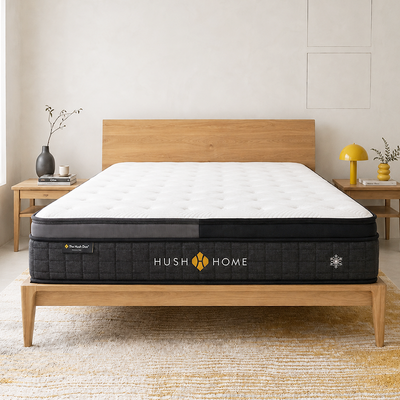
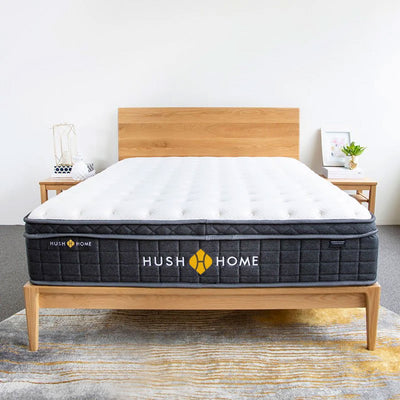
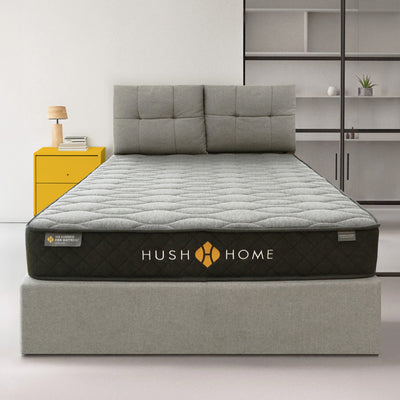
Hush Home currently uses several different perimeter-reinforcement approaches across selected mattresses. The important point is that “EdgeSupport” is the performance objective; the physical construction is not identical in every model.
The current Hush Mattress™ product page describes a steel-encased EdgeSupport system around the perimeter. Hush says this reinforces the outer edge and makes more of the sleeping surface usable.
The Organic Mattress™ uses Hush's Butterfly™ EdgeSupport around its dual-coil support system. Hush describes it as reinforcing the perimeter, protecting the integrity of the coils and increasing usable sleeping surface.
The Hush Duo Mattress™ uses an extra-firm high-density foam encasement around its 5-zone pocket-coil support base. The current product page describes this EdgeSupport™ Base as stabilising the mattress edges and helping maximise usable sleep space.
The current Essence Firm Mattress™ product page lists EdgeSupport as a perimeter-reinforcement feature alongside its high-gauge pocket coils and orthopedic foam.
This is an important distinction whenever you see edge-support marketing.
A Queen mattress does not become physically larger after perimeter reinforcement is added. The stated dimensions remain the same. What brands are usually describing is the proportion of the existing surface that they consider comfortably usable compared with a weaker-edge reference design.
There is no single consumer-facing industry formula used by every mattress company to calculate “usable sleep surface”. Different brands may use different baselines, pressure thresholds or marketing methods.
Therefore, treat the percentage as a product-specific claim. To compare edge support between mattresses, physically test them or use independent reviewers that apply the same procedure across multiple models.
Use this checklist:
False. The physical dimensions do not change. Stronger edges can make more of the existing surface feel usable.
False. Edge performance depends on perimeter design. Pocket springs without stronger outer coils or another reinforcement can still compress significantly.
False. Dense foam encasements and carefully designed foam zoning can provide strong perimeter support.
False. Some compression is normal. The useful question is whether the edge remains controlled and stable under realistic load.
False. Edge support concerns perimeter stability; motion isolation concerns how movement travels through the mattress.
False. They reinforce the perimeter but do not determine the durability of every comfort and support layer in the mattress.
Not unless the numbers were measured using the same methodology. Brand-specific percentages are not automatically comparable.
It means how stable and supportive the mattress feels around its outer perimeter. Strong edge support limits excessive collapse when you sit or lie near the side.
Often yes. Two people use more of the mattress width, so stronger perimeter support can make it easier for both sleepers to lie closer to their respective edges without feeling unstable.
It depends. If you sleep in the centre and rarely sit on the edge, it may be less important than other features. If you sleep near the side or regularly sit there, it can still matter a lot.
A more stable perimeter can provide a firmer sitting surface during the transition from lying to standing. Overall bed height, your mobility and the bed frame also matter.
There is no universal winner. Hybrid, innerspring, foam and latex mattresses can all have strong edges when their perimeter is engineered well. Test the finished mattress rather than choosing only by material category.
No. Pocket coils can be part of a strong perimeter system, but the outer rows need appropriate reinforcement or another supporting structure if stronger edge stability is desired.
Yes. Foam can soften, coils can deform, fasteners or foundations can deteriorate and repeated sitting in the same place can create uneven wear. A noticeable change should prompt inspection of both mattress and bed base.
The perimeter may feel firmer, but overall mattress firmness is determined by the whole comfort and support system. A soft mattress can still have a reinforced firm edge.
Not universally. Both can work well. Foam density and resilience matter in encasements, while coil gauge, geometry, tension and support layout matter in reinforced spring perimeters.
Sit on the side, shift your weight, lie near the edge in your normal sleep position and roll gradually toward the perimeter. Repeat the test over several nights and make sure the bed frame is stable.
No. Edge support helps stabilise the perimeter. Long-term sagging depends on the durability of the whole mattress and foundation.
No universal consumer standard is used across all brands for that type of claim. Treat the number as brand-specific unless the manufacturer publishes a comparable standardised methodology.
Mattress edge support is simply the stability of the mattress around its perimeter—but that simple feature can materially affect how a bed feels in daily use.
Strong edges can make sitting on the bed feel more secure, reduce the sensation of rolling or sliding near the side and allow sleepers to use more of the mattress's existing surface comfortably. Those benefits are particularly relevant for couples and for Hong Kong bedrooms where upgrading to a wider mattress is not always practical.
But edge support should not be oversold. It does not physically enlarge the mattress, guarantee no sagging, determine overall firmness or replace good motion isolation. It is one component of a well-designed mattress.
When shopping, ask how the perimeter is reinforced, test it with your own body and compare it alongside the features that affect you all night. A feature you can actually feel is more useful than a percentage you cannot independently interpret.