



Your Partner Likes Firm and You Like Soft — Who Should Compromise?
11 Sep 2026
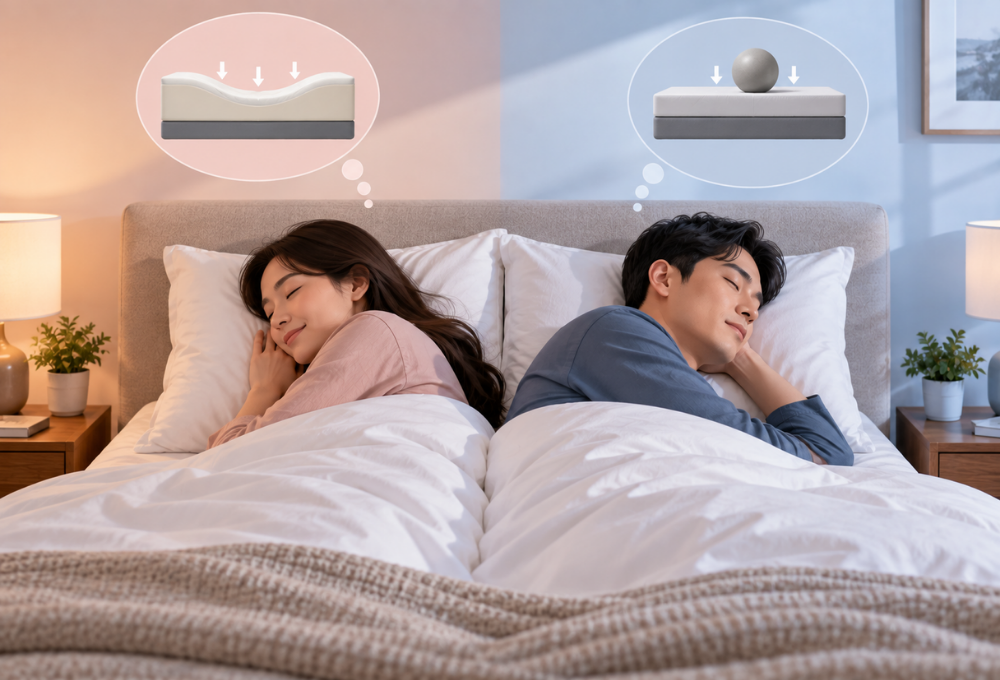
Neither partner should automatically have to compromise. If your preferences are only slightly different, a balanced medium or medium-firm mattress may keep both people comfortable. If one person genuinely needs a much softer feel and the other needs significantly firmer support, forcing either partner to surrender their preference may leave one person sleeping poorly for years.
The best answer is to determine whether your disagreement is small enough for one shared comfort level—or large enough to justify independent firmness on each side. For a broader overview, see our guide to choosing the best mattress for couples in Hong Kong.
KEY TAKEAWAY
Compromise works when both people remain comfortable. If the compromise leaves both partners merely tolerating the mattress, it is not a successful solution.
Firmness describes the immediate feel of the mattress surface: how soft, resistant or cushioning it feels when you lie down.
Support describes how the complete mattress responds beneath the body. A softer mattress can still have a strong underlying support system, while a hard-feeling surface is not automatically suitable for every body or sleeping position.
This distinction matters because the firm-preferring partner may actually dislike deep sinkage rather than need the hardest possible mattress. The soft-preferring partner may want pressure relief rather than an unstable surface.
Clarifying the desired sensation often reveals more room for agreement than simply arguing over “soft” and “firm.”
Mattress firmness is personal because two bodies do not compress the same materials in the same way.
A heavier sleeper generally compresses the comfort layers more deeply, while a lighter sleeper engages less of the material. The same mattress can therefore feel softer to one partner and firmer to the other.
Side sleepers often want more cushioning around the shoulders and hips. Back sleepers commonly prefer a balance of contouring and stability, while stomach sleepers frequently look for more resistance beneath the torso and pelvis. If sleeping position is the main difference between you, see our guide to mattresses for couples with different sleeping positions.
Two people of similar weight may still distribute that weight differently. Shoulder width, hip shape and sensitivity at particular contact points can change which surface feels comfortable.
People often become accustomed to the type of mattress they grew up with or used for many years. One partner may associate firmness with stability, while the other associates softness with relaxation.
The Hong Kong Consumer Council has also stated that mattress firmness has no single standard and that suitability can change with body shape, weight and sleeping position.

No. “Firmer is always more supportive” is too simplistic.
A mattress that feels too hard for one sleeper can create concentrated pressure around prominent areas such as the shoulders and hips. The person may struggle to settle comfortably even if the surface feels stable to their partner.
The Consumer Council’s mattress guidance similarly notes that an excessively hard mattress may place too much pressure on certain parts of the body.
The firmer-preferring partner should describe what they actually need: less sinkage, easier turning, stronger edge stability or a more resistant surface. These needs may be achievable without making the other side equally hard. If you are specifically comparing firmer options, you can also browse Hush Home’s firm mattress collection.
Not automatically. Softer is not universally more comfortable.
A surface that provides welcome cushioning for one partner may allow the other person to sink more deeply than they prefer, feel less stable or find turning more difficult.
The soft-preferring partner should identify whether they need overall softness or targeted pressure relief around particular areas. A mattress can provide cushioning at the surface while retaining stronger support underneath. If an otherwise suitable mattress simply feels too hard, see our guide on how to make a firm mattress feel softer.
A shared medium or medium-firm mattress can work well when:
For example, one partner may prefer a 6 out of 10 and the other a 7. A balanced medium-firm mattress may satisfy both.
Compromise becomes less convincing when one person wants a deeply cushioning surface and the other strongly dislikes any noticeable sinkage. Our guide to mattresses for couples with different firmness preferences explores this mismatch in more detail.
Neither partner should be expected to accept the shared firmness when:
In these situations, the decision should move away from “Who wins?” and towards “How can each side be configured differently?”
A topper is useful when an otherwise supportive mattress feels slightly too firm for both sleepers. It adds cushioning across the surface.
However, a full-width topper also changes the firm-preferring partner’s side. It cannot make one side softer while leaving the other side completely unchanged.
Using a topper on only half the bed may create differences in height, movement or centre feel unless the complete system is designed for side-specific components.
A topper also cannot reliably make a weak or sagging mattress supportive again. If the issue is that your mattress has become too soft or uneven over time, see our guide on how to make a soft or sagging mattress firmer.
Best when preferences are close and both partners remain comfortable on the same surface.
One half is permanently softer and the other firmer. This solves an established mismatch but may be less flexible if either person’s needs change.
Each partner selects their own side, and the firmness can be reconfigured after purchase. This is useful when the couple wants personalisation without two separate mattresses.
This provides strong physical independence and may support different adjustable-base positions, but it creates a centre division and requires more room.
See our Dual-Firmness Mattress vs Split King comparison for a closer look at the differences.
Separate beds or bedrooms may be considered when the disagreement involves much more than firmness, such as schedules, snoring, medical equipment or radically different sleep environments.
Before reaching that point, read our guide to sleep divorce and its alternatives.
Describe Your Needs Separately
Before discussing who should compromise, each partner should write down:
This prevents the louder or more decisive partner from unintentionally controlling the conversation.
Separate Preferences From Non-Negotiables
“I enjoy a slightly firmer hotel bed” is different from “I cannot sleep comfortably when my pelvis sinks deeply.”
Identify what is merely preferred and what repeatedly causes discomfort or disturbed sleep.
Test More Than One Setting Together
Both partners should lie down simultaneously in their usual positions for more than a few minutes. Test turning, getting out of bed and lying near the edges.
Do not let one person sit on the mattress while the other makes the final decision from the showroom floor.
Test Independent Firmness if the Middle Fails
If medium feels too firm for one person and too soft for the other, testing another shared firmness is unlikely to solve the underlying conflict.
Try each person on their preferred side-specific setting and assess the complete mattress features, including motion isolation, edge support and cooling.
Understand What Can Change Later
Preferences can evolve. Ask whether the firmness is permanently fixed, can be rearranged at home or requires replacement components.
Also distinguish between a mattress-return trial, a comfort-adjustment guarantee and a manufacturing warranty.
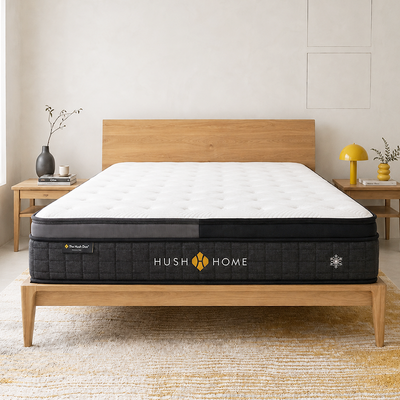
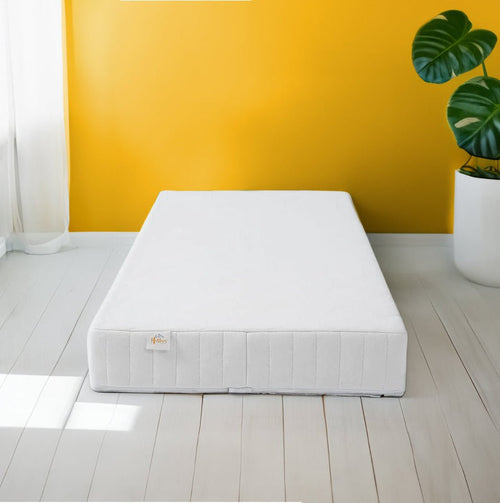
The 11-inch Hush Duo Mattress™ is designed around independent comfort. Its left and right sides can be configured separately beneath one continuous cushioned surface.
Each side contains two rearrangeable Comfort or Support Inserts. Different combinations create four firmness profiles spanning approximately 4.0 to 9.0, from medium-soft to firm.
That means the soft-preferring partner can choose more cushioning while the firm-preferring partner selects greater resistance. Neither setting requires the other side to change.

Underneath both sides, a five-zone pocket-coil base provides hybrid support and helps reduce partner movement. ArcticFlow™ improves airflow, while EdgeSupport™ helps maximise the usable sleeping surface.
The Hush Duo 365-Night Comfort Guarantee allows eligible customers to request up to two complimentary additional inserts during the first year if either side needs further adjustment, subject to the published terms. This is a firmness-adjustment guarantee rather than a full mattress-return trial.
If your preferences are close and both people remain comfortable on a shared middle firmness, both partners can compromise a little.
If choosing soft makes one partner uncomfortable and choosing firm does the same to the other, neither person should have to lose. The better solution is to stop treating the mattress as one indivisible comfort decision.
One shared bed can still provide two personalised firmness levels. The goal is not to decide whose preference matters more—it is to give both sleepers a side that works.
No. The better firmness is the one that provides suitable comfort and support for the individual sleeper. Body weight, sleeping position, body shape and personal preference all affect the answer.
Medium-firm is a sensible starting point when both partners have similar needs. It is not automatically the best answer when one person strongly prefers soft and the other strongly prefers firm.
A standard full-width topper changes both sides. A half-width topper may create a height or centre difference unless it is part of a mattress system designed for side-specific components.
Not necessarily. Some designs use two separate mattresses and have a centre division. Others, including Hush Duo, place independent comfort zones beneath one continuous outer cover.
An adjustable or modular mattress provides more flexibility than permanently fixed split firmness. Hush Duo’s internal inserts can be rearranged, and replacement inserts remain available during the life of the mattress.
The couple can assign sides according to their normal sleeping positions. Each side’s firmness is then configured for that sleeper. The important issue is matching the configuration to the person, not whether soft is placed on the left or right.