











Mattress Body Impressions vs Sagging: What's Normal and What's a Problem?
13 Oct 2026
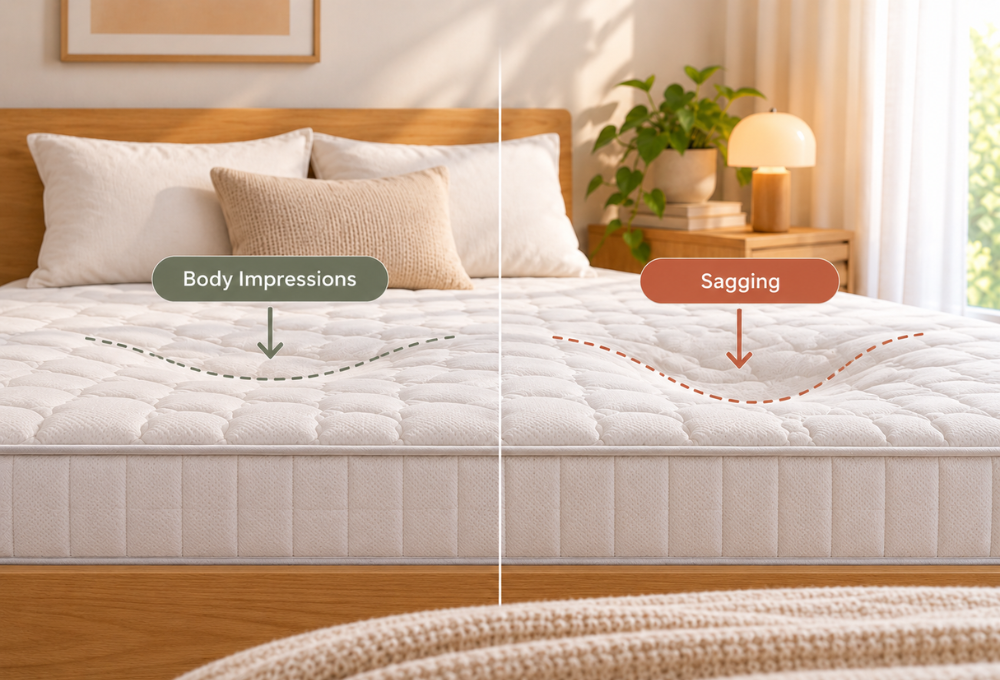
A shallow body impression is often a normal result of mattress comfort layers settling around the places you sleep. Sagging becomes more concerning when a depression remains visible without anyone on the bed, grows over time, changes the support you feel or comes from an unstable foundation. The distinction is not simply whether the surface looks perfectly flat: depth, recovery, support and the bed base all matter.
For Hush Home owners, the published HushCare limited warranty identifies a visible indentation or sag of 1.5 inches (approximately 3.8 cm) or more when no weight is applied, subject to its full terms, including a proper supporting foundation. Normal softening or settling, including ordinary body impressions, is excluded. This is a warranty assessment threshold—not a universal medical, comfort or replacement threshold.
Quick Answer: Body Impression or Sagging?
| Body Impression | Potential Sagging |
|---|---|
| Body impression: a relatively shallow, gradual change in the comfort surface where shoulders, hips or the torso repeatedly rest. It may rebound partly or substantially after you get up, but some mild unloaded contouring can remain as ordinary settling. | Potential sagging: a more persistent or progressive hollow, trough or slope that affects the mattress's usable support. It can arise from weakened comfort layers, the support structure or the foundation underneath—not necessarily just from broken springs. |
Foundation problem: the mattress seems to dip because a slat, centre beam, support leg or platform is bowed, missing, loose or uneven. This must be investigated separately before concluding that the mattress itself is defective.
The practical rule: first look with the mattress unloaded, then measure the gap using a straight edge, then inspect the support base, and finally consider how the mattress feels in normal use.
A body impression is a change in the sleep surface caused by repeated pressure from a person's body. Mattress comfort layers are meant to respond to weight, so some settling can occur as foam, latex, fibres, quilting or padding adapts to habitual sleeping positions.
Impressions often appear most clearly where hips or shoulders rest. Couples may notice two separate sleeping zones with a firmer-looking strip between them, because the centre has received less repeated pressure.
A mild body impression does not automatically indicate a manufacturing defect or lost support. It is more reassuring when the contour is shallow, broadly consistent with where you sleep, not progressing rapidly and the mattress continues to feel stable.
Do not make recovery the only criterion. Some normal material settling can remain visible when the mattress is empty; a body impression does not have to vanish completely to be normal. Equally, a depression that briefly looks smooth after you get up can still deserve attention if support is deteriorating under load.
Sagging describes a depression, dip or slope that persists or worsens enough to raise concern about the mattress's ability to support the sleeper evenly. It may be localised under the hips, run along the centre or develop across a larger section of the bed.
A sag is not a precise diagnosis of which internal component failed. A worn comfort layer, fatigued support foam, deteriorated coils or an unsuitable foundation can produce similar symptoms. The bed frame has to be checked before blaming the mattress core.
A visible unloaded sag is especially useful for warranty documentation. However, some mattresses can feel unsupportive under the sleeper even when a measured unloaded depression is small. This is a comfort and support concern, but it may not satisfy a particular brand's indentation warranty criterion.
You need a rigid straight edge long enough to bridge the suspected hollow, a ruler or tape measure, good lighting and a phone camera. A long level or rigid straight board is easier to keep straight than a flexible tape measure laid over the mattress surface.
Remove the duvet, pillows, fitted sheet, protector and any detachable topper sitting above the mattress. You need to inspect the mattress surface itself rather than the wrinkles or cushioning of an extra layer.
Nobody should sit, lie or press down on the area being measured. Give the surface time to recover from recent use according to the product's care guidance; the purpose is to record the resting, not the loaded, depression.
Look across the mattress from the side and from the head or foot. Note whether the dip sits at a hip or shoulder zone, near the middle seam, along the edge or directly above a support member.
Rest the rigid straight edge across higher surrounding parts of the same sleeping surface, spanning the hollow without pressing the ruler into the foam. Keep it level and straight rather than allowing it to follow the curved mattress surface.
Hold a second ruler vertically from the mattress surface up to the underside of the straight edge. Record the gap in centimetres and, if useful, inches. Do not measure the mattress's total thickness or the depth while a person is lying on it.
Repeat across the width and length where feasible. A change that appears only with the straight edge placed in one direction may be affected by quilting, contours or how the reference points were chosen.
Take one wider photograph showing where the depression sits on the mattress and one close-up showing the straight edge, vertical ruler and measurement. Avoid photographs where your hand is pushing into the foam.
A dip caused by a broken, bowed or improperly supported base needs to be separated from a defect in the mattress. If necessary, ask the manufacturer how to perform a valid support-base comparison without damaging the mattress or compromising its warranty.
There is no universal indentation depth that every mattress brand treats as defective. Manufacturers publish their own terms and may exclude ordinary body impressions even when you can see a shallow resting contour.
Hush Home's current HushCare warranty specifies a visible indentation or sag measuring at least 1.5 inches, approximately 3.8 cm, without weight on the mattress, where the deterioration is not attributable to an improper or unsupportive foundation. Its separate exclusion for normal softening or settling remains relevant.
Do not interpret a measured 3.8 cm dip as automatic approval. The original-purchaser rules, product eligibility, proper usage and foundation, other exclusions, inspection and any applicable repair, replacement or transport charges still matter. Likewise, a shallower indentation does not automatically prove a mattress is comfortable or functioning well.
The foundation carries both the mattress and the people using it. A sagging slat, failing centre beam, missing support leg or warped platform can pull an otherwise usable mattress into a visible low spot.
Hush Home currently recommends a flat stable support surface, including a suitable platform or slatted base with gaps no greater than 7 cm between slats. This is particularly relevant when reusing an old frame under a new mattress.
Check whether slats are seated correctly, centre legs reach the floor, brackets are secure, and the frame is level. Photograph damaged or uneven supports before changing anything if a warranty review may be needed.
If a support component is cracked, broken or visibly unstable, stop using that frame until repaired or replaced. Do not repeatedly test a dangerous structure by lying or jumping on it.
Foam compresses and conforms under body weight. Minor softening or a shallow repeated-use contour can be normal, while loss of rebound or deep permanent depressions may point to material fatigue.
Latex is generally resilient, but it is not immune to compression or ageing. Comfort-layer contouring and loss of resilience are different questions; neither the word natural nor a high price guarantees a surface will remain unchanged forever.
Hybrid mattresses combine a support unit with upper comfort materials. A shallow body impression may come from the padding rather than the coils. If a bed develops a major trough, both the comfort system and underlying springs or foundation deserve assessment.
Stitching, quilting and tufting deliberately create raised and recessed patterns. Do not confuse those original construction details with a new depression caused by wear. Compare the same area with the original appearance where possible.
A mattress can lose some of its original resistance before a deep resting impression develops. You may notice your hips sinking farther during sleep, difficulty changing position or a feeling that the bed is no longer as supportive as before.
These symptoms deserve a practical check, but they do not establish a manufacturing defect. A change in body weight, sleeping position, mattress preference, pillow height or bed-base condition can also change how a mattress feels.
Keep two separate questions in mind: does this mattress still work for me, and does it meet the manufacturer's written warranty defect criteria? The answers can be different.
Two shallower impressions where a couple usually sleeps can reflect normal repeated-use patterns, especially when the middle of the mattress receives less pressure. The visual contrast alone does not prove a defect.
Pay closer attention if one side has a sharply worsening trough, if both sleepers repeatedly roll toward the centre or if the frame's centre support is missing or bowed.
The Hush Duo Mattress™ has two independently adjustable firmness zones. Different levels of sinkage or perceived firmness between the left and right sides can be an intended result of the selected comfort/support insert configurations, rather than evidence of sagging.
If one side suddenly feels very different, first confirm the current firmness profile and whether the removable components are arranged according to the official product instructions. Do not treat a choice of softer inserts as an unloaded structural depression.
Hush Duo's 365-night firmness-adjustment guarantee is not the same as the mattress-defect warranty. The first addresses firmness adjustment under its separate terms; an actual sagging complaint should be assessed under the relevant HushCare warranty conditions.

Hush Home currently publishes 25 years of limited HushCare warranty for the Organic Mattress™ and 15 years for the Hush Duo Mattress™, Hush Mattress™, Essence Firm Mattress™ and Loft Mattress™. A long warranty duration does not mean every comfort change is covered.
The stated sagging criterion is a visible depression of 1.5 inches or greater when there is no weight on the mattress, provided the problem is not attributable to an improper or unsupportive foundation and the other HushCare conditions are satisfied.
HushCare expressly excludes normal increases in softness and settling of materials, including body impressions, as well as changes in comfort preferences such as desired firmness or feel.
The formal terms also exclude various forms of improper use, damage from liquid or staining, mould or odour associated with poor care or external conditions, and damage caused by an unsuitable support base. Eligibility and original-purchaser requirements apply.
The published HushCare schedule provides free repair or replacement at Hush Home's discretion for qualifying mattress defects during the early warranty years, then specifies increasing contribution charges in later years. It also states that transportation costs are borne by the customer. Read the exact current schedule for your model before assuming a claim will be free.
This article explains the published wording; Hush Home remains the party that assesses the actual product, its foundation and warranty eligibility. The measurements here help you prepare a clear enquiry rather than pre-approve a claim.
Rotating a mattress head-to-foot can spread repeated load over different zones and may reduce how quickly uneven impressions develop. It is prevention and wear management, not a structural repair for foam or springs that have already failed.
Hush Home's current care guide recommends rotation about once every three months. The Organic Mattress™, Hush Duo Mattress™, Hush Mattress™ and Essence Firm Mattress™ are no-flip designs. The Loft Mattress™ is the exception: it is reversible so users can select between its intended firmness surfaces.
Do not flip a single-sided mattress to conceal a sag or copy a generic rotation schedule without checking the manufacturer's current instructions.
A mattress topper can change surface cushioning or firmness and may temporarily make a mildly uncomfortable bed feel better. It cannot rebuild fatigued springs, repair a broken support layer or correct a sagging foundation.
Sleep Foundation similarly distinguishes a topper's comfort benefit from a true fix for a sagging mattress. A topper is more appropriate when the mattress is still flat and supportive but you want to change the surface feel.
If you suspect a warranty issue, photograph and measure the bare mattress before adding a topper; an extra comfort layer can obscure the true condition of the underlying bed.
Consider monitoring if the impression is shallow and stable, the foundation is sound and you still find the sleep surface supportive and comfortable. Note its appearance after future rotations so you can tell whether it changes.
If the dip lines up with a bowed slat, faulty centre beam or unstable base, address that foundation problem first. Replacing the mattress without fixing the frame may simply repeat the same issue.
If you document a significant unloaded depression, persistent material damage or another suspected manufacturing defect during the warranty period, ask the manufacturer to review the product and its foundation.
If the mattress is consistently uncomfortable, no longer supports you as needed or cannot be made usable through appropriate maintenance and foundation checks, replacement may make sense even when the visible indentation is below a written warranty threshold.
Do not diagnose a medical condition from the mattress. New, severe or persistent back pain has many possible causes; discuss symptoms with a qualified healthcare professional rather than assuming the bed is the sole explanation.
Mild settling can occur as comfort materials adapt to repeated use, especially under the hips or shoulders. The more important questions are whether the impression is shallow and stable, whether support remains comfortable and whether the foundation is appropriate.
A body impression is usually a modest contour where the sleeper repeatedly rests. Sagging is a more concerning persistent or worsening dip that may affect support. Appearance alone is not enough: check the unloaded depth, function and bed base.
The published HushCare indentation criterion is 1.5 inches or more, approximately 3.8 cm, measured with no weight on the mattress. This does not automatically approve a claim; the other warranty and foundation conditions still apply.
Not automatically. A shallow impression may reflect ordinary settling. But no single measurement proves the mattress is comfortable or healthy, and warranty thresholds vary by brand. Check stability, progression, support and the manufacturer's exact terms.
No for the HushCare indentation criterion. Hush specifies an unloaded visible indentation. Measure with nobody on the mattress, using a rigid straight edge and a vertical ruler.
Yes. Bowed or broken slats, a weak centre beam, uneven platform or missing support leg can produce a dip that resembles a mattress problem. Inspect the support structure before concluding that the mattress is defective.
Rotation can spread wear more evenly and may reduce further concentration of impressions. It cannot guarantee that an existing impression disappears or repair failed foam, coils or support structures.
Not as a general fix. Organic, Hush Duo, Hush and Essence Firm are no-flip models. Loft is reversible for its designed firmness choices. Follow the specific model's care guide and do not flip a no-flip mattress.
A topper can improve surface feel temporarily, but it cannot restore a broken support core or correct a bowed frame. It is better suited to adjusting comfort on an otherwise stable mattress.
Mattresses are designed to compress under body weight. The issue is whether that compression is appropriate for your body and position, or whether the support has become uncomfortably weak. Loaded sinkage alone does not satisfy an unloaded indentation warranty test.
There is no universal timetable. It depends on construction, the comfort layers, body weight, sleeping position and how the mattress is used. Focus on whether the impression stabilises and the support remains suitable rather than expecting a fixed break-in date.
No. The manufacturer must assess the specified measurement and other conditions. A dip arising from an unsuitable foundation, excluded damage or ineligible purchase may not be covered even when it is visibly deep.
Body impressions and sagging are related but not identical. A shallow settled contour can be normal; a persistent, progressing depression or weakened support deserves a closer look. The most useful assessment combines an unloaded straight-edge measurement, foundation inspection and an honest check of whether the mattress still performs for you.
For Hush Home owners, remember the specific HushCare wording: at least 1.5 inches / about 3.8 cm of visible unloaded indentation is one relevant defect criterion, not an automatic replacement promise. Read the full policy, document the condition and speak to Hush Home if you suspect a qualifying issue.