



Signs You and Your Partner Might Be Sleeping on the Wrong Mattress
11 Sep 2026

The wrong mattress is not simply one that feels “bad” for a few minutes. It is a mattress that repeatedly fails to provide suitable comfort, stability or support for one or both sleepers.
For couples, the mattress may be comfortable for one person and completely wrong for the other. Differences in body weight, sleeping position, firmness preference and sensitivity to movement can make the same bed feel very different on its two sides.
One sign alone does not prove that the mattress is responsible for poor sleep. A repeated pattern involving several signs—and noticeable improvement when sleeping elsewhere—provides a stronger reason to investigate.
Do not ask only, “Is this a good mattress?” Ask, “Is this mattress still right for each of us?”
Discomfort that is strongest immediately after waking may suggest that the sleeping surface is not allowing one person to settle comfortably. This can happen when the mattress feels too firm, too soft, uneven or poorly matched to the sleeper’s usual position.
However, pain has many possible causes. Persistent, severe or unexplained discomfort should be assessed by an appropriate healthcare professional rather than attributed automatically to the mattress.
Side sleeping concentrates more load around the shoulder and hip. If the mattress is too firm for that particular sleeper, these areas may not settle far enough into the comfort layers.
The sleeper may repeatedly move an arm, shift the pelvis or turn onto their back to escape pressure. A partner who is heavier or sleeps differently may experience no problem on the same surface.
A mattress that is too soft for one sleeper may allow the heavier areas of the body to settle more deeply than they prefer. This can create an unstable or “stuck” sensation and make turning more difficult.
This does not mean that soft mattresses are inherently unsupportive. Suitability depends on how the complete comfort and support system responds to that person’s body.
Frequent turning can have many causes, but it may be mattress-related when the sleeper repeatedly changes position to relieve pressure, escape sinkage or find a more stable part of the bed.
Ask whether the movement is a normal sleeping habit or a response to discomfort. If one partner moves much less on a different mattress, the current bed deserves closer examination.
A pronounced dip or weakened support in the centre can cause sleepers to roll towards the same area. This is different from choosing to sleep close together.
Check whether the mattress surface has visible indentation and whether the bed frame or centre support is level. The problem may involve the mattress, the base or both.
If one sleeper feels every movement from the other side, the mattress or bed frame may be transferring too much motion.
This is especially disruptive when one partner is a light sleeper, changes position frequently, works different hours or gets up during the night.
Individually wrapped pocket coils and movement-absorbing comfort materials may help, although no mattress should be assumed to eliminate every possible movement.
This is one of the clearest signs that the problem may be compatibility rather than overall mattress quality.
The Hong Kong Consumer Council has noted that the same mattress can perform differently for people of different body weights and in different sleeping positions.
If the two partners’ needs are far apart, a single fixed firmness may always favour one person more than the other.
Two sleepers create more combined body heat than one. Heat can build up when the mattress uses less-breathable materials, the bedding traps warmth or airflow around the bed is limited.
In Hong Kong’s humid climate, a mattress that once felt acceptable in cooler weather may become uncomfortable during warmer months.
Try breathable bedding and room-temperature adjustments first. If heat remains concentrated around the sleep surface, the mattress construction may be contributing.
Couples use more of the mattress surface than solo sleepers. Weak edges can force both people towards the centre and make a Full or Queen mattress feel smaller than its actual dimensions.
Edge instability can also make sitting down, standing up or getting into bed less secure.
If the edge performance has worsened noticeably over time, inspect the mattress perimeter and bed frame for deterioration or inadequate support.
Visible changes in the sleep surface are stronger evidence than firmness preference alone. Look for permanent indentations, compressed areas, uneven edges, displaced internal material or a pronounced centre hollow.
Remove the bedding and inspect the complete mattress in good light. Then check whether the frame, platform or slats are level and intact.
A topper may make a slightly firm surface feel softer, but it cannot restore a damaged support core or permanently sagging base.
Sleeping noticeably better in a hotel, guest room or family home can be a useful clue—particularly if it happens repeatedly.
Compare what was different. Was the other mattress firmer, softer, wider, cooler or better at isolating movement? The answer may reveal which characteristic is missing from your current bed.
One good night elsewhere is not conclusive because travel, tiredness and the sleep environment also affect rest.
A mattress can remain physically intact but stop matching its sleepers. Body weight, preferred sleeping position, fitness habits, pregnancy, ageing, injury recovery and sensitivity to heat can all change over time.
A mattress chosen for two back sleepers may not remain ideal if one person becomes a committed side sleeper. Likewise, a firmness that worked at one body weight may feel different after a substantial change.
Poor sleep is not always caused by the mattress. Noise, light, stress, temperature, caffeine, alcohol, irregular schedules, snoring and sleep disorders can all affect sleep quality.
The CDC describes repeated waking and feeling tired despite enough time in bed as signs of poor sleep quality, but these signs do not identify one specific cause.
If sleep problems happen regularly, affect daytime life or suggest a condition such as insomnia or sleep apnoea, speak to an appropriate healthcare professional. A mattress purchase should not replace medical assessment.
Each partner should separately record bedtime, night-time awakenings, discomfort on waking, temperature, partner disturbance and daytime energy.
Patterns are more useful than one isolated night. Note whether the problems affect both people or mainly one side of the bed.
Remove all bedding and look for depressions, uneven edges, displaced material, damaged slats or an unsupported centre.
Place the mattress on the type of base approved by its manufacturer. An unsuitable frame can make a good mattress perform poorly.
Ask each person to describe the mattress without hearing the other’s answer first:
If the answers strongly disagree, the mattress may not be wrong for everyone—it may simply be wrong as a one-firmness solution for that couple.
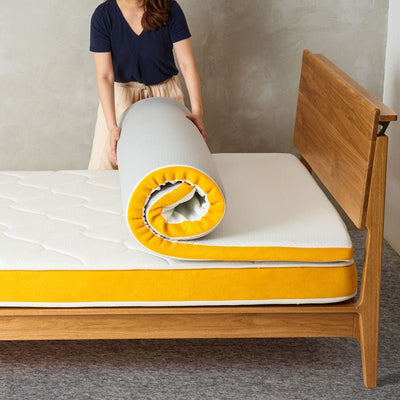
A suitable comfort layer or topper may add cushioning when the support core remains level and stable. However, a topper changes the whole shared surface unless it is side-specific.
First confirm that the bed frame is providing correct support. A topper cannot reliably repair a weak, damaged or sagging mattress core.
If the mattress is structurally sound but still too soft for one sleeper, a firmer individual sleep zone may be more practical than changing the entire bed for both people.
Look for construction that responds more independently to movement, such as pocket coils combined with movement-absorbing comfort materials.
A dual-firmness mattress allows the problem to be addressed on each side instead of forcing the entire bed softer or firmer.
Read our guide to the best mattress for couples with different firmness preferences.
Move to the widest mattress that fits the room and delivery route, or choose a model with strong edge support that makes more of its surface usable.

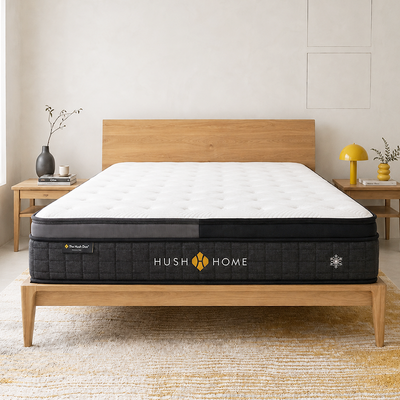
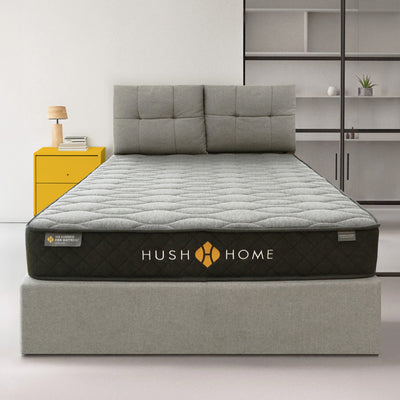
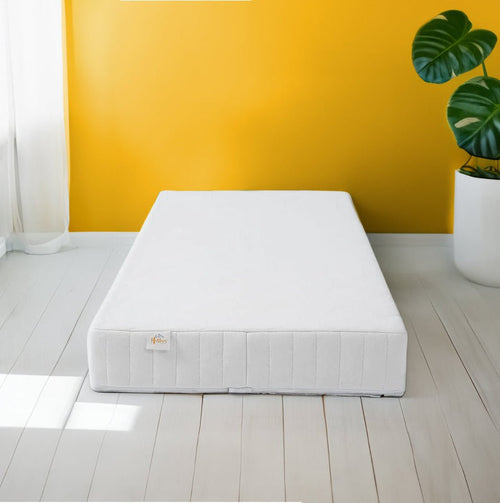
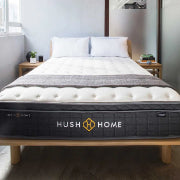
The 11-inch Hush Duo Mattress™ is designed for situations where the mattress remains shared but the sleepers’ comfort needs differ.
Each side can be configured independently across four firmness profiles spanning approximately 4.0 to 9.0. One partner can choose more cushioning while the other selects firmer resistance.
A five-zone pocket-coil base helps provide targeted support and reduce partner movement. EdgeSupport™ stabilises the perimeter, while ArcticFlow™ combines breathable components to improve airflow.
The continuous outer cover keeps the two comfort zones beneath one smooth surface. During the first 365 nights, eligible customers can also request up to two complimentary inserts if either side needs further firmness adjustment, subject to the published terms.
Hush Duo cannot repair an unsuitable bed frame, treat a sleep disorder or create a larger bedroom. Its main strength is resolving comfort and firmness differences within one shared mattress.
The wrong mattress for a couple is not always old, damaged or low quality. It may simply provide one fixed answer to two very different sleepers.
Look for repeated patterns: morning discomfort, concentrated pressure, excessive sinkage, movement disturbance, overheating, unstable edges, visible sagging or one partner being consistently uncomfortable.
If the mattress is structurally damaged, replacement may be necessary. If the main problem is that the two sleepers need different comfort levels, independent firmness may offer a more precise solution.
Possible signs include concentrated pressure around the shoulders or hips, difficulty settling into a comfortable position and one sleeper consistently wanting more cushioning. These signs are not medical diagnoses and should be considered alongside sleeping position, body weight and other possible causes.
Possible signs include uncomfortable sinkage, difficulty turning, an unstable feeling or rolling towards a visible depression. Check the mattress and bed frame for structural problems before deciding that firmness alone is responsible.
A topper can adjust surface cushioning when the mattress underneath remains supportive and level. It cannot reliably repair broken components, severe sagging or inadequate underlying support.
There is no single expiry date for every mattress. Materials, construction, sleeper weight, bed-frame support and care all affect useful life. Judge the mattress by its condition and performance rather than replacing it solely because it reaches a particular age.
Body weight, body shape, sleeping position and firmness preference change how each person interacts with the same surface. The mattress may be good quality but incompatible with two different sets of needs.
Yes. Its Comfort and Support Inserts can be rearranged at home, and replacement inserts remain available during the life of the mattress. The 365-Night Comfort Guarantee also provides eligible customers with up to two complimentary additional inserts during the first year, subject to its terms.