








Inside a Mattress: Comfort Layer vs Support Core vs Transition Layer
07 Oct 2026
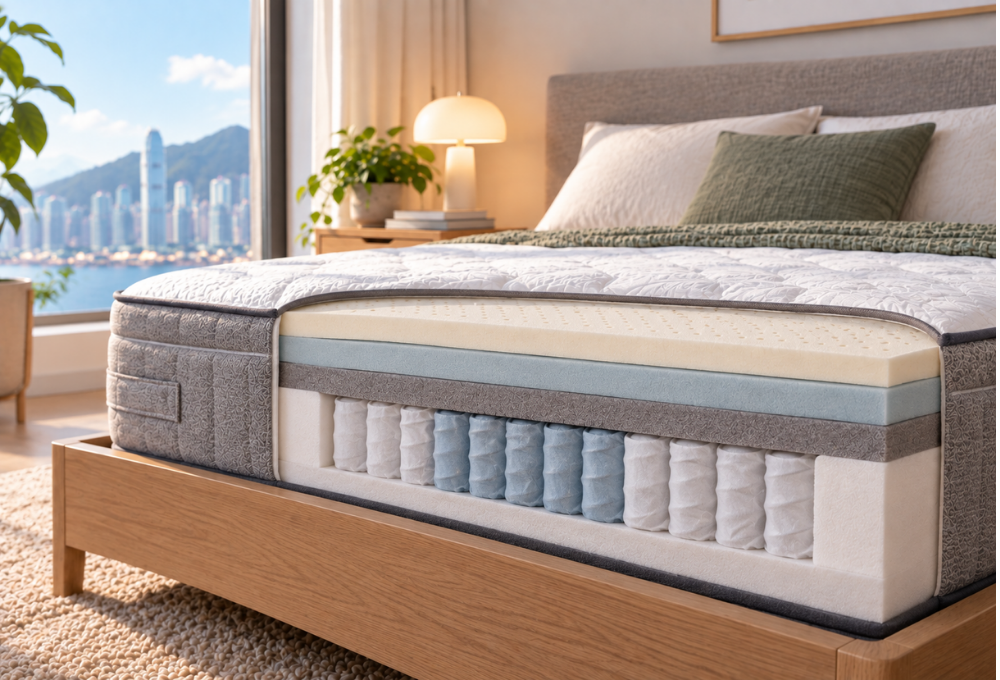
When you lie on a mattress, you experience the combined effect of several layers—not one single block of material. The top of the mattress needs enough cushioning to feel comfortable around the shoulders, hips and other pressure points, while the deeper structure needs enough resistance to keep the body from sinking without control.
That is why mattress construction is often easier to understand when you separate it into three functional zones: the comfort layer or comfort system, the transition layer, and the support core.
Quick Answer: What Is the Difference?
Comfort layer: the uppermost cushioning layer or layers. It has the strongest direct influence on pressure relief, contouring and how soft or firm the surface initially feels.
Transition layer: an intermediate layer between the comfort system and the main support core. It usually feels firmer than the comfort layer but softer or more adaptive than the core, helping prevent an abrupt change from plush to very firm.
Support core: the deeper structural foundation of the mattress. It provides most of the bed's deep resistance and stability and helps prevent excessive sinkage. In a hybrid this is usually the full-size coil unit; in an all-foam mattress it is commonly dense polyfoam; in latex mattresses it may be a firmer latex base.
The important point is that these layers work together. A good comfort layer without a suitable core may feel pleasant for a few minutes but allow too much deep sinkage. A strong core with too little cushioning can feel excessively hard at the surface.
The comfort layer is the part of the mattress closest to your body. Some mattresses have one clear comfort layer, while others use several materials together and describe the combination as a comfort system.
Its main jobs are cushioning the body, redistributing pressure and creating the surface feel. Because this section compresses first when you lie down, it strongly affects whether the mattress initially feels plush, conforming, responsive or firm.
Common comfort-layer materials include memory foam, polyfoam, latex, natural fibres and small microcoils or minicoils. These materials behave differently: memory foam generally conforms more closely, latex feels more buoyant and responsive, while small coils can add airflow and springiness.
A comfort layer is not simply decorative padding. Its thickness, firmness, responsiveness and ability to contour all affect how the sleeper's weight is distributed before that load reaches the deeper layers.
A softer, thicker comfort system may allow the shoulders and hips to sink more deeply, which can be useful for some side sleepers. A thinner or firmer comfort system usually creates a more immediate sense of pushback and less surface sinkage. Neither approach is automatically better; suitability depends on body type, sleeping position and personal preference.
The transition layer sits between the upper comfort system and the main support core. Not every mattress contains a clearly separate transition layer, but when it does, the layer helps the mattress change gradually from softer contouring near the top to firmer structural support underneath.
A transition layer can also help prevent the sleeper from sinking directly through a soft comfort layer and feeling the firmer coil or foam core too abruptly. This is sometimes described as helping prevent 'bottoming out'.
Common transition materials include firmer polyfoam, latex and small coils. The transition layer is normally firmer than the main comfort layer but does not have to be the hardest part of the mattress.
No. A transition layer is a design option, not a mandatory component. Some simple mattresses move directly from the comfort layer to the support core. Others use multiple upper layers whose firmness increases gradually, so one of those layers effectively performs a transitional role even if the manufacturer never calls it a 'transition layer'.
This is why mattress diagrams should be interpreted by function rather than assuming every brand uses the same vocabulary.
The support core is the deeper, more substantial part of the mattress that provides the main structural resistance beneath the sleeper. It stabilises the bed, supports the upper layers and helps prevent the body from sinking too far into the mattress.
Support cores are commonly made from full-size steel coils, high-density polyfoam, firm latex or adjustable air chambers. In many mattresses, the support core is also the thickest section.
The core does not need to feel rock-hard. A well-engineered support system can flex under load while still resisting excessive deep compression. The goal is controlled support, not maximum hardness.
This is one of the most important mattress concepts to understand. Firmness describes how soft or hard the mattress feels, especially at the surface. Support describes how effectively the mattress keeps the body from sinking in an uncontrolled way and helps maintain a stable sleeping position.
Because the comfort system strongly influences surface feel while the core provides most deep structural support, a mattress can be soft and supportive at the same time. Likewise, a mattress can feel very firm at first contact but still provide poor support if the deeper structure is unsuitable or worn out.
| Layer | Primary Role |
|---|---|
| Comfort layer | Closest to the sleeper; primarily influences cushioning, pressure relief, contouring and surface feel. |
| Transition layer | Sits between the upper comfort system and core; moderates sinkage and creates a smoother change from soft to firm. |
| Support core | Forms the main deep structural foundation; stabilises the mattress and supplies most of the resistance against deep compression. |
Material name alone does not tell you what a layer does. Polyfoam can be soft enough for a comfort layer, medium-firm for a transition layer or dense and firm enough to form an all-foam support core. Latex can also appear near the surface or as a deeper structural layer.
Even coils do not always mean 'support core'. Full-height coils usually form the primary core in a hybrid or innerspring mattress, but microcoils and minicoils are much smaller and are often used in comfort or transition layers.
Density measures how much material exists within a given volume of foam. Firmness measures how resistant a material or complete mattress feels when compressed. They are related in some formulations, but they are not interchangeable measurements.
A high-density foam can be engineered for a relatively soft comfort layer, while another high-density foam can be designed as a firm support material. Mattress shoppers should therefore avoid assuming that 'high density' automatically means 'very firm'.
There is no required thickness, but common modern mattress designs often use comfort systems of roughly 2 to 4 inches, transition layers of around 1 to 3 inches when present, and support cores of around 6 to 10 inches. These are broad construction ranges, not quality standards.
A thicker comfort layer is not automatically better, and a thicker core is not automatically more supportive. Material properties, body weight, zoning, coil design and the way all layers interact are more important than thickness by itself.
The comfort system usually has the most direct influence on pressure relief because it is the first part of the mattress to compress around the body's contours. Materials that contour more closely can spread pressure around areas such as the shoulders and hips.
However, the deeper layers still matter. If the transition layer or core allows too much deep sinkage—or resists too abruptly—the sleeper may still feel poorly supported even if the surface is initially soft.
All three can contribute. Memory foam in the comfort system can absorb surface movement; transition materials influence how quickly movement reaches the deeper structure; and the support core determines how energy travels through the main body of the mattress.
A pocket-coil support core can respond more locally than an interconnected traditional spring system, while microcoils in an upper layer can add bounce without necessarily acting as the mattress's main structural core.
The layers closest to the body strongly influence immediate heat and moisture comfort because they sit directly beneath the sleeper. Open-cell foams, latex, fibres and ventilated designs can affect airflow and heat retention near the surface.
The support core also matters. Coil cores contain more open space for air movement than a solid block of foam, so the deeper construction can influence how easily heat dissipates through the mattress.
When comparing mattresses, do not simply count the number of layers. More layers do not automatically mean better engineering.
Instead, ask four questions:
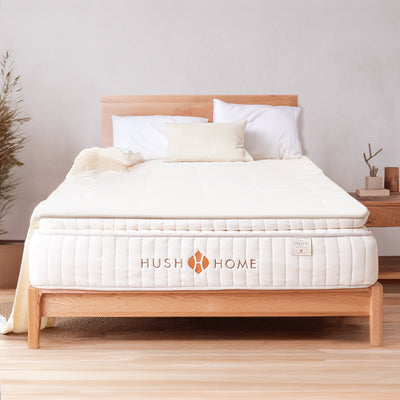
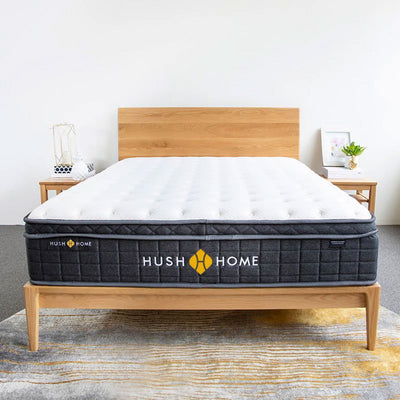
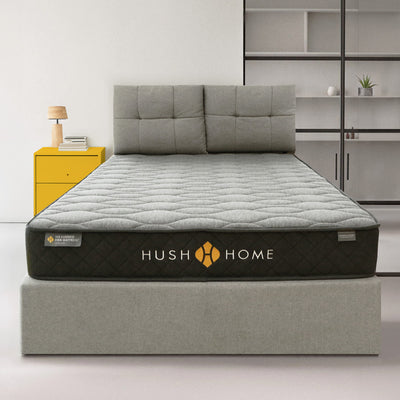
Hush Home currently describes the 10-inch Hush Mattress™ as moving progressively from plush comfort to firm support. Its published layer order includes CoolStitch fabric, high-density memory foam, open-cell foam, firm orthopedic foam, tempered-steel pocket coils and perimeter EdgeSupport.
In functional terms, the memory foam and open-cell foam form the upper comfort system. The firmer orthopedic foam acts as a deeper supportive buffer between those softer foams and the pocket-coil unit, so it can be understood as performing a transition-like role. The full-size pocket coils form the main deep support system.

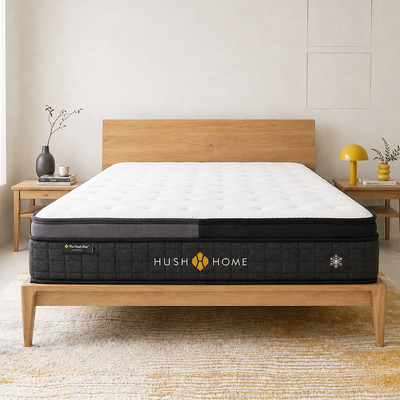
The Hush Duo Mattress™ is a useful example of why layer names can be misleading when taken literally. Its upper system includes an Ice Silk quilted cooling top, open-cell ventilation foam and interchangeable Comfort and Support Inserts. Beneath both sides is a pre-tensioned 5-zone pocket-coil base.
Although one insert is called the Support Insert, it is still part of the configurable upper comfort/firmness system. It changes how much cushioning and pushback the sleeper feels near the surface. The pocket-coil base remains the main structural support core underneath every configuration.

Hush Home's Organic Mattress™ also demonstrates that not all springs perform the same role. Its published construction includes organic latex, felt-wrapped mini-coils, a larger 7-zone pocket-coil system and a coconut-fibre layer.
The latex sits in the upper comfort area. The mini-coils provide responsive contouring closer to the sleeper and function more like part of the comfort/transition system. The larger 7-zone pocket coils provide the deeper primary support, while the coconut-fibre layer beneath helps protect and stabilise the coil structure.

Again, these are functional descriptions used to explain the architecture rather than replacing Hush's published product terminology.
The Essence Firm Mattress™ uses high-density support foam and extra-firm orthopedic foam above high-gauge pocket coils. This illustrates how a mattress can create a very firm surface feel through its upper foam system while still relying on a coil unit for deep structural support.
It is therefore more accurate to say that firmness comes from the whole construction—especially the upper layers—rather than assuming the firmest material must always be the support core.

A flippable mattress can complicate the usual top-to-bottom diagram because either side may become the sleep surface. The Loft Mattress™, for example, places a pocket-spring unit between a medium-firm foam side and a firmer foam side.
Whichever side faces upward becomes the active comfort surface, while the central pocket-spring system remains the main structural core. This is another reason layer roles should be understood in context rather than by a fixed top-to-bottom recipe.

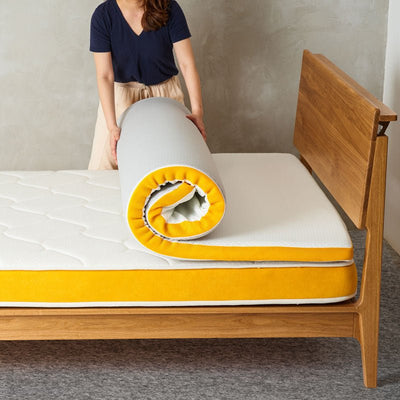
A mattress topper sits outside the mattress rather than inside its sewn construction, so technically it is an external accessory. Functionally, however, it changes the topmost cushioning and can significantly alter the way the comfort system feels.
What it normally cannot do is rebuild the internal support core. Adding a soft topper may change pressure relief and surface firmness, but it cannot structurally repair a collapsed or deeply sagging mattress underneath.
False. The comfort system has the strongest direct influence on surface feel, but the transition layer and core determine how that surface behaves under deeper load.
False. All-foam mattresses commonly use dense polyfoam cores, latex mattresses may use firm latex, and airbeds can use air chambers.
False. Layer count alone says little about quality. Material quality, proportions and how the layers work together matter much more.
False. Density and firmness are different properties. A foam can be relatively dense yet engineered to feel soft or conforming.
False. Full-height coils commonly form a support core, but microcoils and minicoils can sit much higher in the mattress and function as comfort or transition components.
There is no single most important layer because the mattress works as a system. The comfort layer shapes pressure relief and surface feel; the transition layer manages the change in resistance; and the support core supplies deep structural stability. Weakness in any one area can affect the overall performance.
Not necessarily. A pillow-top is one specific surface construction in which extra cushioning is sewn onto the top of the mattress. It can form part of the comfort system, but many mattresses without a pillow-top still contain substantial comfort layers inside.
Yes. Some mattresses gradually increase firmness through several materials rather than using one clearly defined transition layer. The important point is the progressive change in resistance, not the number of labels on the diagram.
No. A hybrid combines a substantial comfort system with a coil-based support core, but the exact middle construction varies. Some models include dedicated transition foam or microcoils; others move directly from the comfort system into the main coil unit.
No single layer determines it completely. The upper comfort system usually has the strongest effect on the firmness you perceive first, while transition and support layers influence how the mattress feels as the body sinks deeper. Overall firmness comes from the full construction.
The support core provides most of the deep structural support, but the transition and comfort layers still affect body positioning. Good support depends on the complete system keeping the sleeper in a stable, comfortable position.
The easiest way to understand a mattress is to think of it as a layered system rather than a single material. The comfort layer manages the first contact with your body. The transition layer, when present, controls the move from cushioning to deeper resistance. The support core provides the main structural foundation underneath.
Do not judge quality by layer count, thickness or material name alone. Look at how the layers are arranged, how gradually firmness changes from top to bottom, what provides the main structural support, and whether the complete construction suits your body and sleep preferences.