




What Duvet Is Best for Hong Kong? All-Season, Summer & Air-Con Duvets
18 Sep 2026
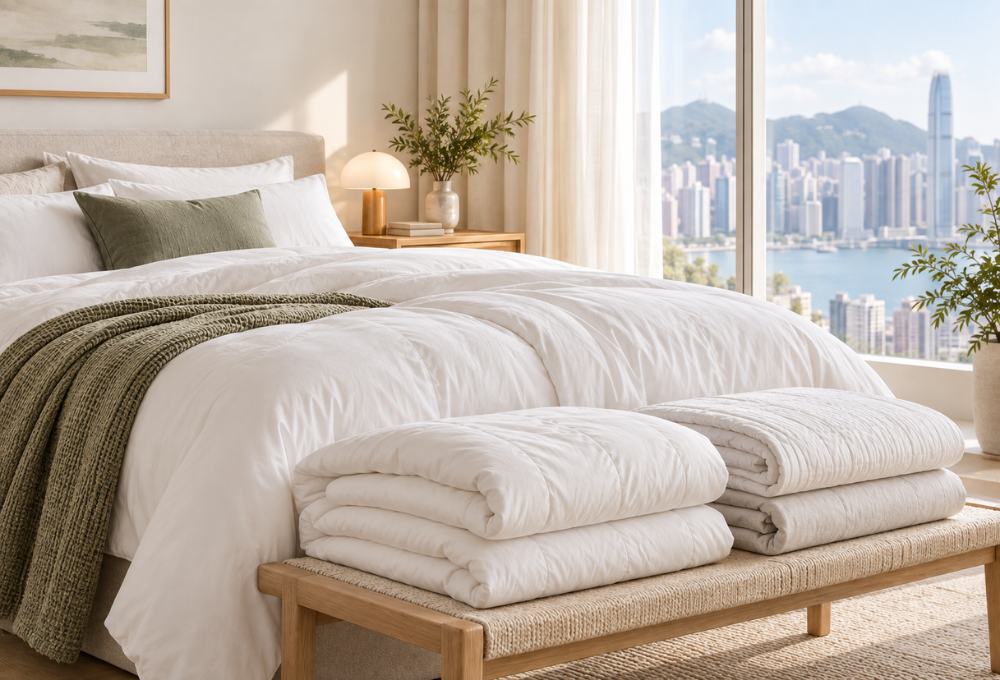
Hong Kong’s climate makes choosing a duvet surprisingly complicated. Summers are hot and humid, winters can still feel cool indoors, and many people sleep with air-conditioning for much of the year.
For most Hong Kong homes, a lightweight, breathable all-season duvet is the most practical choice because it can provide enough insulation in an air-conditioned bedroom without requiring a separate winter and summer duvet. A dedicated summer or air-con duvet can still make more sense if you sleep particularly hot or keep your bedroom warm at night.
The best choice depends less on the season written on the label and more on your bedroom temperature, whether you use air-conditioning, how warm you naturally sleep, and how breathable the duvet is.
KEY TAKEAWAY
For most people in Hong Kong, an all-season duvet offers the best balance of breathability, light insulation and year-round convenience.
Choose a summer duvet if you sleep hot or use little air-conditioning. Choose an air-con duvet if you want a light layer specifically for a cooled bedroom. An all-season duvet is usually the more versatile option if you want one duvet for most of the year.
Hong Kong does not have the same bedding requirements as a cold, dry climate.
The Hong Kong Observatory describes May to August as hot and humid, with daytime temperatures often above 31°C and nighttime temperatures generally around 26°C. Long-term climate normals also show average relative humidity of around 81–83% from March through August.
That creates two competing problems.
Outside the bedroom, the weather can feel warm and sticky. Inside, air-conditioning can make the sleeping environment substantially cooler.
A duvet that is very warm and poorly ventilated can feel uncomfortable during humid weather, while an extremely thin summer blanket may not provide enough insulation once the air-conditioner has been running for several hours.
This is why breathability and temperature regulation matter as much as thickness when choosing bedding for Hong Kong.
| Duvet Type | Typical Feel | Best Suited To | Main Advantage | Main Drawback |
|---|---|---|---|---|
| All-season duvet | Light to medium warmth | Most Hong Kong sleepers | One duvet can work across most of the year | May still feel warm for very hot sleepers |
| Summer duvet | Very lightweight | Hot sleepers and warmer bedrooms | Minimal insulation and less bulk | Can feel too cool under strong air-conditioning |
| Air-con duvet / 冷氣被 | Lightweight with some insulation | Air-conditioned bedrooms | Designed to take the chill off without feeling like winter bedding | The term is not standardized, so warmth varies by product |
| Winter duvet | Thick and highly insulating | Very cold sleepers or unusually cool rooms | Maximum warmth | Often unnecessary for typical Hong Kong indoor conditions |
“Air-con duvet” is not a standardized technical category. In Hong Kong, 冷氣被 generally refers to a lighter duvet or quilt intended for use while sleeping with air-conditioning. Compare the actual materials, fill and construction rather than relying only on the product name.
An all-season duvet is designed to strike a middle ground between a very light summer duvet and highly insulating winter bedding.
The aim is not to make the duvet equally warm in every possible temperature. Instead, a well-designed all-season duvet combines enough insulation for cooler nights with enough breathability to remain comfortable when the room is warmer.
That can be particularly practical in Hong Kong because bedroom conditions often change more because of air-conditioning settings than because of the outdoor season.
An all-season duvet is particularly useful if:
For smaller Hong Kong homes, the storage advantage is significant: one versatile duvet takes up much less cupboard space than separate warm- and cool-season bedding.
A summer duvet is designed to provide minimal insulation while still giving you the familiar covered feeling of sleeping under a duvet.
It usually contains less filling or uses particularly breathable materials to reduce heat retention.
However, “thin” does not automatically mean “cool.”
A thin duvet made from poorly breathable materials can still trap heat and moisture. Likewise, a slightly fuller duvet using breathable fabrics and well-designed filling can sometimes feel more comfortable.
For a deeper look at this category, see our Summer Duvet Guide: 5 Facts & Myths About 冷氣被.
An air-con duvet, commonly called a 冷氣被 in Hong Kong, is essentially a lightweight duvet designed for sleeping in an air-conditioned room.
The concept makes sense locally because bedroom temperatures can be dramatically cooler than outdoor temperatures during summer.
Someone may feel hot before bed, switch on the air-conditioner, and then wake several hours later feeling cold beneath bedding that was chosen only for the outdoor weather.
An air-con duvet therefore aims to provide light insulation without the bulk of a traditional winter duvet.
Often, but not always.
Retailers may use “summer duvet” and “air-con duvet” almost interchangeably, but the intended use can differ slightly:
Because neither term has one universal technical definition, always compare the actual fill, shell fabric, breathability and construction instead of relying only on the product name.
Not necessarily.
Traditionally, some Hong Kong households switch between a thinner summer duvet and a thicker winter duvet. Others use combination or 子母被 systems that allow layers to be attached or separated.
That flexibility can work well, but it also means owning, washing and storing multiple pieces of bedding.
For many households, a breathable all-season duvet is simpler.
The important question is whether the duvet can provide enough warmth in an air-conditioned or winter bedroom without trapping excessive heat during warmer conditions.
The outer shell influences how easily heat and moisture can move away from the body.
Cotton is popular because it is breathable, comfortable against bedding and suitable for Hong Kong’s humid climate.
A tightly woven, good-quality cotton shell can also help contain fine filling while remaining comfortable.
More filling is not automatically better.
For Hong Kong, an ideal duvet should provide insulation without creating excessive bulk or heat.
Synthetic microfiber can be engineered to provide loft and insulation at relatively low weight, while natural down can also provide excellent warmth-to-weight performance.
Hong Kong’s high humidity makes ventilation especially relevant.
Look for a construction that allows airflow rather than simply choosing whichever duvet feels thinnest in the shop.
Ask yourself:
Two people living in the same Hong Kong building may need completely different bedding because their sleeping environments are different.
A duvet collects moisture, dust and other particles over time.
Check the product’s care instructions and consider hypoallergenic materials if you are sensitive to natural down or other filling materials. Hush Home owners can also refer to the Product Care Guide for current cleaning instructions.
For a broader step-by-step comparison of duvet filling, construction and sizing, see our Duvet Buying Guide 2026.
TOG is a measure of thermal insulation: the higher the TOG, the more heat a duvet is designed to retain.
It can be useful when comparing duvets, but TOG should not be treated as the only measure of comfort.
Two duvets with similar insulation can feel different because of:
For a bedroom without strong air-conditioning, a lightweight and highly breathable summer duvet can be the safest starting point.
But if you sleep with air-conditioning all night, an extremely thin summer duvet may not necessarily be the most comfortable option.
In that situation, a breathable all-season or air-con duvet can provide a better balance between avoiding overheating at bedtime and avoiding feeling cold toward morning.
The Hong Kong Observatory's long-term climate data helps explain why this balance matters: summer nights remain warm and humid outdoors, even while many bedrooms are artificially cooled.
Hong Kong winters are much milder than those of northern Europe or North America.
January and February can bring colder spells, with urban temperatures occasionally falling below 10°C, but those conditions are not the norm for the whole winter.
For many homes, a breathable all-season duvet provides enough flexibility.
People who feel particularly cold can add a lightweight blanket on colder nights rather than storing a very heavy winter duvet for the rest of the year.
There is no universal winner.
High-quality down can provide excellent insulation with relatively little weight.
However, it can be expensive and may not suit people who prefer synthetic or hypoallergenic bedding.
Quality microfiber can imitate some of the loft and insulating qualities of down while offering easier care and a down-free construction.
Its performance varies considerably, so the quality of the fibre and overall duvet design matter.
Cotton is more commonly used as a shell material but can also be used as filling.
It is breathable and moisture-friendly but generally produces a different, less lofty feel than down or fine microfiber.
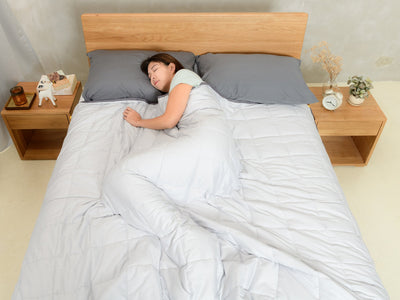
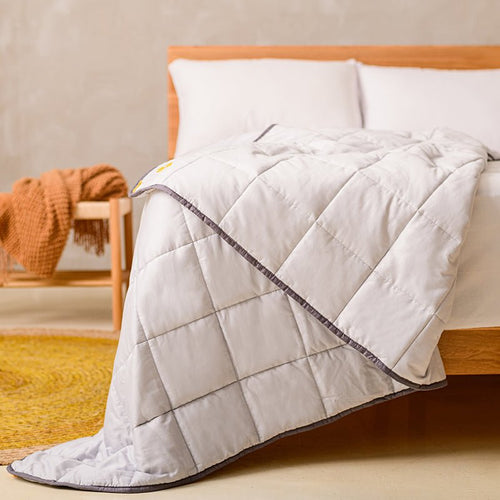
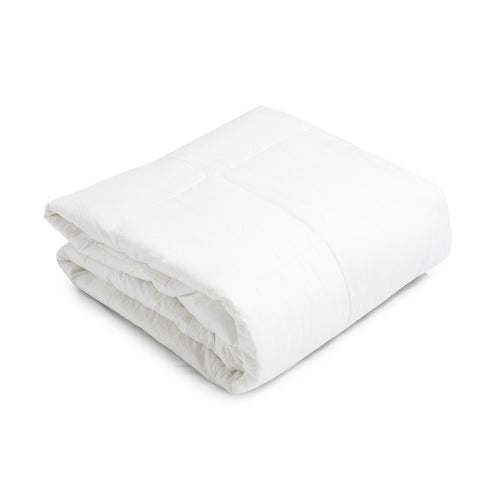
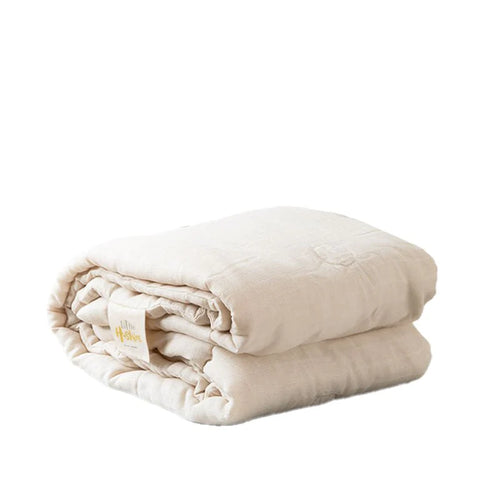
Hush Home's All-Season Duvet™ is designed around the exact problem Hong Kong sleepers face: needing enough insulation for air-conditioned and cooler nights without relying on a bulky winter duvet.
The current duvet uses:
Hush describes the filling as designed to reproduce the loft and heat-insulating characteristics of natural down while retaining the breathability associated with cotton. The current product is positioned specifically as a lightweight, breathable duvet for both summer and winter use.
Fill weight alone does not determine how warm a duvet feels.
A 250 gsm microfiber duvet can still feel relatively light if the fibres provide good loft and the shell allows airflow.
For Hong Kong, the practical objective is not maximum insulation. It is enough warmth for an air-conditioned bedroom without creating an unnecessarily heavy sleep environment.
| 特色 | Hush All-Season Duvet™ | Typical Summer Duvet |
|---|---|---|
| Intended use | Year-round / air-conditioned rooms | Warmest months |
| Fill | 250 gsm microfiber | Usually lighter fill |
| Shell | Long-staple cotton | 费用不定 |
| 手感 | Lofty but lightweight | Very light |
| Best for | One-duvet simplicity | Very hot sleepers |
| Winter flexibility | Better | May need extra layers |
| Storage | One duvet | Often paired with a separate winter duvet |
For people who routinely overheat even with air-conditioning, a thinner summer duvet may still be preferable.
But if you want one duvet that can move between humid summers, air-conditioned nights and Hong Kong's milder winter, an all-season design can be more practical.
Do not choose duvet size only according to the mattress name.
The amount of overhang you prefer matters too.
Hush Home's current duvet sizing is:
| 尺寸 | Duvet Dimensions | Common Mattress Fit |
|---|---|---|
| 单人床 | 150 × 200 cm | Small Single / Single |
| 双人 / 加大双人 | 210 × 210 cm | Large Single through Full |
| 女王 / 国王 | 245 × 220 cm | Queen through King |
If the bed sits in the middle of the room, choosing more overhang can create a fuller hotel-style appearance. If one side of the bed sits against a wall, a smaller duvet can sometimes be easier to manage.
For the full size-by-size breakdown, see the Hush Home Duvet Size Guide Hong Kong.
For many sleepers, a lightweight and breathable all-season duvet is the most practical option because it can work across air-conditioned summers and Hong Kong's mild winters. Hot sleepers may prefer a dedicated summer duvet.
A 冷氣被 is a lightweight duvet designed for use in an air-conditioned bedroom. It provides more coverage and insulation than a sheet without the heavy warmth of traditional winter bedding.
They often overlap, but not necessarily. A summer duvet focuses on minimizing warmth, while an air-con duvet may provide slightly more insulation for a cooled bedroom.
Not everyone does. Many homes can use an all-season duvet through winter and add an extra blanket during occasional colder spells.
No. Insulation depends on filling material, loft and construction as well as thickness or weight.
A breathable all-season or air-con duvet is usually a good starting point. If your air-conditioner is set particularly cold, an all-season duvet may be more comfortable than an ultra-light summer duvet.
A lightweight summer duvet with breathable materials is usually the better choice. The sleeper's bedroom temperature and air-conditioning habits should still be considered.
Yes. Hush designed the All-Season Duvet™ for both summer and winter use, using a 250 gsm microfiber fill and breathable long-staple cotton shell.
The best duvet for Hong Kong is not necessarily the thinnest duvet for summer or the thickest one for winter.
Hong Kong sleepers move between hot, humid outdoor weather and cooled indoor bedrooms, so the most useful duvet is one that matches the conditions where you actually sleep.
If you sleep hot and keep the bedroom warm, choose a lightweight summer duvet.
If you mainly want a thin layer while the air-conditioner is running, an air-con duvet may be enough.
If you want one breathable duvet that can handle air-conditioned summer nights, transitional weather and Hong Kong's mild winter without taking up extra storage space, an all-season duvet is usually the most versatile choice.
The Hush Home All-Season Duvet™ is specifically designed around that approach, combining 250 gsm hypoallergenic microfiber filling with a long-staple cotton shell for lightweight, breathable year-round comfort.