



Best Mattress for Couples With Different Body Weights
17 Aug 2026
The best mattress for couples with different body weights should account for the fact that the same mattress can feel softer to the heavier partner and firmer to the lighter partner. For couples with a large difference in body weight, independently adjustable firmness may provide a more individualized solution than forcing both sleepers onto one shared firmness.
This is one of the most overlooked facts about mattress shopping.
Mattress firmness is not experienced in isolation.
Your body is part of the system.
Imagine pressing your hand lightly into a piece of foam.
Now press considerably harder.
The material has not changed.
But your interaction with it has.
The same principle applies to your mattress.
Heavier sleepers generally compress comfort layers more deeply and engage more of the support structure underneath.
Lighter sleepers compress the same surface less.
Sleep Foundation's testing methodology therefore assesses mattresses across different weight groups rather than assuming one mattress will perform identically for everyone.
Consider a mattress labelled “medium-firm.”
A heavier sleeper may sink deeply enough to experience substantial contouring.
Their lighter partner may barely compress the same upper comfort layers.
The first person experiences more sinkage.
The second experiences more surface resistance.
The mattress technically has one firmness.
The couple experiences two.
Lighter sleepers tend to interact mostly with the top layers of a mattress.
As a result, an excessively firm surface may not compress enough to provide the contouring they prefer.
Softer to medium surfaces are therefore common starting points, particularly for lighter side sleepers.
Sleep Foundation, for example, uses under 130 lb, 130–230 lb and over 230 lb as practical weight categories in its mattress testing. Its guidance generally places lighter sleepers toward softer firmness ranges and heavier sleepers toward firmer ones. These are useful starting points rather than biological cut-offs.
Personal preference always matters.
As body weight increases, deeper compression becomes more important.
A firmer surface may help provide greater resistance and keep the sleeper from moving too deeply through the comfort system.
However, “firmer” does not mean “hardest possible.”
A heavier side sleeper still needs enough cushioning around the shoulder and hip.
The right mattress combines:
Surface comfort + deeper structural support.
Weight should never be considered alone.
A lightweight side sleeper and a lightweight stomach sleeper may still want different surfaces.
Likewise, two heavier sleepers may prefer different firmness levels because one sleeps on their side while the other sleeps on their back.
This is why the best mattress recommendation should consider both:
Body Weight × Sleeping Position
rather than either factor independently.
Current mattress testing guidance follows this same principle, combining body-weight groups with side, back and stomach-sleeping positions when evaluating firmness suitability.
Your body does not distribute its weight uniformly across a mattress.
Different anatomical regions apply different loads depending on posture and body shape.
Research published in Ergonomics found measurable differences in body pressure distribution across different sleep surfaces, sleeping positions and anatomical regions, highlighting the importance of anatomical variation when designing sleep systems.
A separate 2026 study in the International Journal of Industrial Ergonomics found that mattress firmness affected interface pressure in a region- and posture-specific manner.
In practical terms, mattress response is not uniform across different bodies and sleeping positions.
Imagine:
Partner A prefers 4/10.
Partner B prefers 8/10.
The traditional solution would be something around 6/10.
Mathematically, that is the midpoint.
Ergonomically, however, nobody sleeps on an equation.
Partner A may still feel that the mattress is too hard.
Partner B may still feel that it allows too much sinkage.
If both partners actually enjoy the midpoint, excellent.
If neither does, compromise has not solved the problem.
It has simply divided the discomfort equally.
This directly addresses differences in how deeply each partner compresses the mattress.
The mattress should remain structurally supportive beneath the comfort layers.
Targeted support can help the mattress respond more appropriately to different regions of the body.
If one partner changes position frequently or gets out of bed during the night, strong motion isolation can reduce how much movement reaches the other side of the mattress.
A strong motion-isolating system limits how far movement travels.
Strong edge support is particularly useful for couples because both sleepers can confidently use more of the mattress width.
Higher-density foams and a well-designed support core help maintain consistent comfort under repeated use.
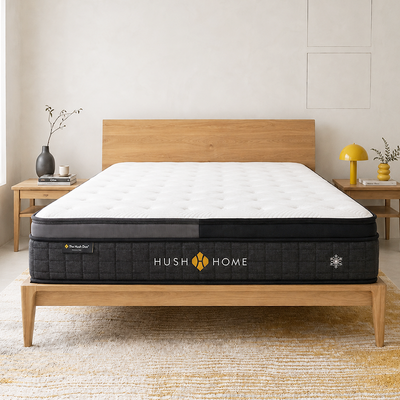
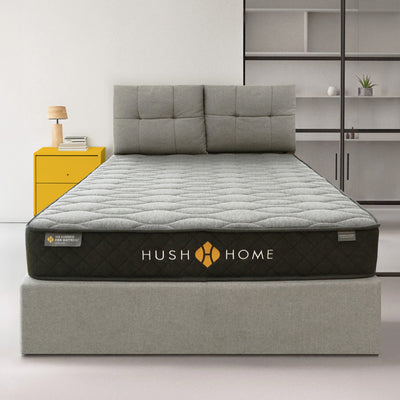
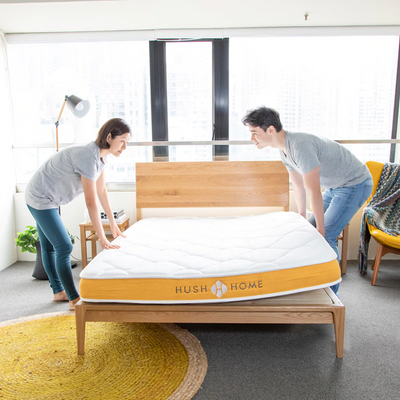
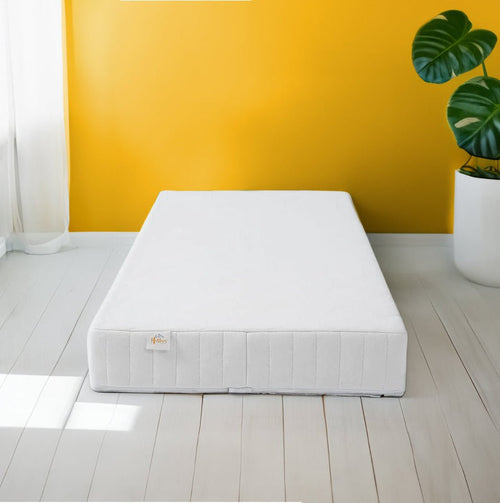
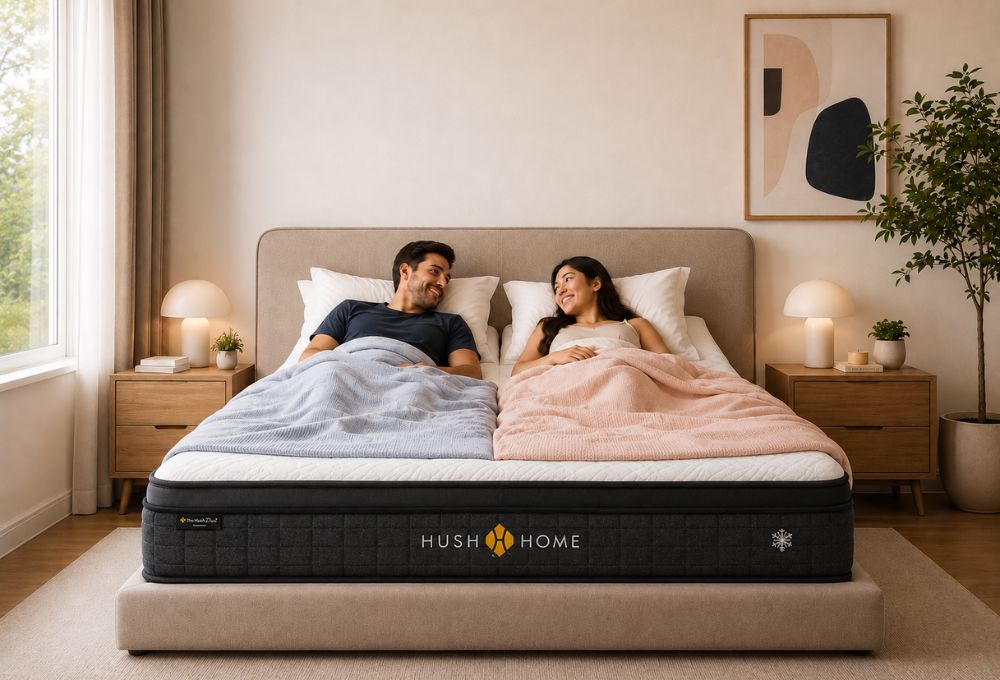
The Hush Duo Mattress™ is designed around this exact idea.
Each side of the 11-inch mattress contains independently configurable comfort and support inserts.
The mattress provides four firmness profiles spanning 4.0–9.0, so two sleepers with different body weights do not have to use the exact same comfort configuration.
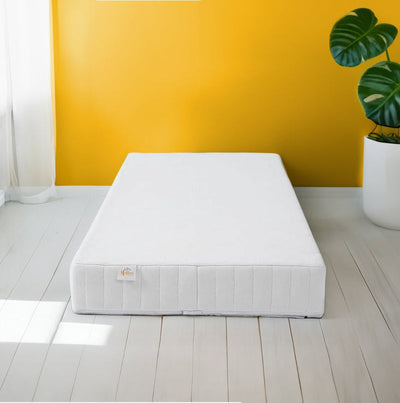
The foundation uses 5-zone pre-tensioned independent pocket coils, providing responsive support beneath different body areas.
Above the coils sit separately configurable high-density memory foam and orthopedic open-cell foam inserts.
The entire system is enclosed beneath one smooth shared cover, so the mattress maintains one continuous surface rather than becoming two visibly separate beds.
Body weight is not static for everyone.
People gain or lose weight.
Exercise habits change.
Pregnancy changes comfort requirements.
Age changes what feels comfortable.
Sleep positions evolve.
On a traditional fixed mattress, your original firmness choice stays the same even when you do not.
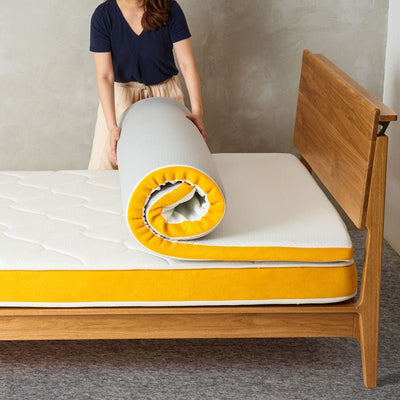
Hush Duo allows the internal inserts to be rearranged, and Hush offers replacement inserts later in the product's life. During the initial 365-night guarantee, customers can also request complimentary replacement inserts to help adjust their setup.
That makes the mattress adaptable not just between two people, but also across time.
Different body weights can make one mattress feel like two completely different mattresses.
That is why couples should not choose firmness solely by finding the numerical midpoint between two preferences.
Consider each sleeper independently:
If those needs are similar, one fixed firmness can work beautifully.
If they are very different, individualized firmness offers a more logical solution.
With Hush Duo Mattress™, two different bodies can share one bed without requiring identical comfort settings.
Find your firmness with the Hush Duo Mattress™
Yes. Body weight affects how deeply you compress the mattress, so the same surface may feel considerably different to two people of different weights.
Not necessarily. Heavier sleepers often benefit from stronger support and may prefer firmer surfaces, but sleeping position and personal preference also matter.
Lighter sleepers often prefer more cushioning because they do not compress a mattress as deeply, but there is no universal rule.
Consider a mattress with strong structural support and independently configurable firmness so both partners can select a surface appropriate for their body and sleeping position.