







How Often Should You Replace Bath Towels? Signs Your Towels Are Worn Out
07 Oct 2026
There is no scientifically fixed rule saying every bath towel must be replaced after one, two or five years. Current consumer guidance varies widely because towel lifespan depends on material, construction, laundering, frequency of use and how many towels you rotate.
For example, experts quoted by ABC Australia in 2026 gave estimates ranging from around one to three years for frequently used towels to at least five or six years for good-quality towels. That spread is exactly why condition is more useful than age alone.
Quick Answer: Replace the Towel When Performance or Structure Has Failed
A bath towel is ready for replacement when one or more problems remain even after appropriate washing and drying: it no longer absorbs well, feels permanently rough, develops recurring odour, becomes thin or threadbare, loses large areas of loops, frays badly or has damage that makes normal use unpleasant.
Age by itself is not a failure. A five-year-old towel that is clean, absorbent and structurally sound can still be useful, while a heavily used towel may wear out much sooner.
Absorbency is one of a bath towel's main jobs. If water seems to sit on your skin, the towel pushes moisture around instead of taking it up, or drying yourself takes noticeably longer than it used to, the towel may be losing useful performance.
However, do not replace it immediately. Laundry-product residue can also interfere with absorbency. If the towel still looks structurally healthy, first wash it according to its care label and check whether the performance improves.
Repeated washing, drying, mineral residue, detergent residue and fibre wear can all change the hand feel of a towel. If it remains harsh or scratchy even after proper laundering, the fibres may be significantly worn.
Roughness alone is not always an end-of-life signal. The American Cleaning Institute notes that stiff fabrics can also result from mineral or detergent residue, so it is worth correcting the washing routine before replacing an otherwise intact towel.
A towel that smells unpleasant after use usually needs washing—not replacement. But if a musty or stale odour repeatedly returns after an appropriate wash and complete drying, especially alongside visible deterioration, it may be difficult to restore to normal everyday use.
Persistent odour should not be confused with a towel that was simply left damp for too long. Always allow towels to dry properly between uses and make sure they are fully dry after laundering before judging their condition.
A few loose threads are cosmetic. Widespread fraying, separating hems or repeated seam failure are more meaningful because the towel is progressively losing structural integrity.
Small loose threads can often be trimmed carefully rather than pulled. But if the edges continue to unravel after normal washing, replacement may be more practical than repeated repair.
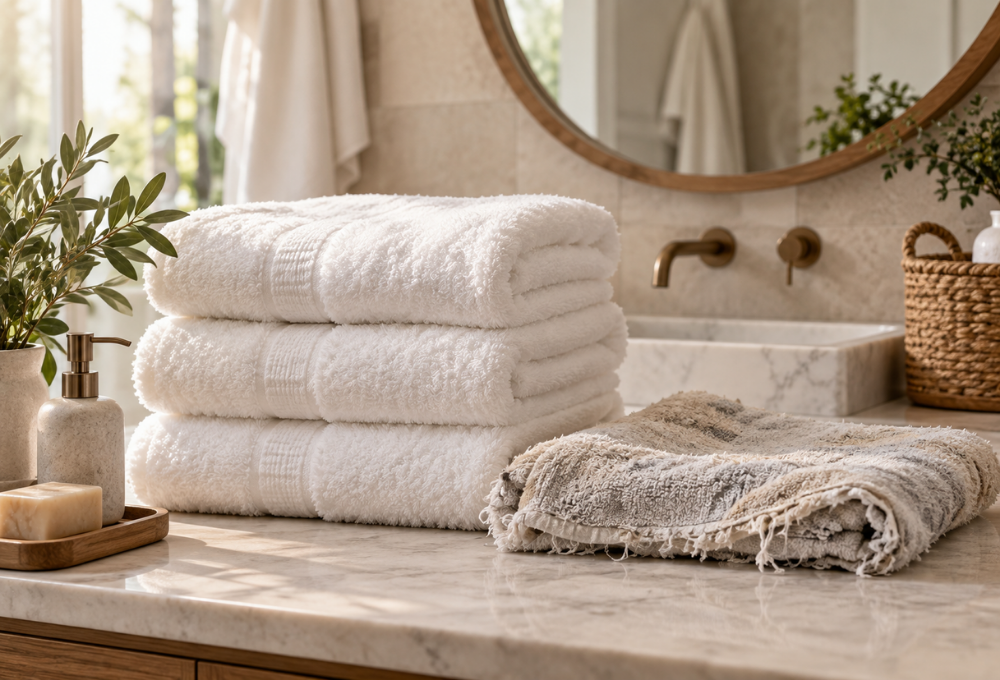
Terry towels absorb well partly because their loops create a large surface area. With long-term wear, those loops can break or flatten and the base fabric can become increasingly exposed.
If large areas look bald, the fabric is visibly thin or you can see light easily through worn sections, the towel is approaching the end of its useful life even if it has not developed a hole yet.
A small snag does not require a new towel. But larger tears, multiple holes or extensive loop damage can reduce absorbency, make the towel uncomfortable and allow damage to spread further in the wash.
At this point, the towel may still have a second life as a cleaning cloth or pet towel even if it is no longer suitable as a bath towel.
Discolouration alone is not automatically a reason to throw out a towel. Fading from repeated washing may be purely cosmetic. The more important question is whether the towel can still be cleaned to a standard you are comfortable using against freshly washed skin.
If a stain comes from a substance you cannot safely remove, contamination remains after appropriate cleaning, or the towel has developed irreversible damage around the stained area, replacement is reasonable.
Washing frequency and replacement frequency are different questions. The American Cleaning Institute recommends hanging bath towels to dry between uses and washing them after roughly three to five normal uses. Cleveland Clinic gives a practical minimum of about once per week and recommends more frequent laundering when towels struggle to dry in a humid indoor environment.
There is no need to throw away a towel merely because it was used several times. Regular laundering removes accumulated sweat, skin oils and debris; replacement becomes relevant when cleaning can no longer restore acceptable performance or condition.
Hong Kong's 1991–2020 climatological normals show annual mean relative humidity of 78%, with monthly means of 82–83% from March through June and 81% in July and August. These are outdoor Observatory readings, not the humidity inside your bathroom, but they help explain why damp textiles can take longer to dry during humid periods.
After showering, spread the towel out rather than leaving it crumpled on the floor or bunched on a hook. A wide towel bar, good ventilation, a fan or dehumidification can help the fabric dry more thoroughly between uses.
A humid climate does not automatically shorten every towel's lifespan. The bigger problem is repeated prolonged dampness. If your bathroom never allows thick towels to dry before the next use, rotating additional towels and washing them more frequently may be more useful than simply buying heavier towels.
Towels age through a combination of use and laundering. Common contributors include very high use frequency, constant washing with no rotation, aggressive drying temperatures, overloading the washer or dryer, repeated friction, harsh treatment of loose loops and unsuitable laundry products or quantities.
The quality and construction of the towel also matter. A dense, well-made long-staple cotton towel may tolerate repeated laundering better than a loosely constructed low-quality towel, but no textile is literally immune to wear.
Hush Home's current Luxury Hotel Towels™ are specified as 100% long-staple cotton, 800 gsm and single-ply construction. Hush also publishes a hotel-durability specification of a minimum 300 washes and a 1-year HushCare warranty.
Neither figure should be turned into a fixed household replacement date. Three hundred washes is a durability specification, not a promise that every towel will last a particular number of years. A towel washed twice a week reaches 300 wash cycles much sooner than a towel rotated among several sets. Likewise, a 1-year warranty period is not the same thing as expected useful life.
The better test is the same as for any towel: check absorbency, texture, odour after washing, loop condition, thickness, seams and overall structural integrity.
Hush's current Care Guide recommends washing the towels as often as necessary, machine washing at 40°C with mild liquid detergent, pre-washing new towels separately before first use, tumble drying at normal temperatures, using non-chlorine bleach where needed, and avoiding dry cleaning.

Often, yes. A towel that is too worn for comfortable post-shower use may still be useful as a household cleaning cloth, pet towel, floor-protection cloth during DIY work or padding when moving fragile objects.
Donation depends on the receiving organisation. Do not assume every charity or animal shelter accepts used towels; check its current requirements before dropping anything off.
False. There is no universal one-year expiry date. Usage, construction, laundering and rotation matter more than the calendar alone.
Not necessarily. Roughness can come from fibre wear, but detergent or mineral residue can also make fabric feel stiff. Try correcting the care routine before replacing an otherwise intact towel.
Usually, no. A damp or dirty towel first needs appropriate washing and complete drying. Replacement becomes more reasonable when odour repeatedly returns despite correct cleaning and the towel also shows deterioration.
False. Wash cycles are not calendar years. Rotation and laundering frequency determine how quickly any household reaches a given number of washes.
There is no universal number. Current expert guidance ranges from roughly one to three years for heavily rotated everyday towels to five years or more for good-quality towels that are well cared for. Use those figures as context, not deadlines.
Check its performance and structure. Poor absorbency, permanent roughness, recurring odour after washing, thinning, large bald areas, fraying, holes and damage that no longer cleans satisfactorily are more meaningful than age alone.
A practical general guideline is after around three to five normal uses, provided the towel can dry fully between uses. Some health guidance uses at least weekly as a simple minimum and recommends more frequent washing in humid environments where towels stay damp.
Yes, if fading is only cosmetic and the towel remains clean, absorbent and structurally sound. Colour loss alone does not mean the towel has failed.
Not automatically. A higher-GSM towel contains more material and may feel more substantial, but fibre quality, yarn, loop construction, finishing and care all influence durability. Thicker towels can also take longer to dry.
No. Towels in the same household often wear at different rates depending on how frequently each one is used and washed. Replace individual towels based on condition rather than discarding an entire matching set unnecessarily.
Bath towels do not need to be replaced on a fixed annual schedule. A better rule is to keep using them while they remain cleanable, absorbent, comfortable and structurally sound—and replace them when those functions no longer recover with appropriate care.
For Hong Kong households, drying matters almost as much as washing. Give towels enough space and airflow to dry between uses, rotate them when necessary during humid weather, and do not confuse a temporarily damp or poorly laundered towel with one that has genuinely reached the end of its useful life.