




How Long Does a Mattress Topper Last? Signs It's Time to Replace It
07 Oct 2026
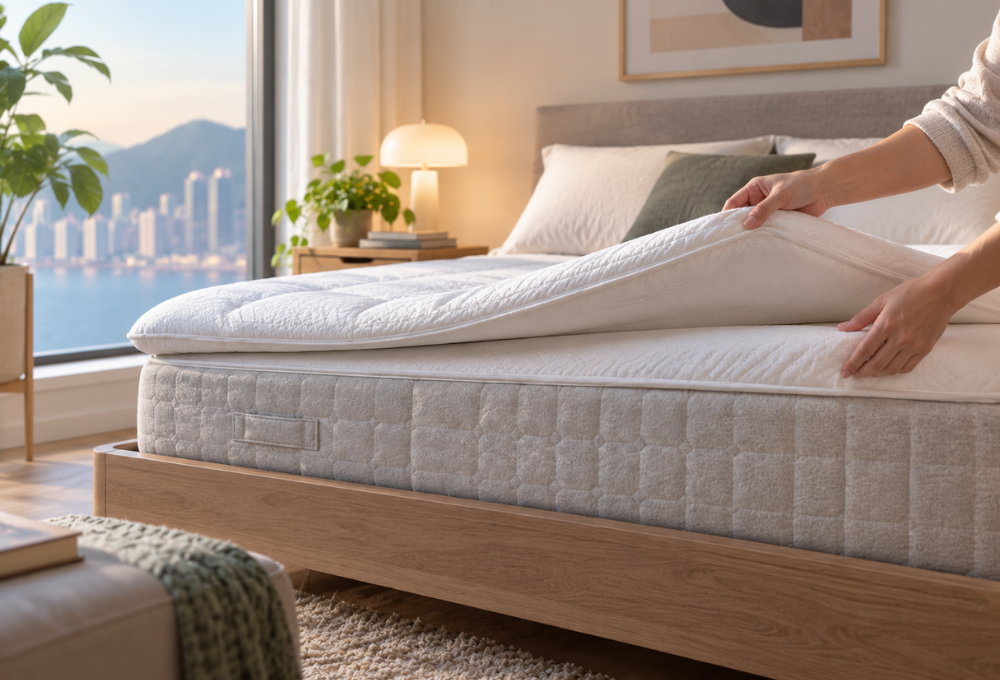
A mattress topper is designed to change how your existing mattress feels. It may add pressure relief, make a firm bed feel softer, make a soft bed feel firmer or refresh a mattress with light surface wear.
Because a topper sits directly beneath the sleeper and contains relatively little material compared with a full mattress, it usually wears out sooner than the mattress underneath it. That does not mean you should replace it on a fixed calendar. A topper that is four years old and still flat, supportive and comfortable may have more useful life than a two-year-old topper that has developed permanent dips.
The best rule is therefore simple: use age as a guide, but use condition and performance to decide when to replace it.
Quick Answer: How Long Should a Mattress Topper Last?
Current Sleep Foundation guidance says a quality mattress topper commonly lasts about three to four years, although actual service life can range from roughly one year to well beyond five years depending on quality and construction. Some durable latex toppers may last five years or longer, while low-quality foam can develop permanent impressions much earlier.
These are not expiry dates. A topper should be replaced when it no longer performs the job you bought it to do, or when its physical condition makes continued use impractical or unhygienic.
A warranty tells you how long the manufacturer agrees to cover specific eligible defects under its terms. It does not guarantee that the product will feel exactly the same for the entire warranty period, and it does not mean the product must be replaced the day the warranty ends.
Normal softening, gradual compression and comfort changes can occur as cushioning materials are repeatedly loaded. Whether those changes are acceptable depends on the topper's design, your body and the reason you bought it.
Memory foam is popular because it contours closely around the body and absorbs pressure, but those same comfort properties mean the foam experiences repeated compression every night.
A good memory foam topper can remain comfortable for several years, but lifespan varies greatly with foam density, formulation, thickness, firmness and how heavily it is used. Lower-density or very soft memory foam is generally more prone to permanent body impressions and premature softening than denser, more resilient foam.
A commonly quoted three-year lifespan for foam toppers is useful as a planning reference, but it should not override the topper's actual condition.
Latex is generally more resilient than many polyurethane foams. Sleep Foundation notes that latex toppers commonly outlast other topper categories and may last five years or longer when well made and properly maintained.
However, “latex” is still not a durability guarantee. Blend, density, thickness, manufacturing method, exposure to heat or UV and the overall product construction all matter.
Polyfoam toppers vary widely. Higher-density foam generally resists permanent compression better than low-density foam, although firmness and formulation still matter.
Fibrefill, down and feather toppers usually depend on loft rather than a solid foam structure. Their comfort can therefore decline when filling compresses, clumps or migrates. Regular fluffing may restore some loft, but once the filling no longer rebounds evenly, replacement may be more practical.
Wool can be durable and temperature-regulating, but it also compresses gradually with use. As with every material, construction quality matters more than the category name alone.
Usually, yes. Within comparable foam types, higher-density foam generally contains more material per unit volume and tends to resist permanent compression better than lower-density foam.
But density is not the same as firmness. A dense foam can still be made soft, and a firm foam is not automatically high-density. Consumers should avoid treating either term as a complete quality score.
Thickness changes how much material is available to compress, but thicker is not automatically more durable. A thick, very soft topper can develop deep impressions because the body sinks farther into the material. A thinner, firmer topper may resist compression better but provide less cushioning.
Sleep Foundation's topper testing methodology notes this trade-off: dense foam and latex tend to resist wear well, while very thick and soft toppers can lose shape more quickly.
A topper in a guest room used a few weekends per year may last far longer than the same model used by two adults every night.
Higher body weight also increases the amount of compression the topper experiences. This does not mean heavier sleepers cannot use soft toppers, but it does mean material thickness, density and firmness become more important for avoiding bottoming out and permanent impressions.
A topper follows the surface beneath it. If the mattress has a deep permanent dip, broken support unit or unstable foundation, the topper will usually sink into the same low area.
This is why a topper cannot structurally repair a sagging mattress. It can improve comfort on a mattress with light surface wear, or temporarily adjust firmness, but it cannot restore a failed support core.
If a relatively new topper suddenly feels uneven, remove it and inspect the mattress and bed base separately before assuming the topper has failed.
Hong Kong Observatory's 1991–2020 climate normals show annual mean relative humidity of 78%, with monthly means reaching 82–83% during parts of spring and early summer.
Humidity does not automatically destroy foam, but persistent dampness can make drying slower, encourage odour or mould problems and make hygiene harder to manage. This is particularly relevant if the topper sits on a poorly ventilated surface or is remade before a washed cover is fully dry.
Keep the bedroom ventilated, manage indoor humidity and make sure any cleaned cover is completely dry before putting it back on.
One of the clearest signs of topper wear is a dip that remains even after the bed has been unused for hours.
Temporary compression while you are lying down is normal. Permanent impressions are different: the material no longer rebounds to its original profile. If your hips or shoulders repeatedly fall into the same depression, the topper is no longer distributing pressure as evenly as intended.
Foam gradually softens with repeated compression. A small change is normal, but if the topper no longer changes the mattress feel in the way you need, its useful function may be ending.
A topper bought to soften a firm mattress may start to feel thin and ineffective. A topper bought to add firmness may begin allowing too much sink. Judge it against the purpose you originally bought it for.
If one side, hip zone or sleeping position feels substantially softer than the rest, the topper may be wearing unevenly.
Before replacing it, confirm that the mattress underneath is level and that the topper is correctly positioned. If the unevenness remains when the topper is placed on a flat surface, the topper itself is more likely to be the source.
Bottoming out means your body compresses through so much of the topper that you strongly feel the mattress underneath.
This can happen because the topper was too thin or soft from the beginning, but it can also develop after the material loses resilience. If a topper that once cushioned your shoulders or hips no longer does so, replacement may restore the intended comfort more effectively than adding another layer on top.
Foam that is cracking, tearing, crumbling into particles or separating from its cover has physically deteriorated.
Minor cosmetic marks do not always affect performance, but widespread structural damage is different. Once the foam can no longer maintain a continuous, even layer, comfort and support become less predictable.
A temporary new-foam smell is different from persistent mustiness or damp odour developing after use.
If a topper has been soaked, remains damp internally, develops widespread mould or cannot be cleaned and fully dried according to the manufacturer's instructions, replacement may be safer and more practical than repeatedly trying to restore it.
Do not machine wash a foam core unless the manufacturer specifically says it is safe. Saturating foam can make complete drying difficult.
A topper is a comfort product. If your sleep surface no longer feels supportive or pressure-relieving, that change matters even if the topper still looks acceptable.
However, do not assume every new ache comes from the topper. Changes in the mattress, pillow, sleep position, training load, injury or other health factors can also affect how you feel in the morning. Use the topper as one part of the troubleshooting process, not as a medical diagnosis.
Sliding alone does not necessarily mean the foam is worn out. It can come from incorrect sizing, smooth mattress fabric, stretched straps or a loose fitted sheet.
But if the topper has warped, curled badly at the edges or no longer lies flat after being properly positioned, the material may have lost dimensional stability.
If the manufacturer allows it, rotating a topper head-to-foot can spread wear more evenly because the heaviest body zones no longer load exactly the same area every night.
Do not automatically flip every topper. Some products have a designated top surface. Others, including The Dual Mattress Topper™ from Hush Home, are specifically designed to be used on either side for different firmness feels.
Always follow the product-specific care guide rather than applying a generic rotation schedule to every topper.
The most useful habits are simple:
Replace the topper first when the mattress underneath is still structurally flat and supportive but the topper has become compressed, uneven or no longer provides the comfort adjustment you want.
Replace the mattress when the underlying bed has deep permanent sagging, a failed support core, broken springs, severe edge collapse or another structural issue that remains even after the topper is removed.
A topper can change the surface feel. It cannot rebuild the structure underneath.

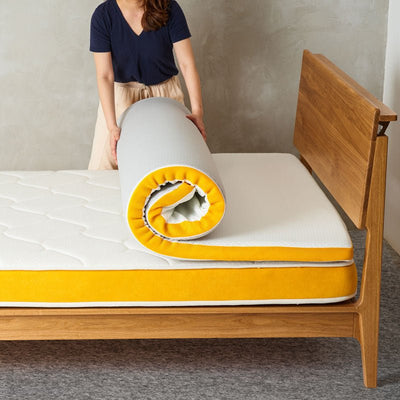
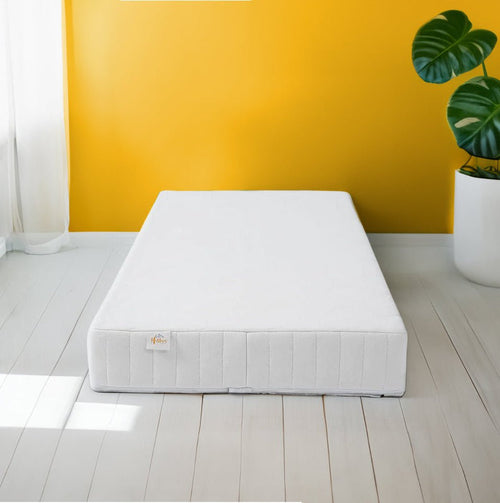
The Dual Mattress Topper™ from Hush Home is approximately 2.5 inches / 6 cm thick and uses two foam layers: cool-gel memory foam and high-density orthopedic foam. One side is medium firm and the other is firm, allowing the topper to be flipped according to preference.
The current product also has a removable washable cover, a vented gusset and adjustable elastic corner straps. Hush currently offers a 30-night Home Trial and 3-year HushCare Warranty for the topper, subject to the published terms.
The 3-year warranty should not be interpreted as a fixed three-year expiry date. As with any topper, replacement should depend on condition, performance and the applicable warranty terms.
Hush Home's current Care Guide recommends:
These instructions are specific to the Hush topper. Owners of other products should follow their own manufacturer's care guide.
Use this checklist:
False. Three to four years is a useful general benchmark for a quality topper, not a universal expiry date.
False. Latex is generally durable, but it can still soften, oxidise, tear or deteriorate with age and environmental exposure.
False. Thick, very soft toppers may develop deeper impressions. Material quality and firmness matter as much as thickness.
Not structurally. It can improve surface comfort temporarily, but it cannot restore a failed support core or erase a deep permanent dip underneath.
False. Foam can soften or develop impressions even when the cover looks almost new.
False. Warranty coverage and expected service life are different concepts.
Usually false. Many foam cores should not be machine washed or soaked. Follow the product-specific care guide.
A quality topper commonly lasts around three to four years, but one year to five years or longer is possible depending on material, density, body weight, use frequency and care.
Several years is common for a good-quality memory foam topper, with around three years often used as a practical average. Dense, resilient foam may last longer, while low-density soft foam may form impressions sooner.
Latex is generally one of the more durable topper materials. Five years or longer is possible for a high-quality, well-maintained latex topper, although there is no guaranteed universal lifespan.
Look for permanent body impressions, uneven softness, bottoming out, cracking or crumbling foam, persistent dampness or odour and a noticeable loss of the comfort or firmness adjustment the topper used to provide.
It can help distribute wear more evenly if the manufacturer recommends rotation. Follow the product's own instructions because not every topper is designed to be flipped or rotated in the same way.
You can temporarily change the surface feel, but a topper cannot structurally repair deep sagging. If the mattress has a failed support core or permanent depression, replacing the mattress is usually the more appropriate long-term solution.
Not automatically. Age is only a guideline. If the topper remains clean, structurally intact, even and comfortable, and the manufacturer has not identified a safety or condition issue, there is no universal rule requiring replacement on its fourth birthday.
Usually, yes, because it experiences fewer nights of loading. Storage conditions, humidity and cleaning still matter.
It is often useful because a protector can reduce sweat, spills and stains reaching the topper. Hush Home specifically recommends using a mattress protector over The Dual Mattress Topper™.
Usually not unless the manufacturer explicitly says otherwise. Many products have a removable washable cover, while the foam core itself should remain dry or be cleaned only as directed.
No. Warranty duration describes the period of eligible defect coverage under the manufacturer's terms. Product lifespan depends on wear, materials, use and care.
Most people do not need to replace a mattress topper on an exact date. A quality topper commonly lasts around three to four years, but its real lifespan can be much shorter or much longer.
The more reliable signals are permanent impressions, loss of pressure relief, uneven firmness, bottoming out, foam damage, persistent dampness and a clear decline in comfort. If the topper itself is worn but the mattress is still flat and supportive, replacing the topper may be enough. If the underlying mattress is structurally sagging, a new topper will only mask the problem temporarily.
Treat lifespan as a performance question, not just an age question: is the topper still doing the job you bought it to do?