
The Small Bedroom Design Guide: How to Fit a King Bed in an HK Apartment
25 Sep 2026
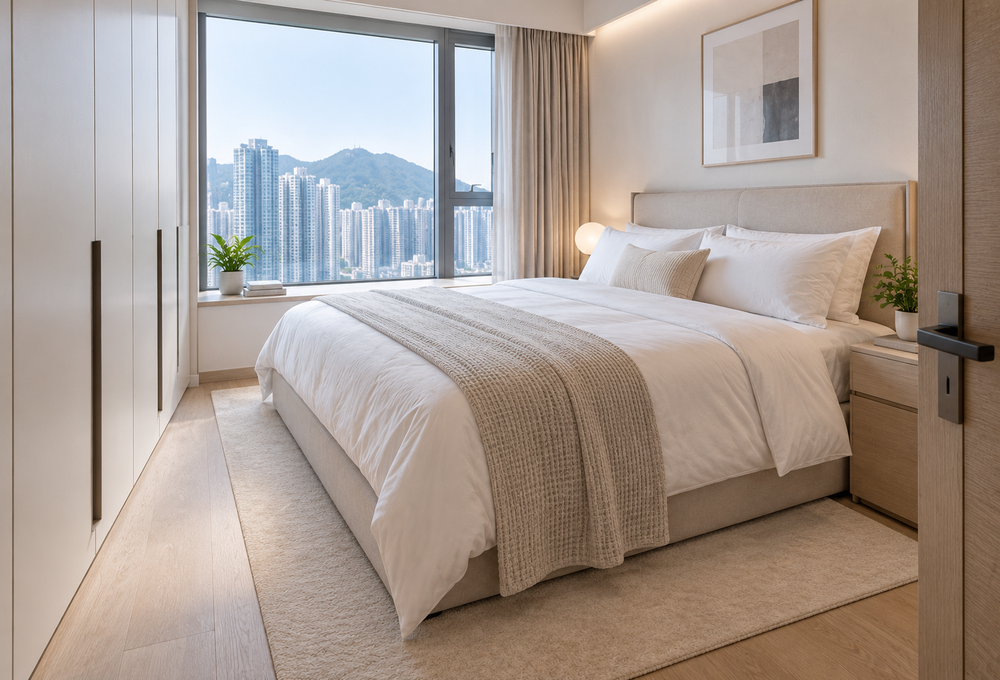
A King bed gives couples considerably more sleeping space, but in a Hong Kong apartment it can quickly become the largest object in the room. The challenge is not simply whether the mattress fits between two walls. The real question is whether the bedroom still works after the bed is installed.
A room may technically accommodate a King mattress while leaving wardrobe doors unable to open properly, creating an awkward route to the bathroom, blocking a window or making one sleeper climb over the other every night. That is why small-bedroom planning should begin with circulation and furniture use, not simply mattress dimensions.
QUICK ANSWER
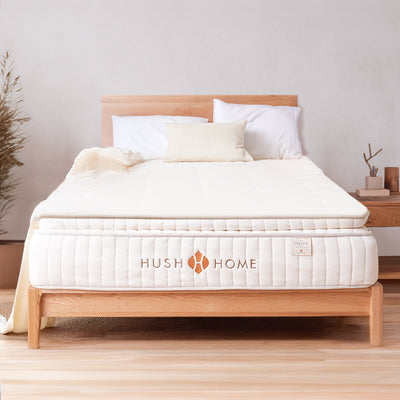
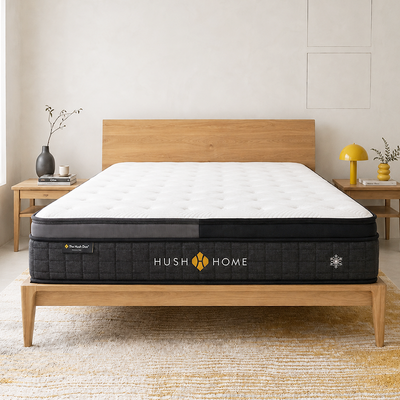
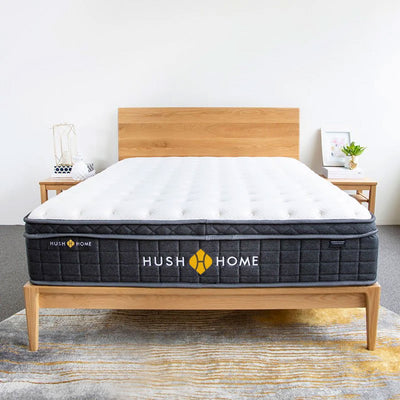
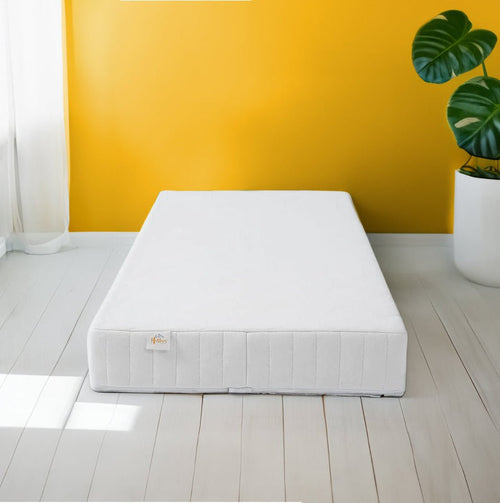
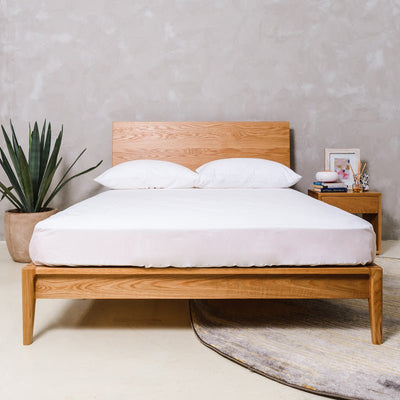
Yes, sometimes. A standard Hush Home King mattress measures 183 × 198 cm, but the finished bed frame is larger. Hush Home’s current bed-frame size guide lists a King Solid Wood Bed™ at approximately 184 × 206 cm and a King Hydraulic Storage Bed™ at approximately 185 × 212 cm. Those extra centimetres matter in a compact room.
A King works best when the room can still provide a practical route to the door and wardrobe, enough space to make the bed, access for both sleepers if required, and clearance for any furniture that opens or slides. If fitting the King removes all of those functions, the bed may physically fit but the layout is not truly successful.
The first mistake is to draw a 183 × 198 cm rectangle and assume that is all the space the bed needs. That is only the mattress footprint.
Bed frames add side rails, a headboard, upholstery, corner structure and sometimes a footboard. Even a streamlined frame can add several centimetres around the mattress. Upholstered and storage designs may add more length at the head or foot.
For planning purposes, always use the external dimensions of the exact bed frame you plan to buy. If you already own the frame, measure it yourself from the widest and longest fixed points.
| King Setup | Approx. Dimensions |
|---|---|
| Hush Home King mattress | 183 × 198 cm |
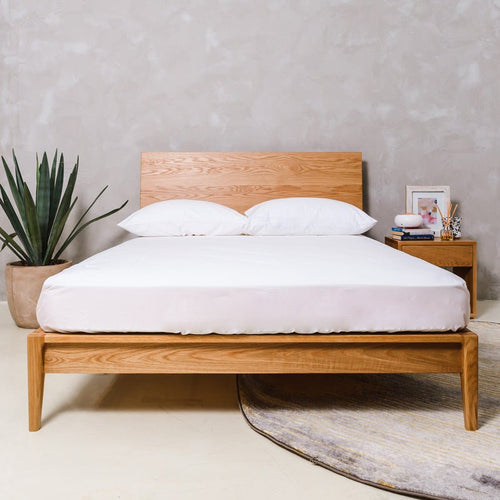
| King Solid Wood Bed™ | Approx. 184 × 206 cm |
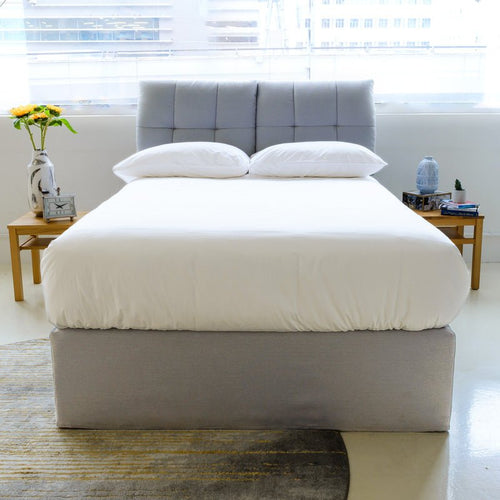
| King Hydraulic Storage Bed™ | Approx. 185 × 212 cm |
You can use Hush Home’s Hong Kong Bed Frame Size Guide as a starting point for comparing finished frame dimensions.
Do not record only the room’s maximum width and length. Compact Hong Kong bedrooms often contain recesses, columns, bay windows, built-in wardrobes, beams, skirting boards and irregular corners.
Measure the usable floor area wall by wall. Then mark the exact position and size of the bedroom door, wardrobe doors, windows, air-conditioning unit, electrical sockets and any fixed furniture.
The most useful method is to sketch the room from above on paper or in a simple floor-planning app. Use one consistent scale and draw the King bed as a separate rectangle that you can move around before buying anything.
A bedroom door may take up a surprising amount of usable floor area. If it opens inward, draw the full arc of the door on your plan.
The bed should not prevent the door from opening sufficiently for normal use. Even if the door can technically squeeze past the mattress, repeatedly brushing against bedding or forcing people to turn sideways is usually a sign that the layout is too tight.
If renovation is possible, a sliding or pocket-style internal door may save floor area because it removes the swing arc. However, whether this is practical depends on wall construction, fire-safety requirements and building rules, so it should be assessed properly rather than treated as a universal solution.
In many rooms, the most efficient King-bed layout places the headboard against the longest uninterrupted wall that does not contain the main door, a large wardrobe opening or essential window access.
This is not an absolute design rule. Some narrow rectangular rooms work better with the bed along the longer axis, while almost-square rooms may support several orientations. The goal is to minimise awkward corners and preserve one clear circulation route.
Do not place the bed simply where it looks most symmetrical if that blocks the wardrobe or forces the main walkway through a gap that is too narrow to use comfortably.
For two adults sharing a King bed, access from both sides is usually the most convenient arrangement. Each person can get in and out independently, make the bed more easily and reach a bedside light or phone without disturbing the other.
But in an extremely compact room, pushing one side of the bed against a wall can make the difference between fitting a King and not fitting one. This is a lifestyle trade-off, not automatically a design failure.
Ask practical questions: Do both sleepers get up at different times? Does one person have reduced mobility? Will making the fitted sheet become frustrating? Is one-sided access acceptable for several years, not just on move-in day?
A King that only works by permanently trapping one sleeper against the wall may be less practical than a Queen with comfortable access on both sides.
You do not need a huge hotel-style gap around every side of the bed, but a compact room should still have one dependable route from the door to the main storage area and sleeping position.
Around 60 cm is often used as a practical furniture-planning target for a main walkway, but it is a rule of thumb rather than a Hong Kong legal minimum. Many compact bedrooms use less, while people who need easier movement may prefer more.
The important test is whether you can walk naturally, open nearby furniture and change the bedding without repeatedly hitting walls or corners.
A built-in wardrobe can make a King layout fail even when the bed itself fits perfectly.
Hinged wardrobe doors need swing clearance in front. Drawers need pull-out depth plus enough room for a person to stand. Sliding wardrobe doors use less floor area while opening, but you still need space to stand in front and access the contents.
If a bed leaves a 40 cm gap in front of a deep drawer unit, the drawer may technically open partway but still be frustrating to use. Test the furniture in its open position, not just closed.
In a small Hong Kong bedroom, under-bed storage can replace an entire chest of drawers or reduce the need for another cabinet.
There are two common approaches. A raised bed with open clearance underneath allows boxes or luggage to slide in from the sides. A hydraulic storage bed lifts the sleeping platform to reveal a large enclosed compartment.
Hydraulic storage is particularly useful when side clearance is limited because it does not depend on long drawers pulling out into the walkway. You still need enough room above and around the bed to operate the mechanism safely.
Hush Home’s current Hydraulic Storage Bed™ has 30 cm-deep under-bed storage and is specifically designed for compact living spaces. For a small bedroom, the useful comparison is not simply “storage bed versus normal bed”, but whether the extra built-in storage lets you remove another piece of furniture from the room.
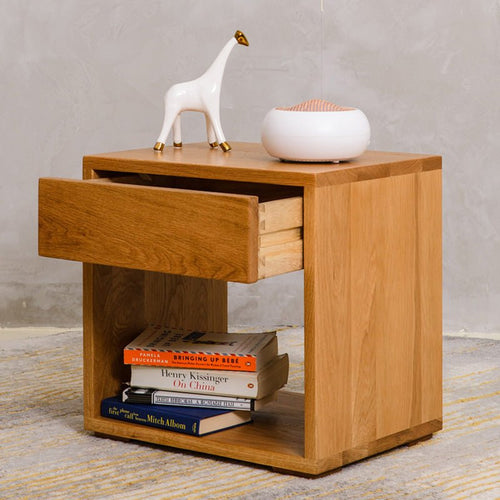
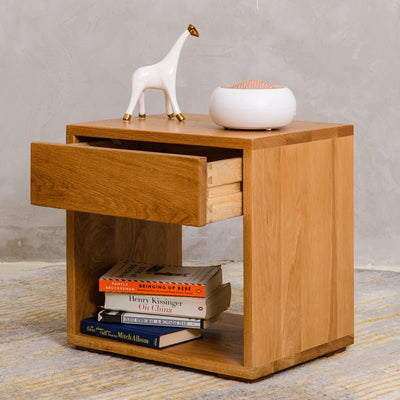
Two traditional bedside tables can consume more width than expected. If each table is 40–50 cm wide, the pair may require almost another metre of wall space around the bed.
In a tight room, consider narrow bedside shelves, wall-mounted ledges, a slim stool, a headboard with integrated storage or a small table on only one side.
Wall-mounted reading lights can also remove the need for large table lamps and free the limited bedside surface for a phone, glasses or water.
When a King already occupies most of the floor, the remaining storage should make better use of wall height.
Full-height wardrobes, shelves above a desk, wall hooks and carefully designed overhead cabinets can provide storage without taking another large rectangle of floor space.
Do not overcrowd the wall immediately above the sleeper with poorly secured heavy objects. Any wall-mounted furniture should be properly fixed for the wall type and installed safely.
Physical dimensions determine whether a bed fits, but visual bulk determines how crowded the room feels.
A streamlined frame with exposed floor underneath often feels lighter because more flooring remains visible. Slim legs, a relatively thin headboard and simple lines can help the room feel less dominated by the bed.
Hush Home’s Solid Wood Bed™ uses a relatively streamlined platform design and has approximately 7 inches of clearance underneath, creating some usable storage while keeping the floor visually more open.
Light colours do not physically increase floor area, but they can reduce visual heaviness. Bedding, curtains and large wall surfaces in a relatively consistent palette can make a compact room feel calmer and less fragmented.
Mirrors can increase the sense of depth by reflecting light and views, but they should be positioned and secured carefully. A mirror works best as part of the room layout, not as a substitute for actual circulation space.
Curtains mounted higher and extending beyond the window width can make the opening feel larger, while keeping bulky furniture away from the window helps preserve daylight.
A bed may look perfect on a floor plan but create problems vertically.
Check whether the headboard blocks a window, whether a curtain can still move freely, whether an air-conditioning outlet blows directly into the sleeper’s face, and whether technicians can still access the air-conditioning unit for cleaning or repair.
Also avoid permanently blocking a window that is needed for ventilation, maintenance or emergency access. The correct placement depends on the specific flat and building design.
One of the cheapest and most reliable planning methods is painter’s tape.
Mark the external dimensions of the proposed bed frame directly on the bedroom floor. Then live with that outline for a day or two. Open the wardrobe, walk through the room, sit where the bedside table would go and imagine changing the fitted sheet.
This often reveals problems that are invisible on a screen. A gap may look acceptable in a drawing but feel cramped when you actually walk through it.
At Hush Home, a standard Queen mattress is 152 × 190 cm while a standard King is 183 × 198 cm. Moving from King to Queen therefore saves 31 cm of width and 8 cm of length at mattress level.
| Mattress Size | 尺寸 | Difference vs Queen |
|---|---|---|
| 女王双人床 | 152 × 190 cm | — |
| 国王双人床 | 183 × 198 cm | +31 cm width, +8 cm length |
Thirty-one centimetres can be a major difference in a small bedroom. It may be enough to restore two-sided access, allow a wardrobe to open fully or create space for a narrow bedside table.
Do not choose King simply because it is considered more premium. Choose the largest bed that still leaves the room functioning the way you need it to.
See Hush Home’s Hong Kong Mattress Size Guide for the full size comparison.
Hong Kong bedrooms sometimes have unusual dimensions where a standard size wastes a narrow strip of usable space or clashes with built-in furniture.
Hush Home currently offers custom mattress widths and lengths for selected mattress models. A custom size can sometimes provide more sleeping area than a standard Queen while remaining smaller than a full King.
Custom mattresses involve different lead times, return conditions and pricing, so they should be considered only after the room has been measured accurately.
See Custom Mattresses Hong Kong for current options and terms.
Some couples consider separate mattresses because one person prefers a softer feel while the other prefers something firmer. In a compact Hong Kong bedroom, two separate sleeping setups can use more floor area or create an awkward centre gap.
The Hush Duo Mattress™ is one example of a single seamless mattress designed with independently adjustable comfort zones for two sleepers. In King size, it can provide different firmness choices on each side without requiring two separate bed frames.
This does not make a King automatically suitable for a small room—the footprint still has to work—but it can solve the firmness problem without creating another space problem.
Suppose a bedroom measures 250 cm wide × 300 cm long with no recesses. A King mattress at 183 × 198 cm would leave 67 cm of total width and 102 cm of total length before accounting for the bed frame.
If the mattress were perfectly centred, that is only 33.5 cm on each side. Once a King bed frame is added, each side could become even tighter. The room may therefore physically fit the King but offer poor two-sided access.
A better solution could be to push the bed closer to one wall and preserve one wider walkway, remove one bedside table, use hydraulic storage instead of another cabinet, or step down to a Queen if two-sided access is important.
The bed frame is larger than the mattress, and the difference matters most when every centimetre counts.
Symmetry can look good, but in a small room it may create two narrow unusable gaps instead of one comfortable walkway.
Wardrobe doors, drawers and the bedroom door all need operating space.
The bedside tables may consume the exact width you need for circulation.
The value of integrated storage is greatest when it allows another piece of floor furniture to disappear.
A King can fit the bedroom but still fail at the lift, corridor or apartment entrance.
The goal is not to win a measurement contest. The goal is to make the bedroom comfortable to sleep in and convenient to live in.
There is no universal minimum room size. A King mattress may be 183 × 198 cm, but room usability depends on the bed-frame footprint, door and wardrobe positions, whether one- or two-sided access is acceptable and how much other furniture you need. Measure the actual room and plan the complete layout instead of relying on one square-metre rule.
Around 60 cm is a useful rule-of-thumb for a comfortable main walkway, but it is not a universal requirement. Compact Hong Kong rooms often use asymmetric layouts with one wider path and narrower clearance elsewhere. If mobility is important, allow more. The real test is whether you can walk, open furniture and make the bed comfortably.
Yes. This is common in very compact rooms and can preserve a useful walkway on the other side. The trade-off is that one sleeper may need to climb across the bed, changing sheets becomes harder and wall-side ventilation may be reduced. Consider whether that compromise works for both sleepers long term.
It can be, especially if the built-in storage allows you to remove a separate dresser or cabinet. Hydraulic storage can be particularly useful where side space is tight because it does not require long drawers to pull into the walkway. However, compare the bed’s external dimensions and make sure the lift mechanism has sufficient clearance.
Not necessarily. Hong Kong apartments and bedrooms vary widely, and many master bedrooms can accommodate a King when the layout is planned carefully. Others are better suited to Queen, Full or a custom size. Do not decide from flat size alone; the bedroom’s actual internal geometry matters more.
Choose King if the extra 31 cm of mattress width materially improves sleep and the room still retains the functions you need. Choose Queen if moving down a size restores comfortable circulation, wardrobe access or two-sided bed access. A better-functioning Queen bedroom is often preferable to an overcrowded King bedroom.
It depends on the design. A streamlined frame may add only a few centimetres around the mattress, while a thick upholstered headboard or footboard can add considerably more length. Always check external frame dimensions. At Hush Home, the current King bed frames are larger than the 183 × 198 cm King mattress footprint.
Hush Home currently offers custom widths and lengths on selected mattress models. That can be useful when a room has enough space for more than a Queen but not enough for a standard King. Custom-order lead times and return conditions differ from standard products, so confirm the current terms before ordering.
Confirm the mattress size, external bed-frame dimensions, room measurements, door and wardrobe clearances, intended bedside furniture and delivery route. If possible, mark the frame footprint on the floor before ordering. For large mattresses, also measure the lift and corridor access.
A King bed can absolutely work in a small Hong Kong bedroom—but “fits” should mean more than the mattress clearing the walls.
Start with the exact external bed-frame dimensions. Draw the room accurately. Preserve one useful walkway, test wardrobes and doors in their open positions, reduce unnecessary bedside furniture and use the bed itself for storage where appropriate. If the King only works by making every other part of the bedroom inconvenient, step down to Queen or consider a custom size.
For Hush Home shoppers, the practical options include the compact-profile Solid Wood Bed™, the storage-focused Hydraulic Storage Bed™, standard King mattresses at 183 × 198 cm, selected custom mattress sizes, and the Hush Duo Mattress™ for couples who want different firmness preferences within one seamless bed.