




What Is Mattress Tufting? Hand-Tufted vs Quilted Mattresses Explained
09 Oct 2026
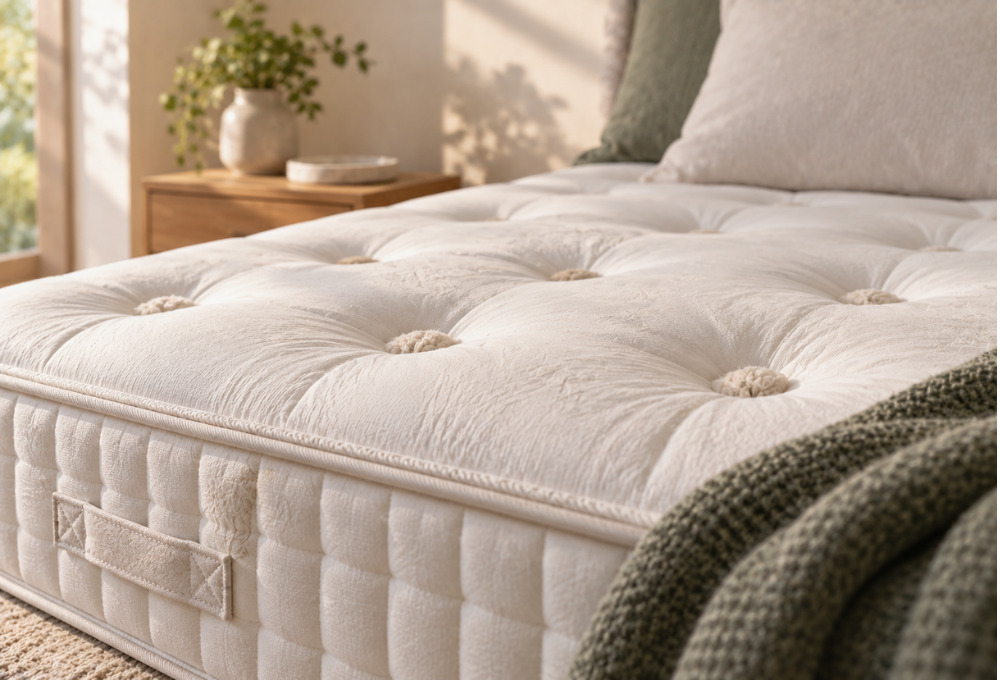
If you have ever seen a mattress covered in evenly spaced dimples, wool rosettes or button-like fastenings, you may have been looking at a tufted mattress. Those depressions are not necessarily decorative. In traditionally constructed mattresses, they can be part of the system that physically holds the upholstery together.
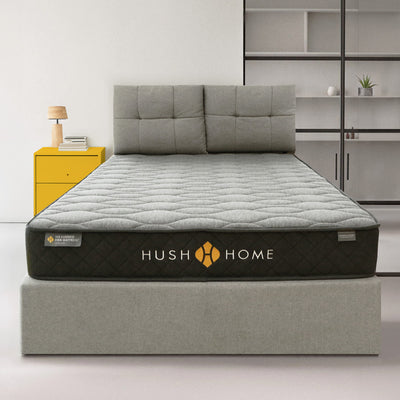
Quilted mattresses can look very different. Instead of deep anchor points, the top panel may have stitched diamonds, waves, squares or other patterns. These stitches usually join the cover to padding close to the surface rather than fastening the entire mattress depth.
The important point is that tufting and quilting are not simply two decorative finishes. They solve different construction problems.
Quick Answer: What Does Mattress Tufting Do?
Mattress tufting compresses and anchors layers of upholstery so they are held together more securely. In a traditional hand-tufted mattress, a cord, tape or similar fastening passes through multiple layers and is secured at the surface with a tuft, rosette, washer or button-like piece.
That mechanical anchoring can be especially useful in mattresses containing generous amounts of loose or springy upholstery such as wool, cotton, horsehair or other natural fibres. Hypnos, for example, describes hand tufting as a way to keep fillings in their correct position and reduce movement or lumping. Vispring similarly says its hand-placed tufts secure natural fillings.
Tufting is therefore best understood as part of the mattress construction—not as a firmness rating, medical feature or guarantee of quality by itself.
The exact process varies by manufacturer, but traditional tufting usually involves several steps.
A thick upholstered mattress is compressed so the layers can be fastened at a controlled depth and tension. Compression equipment may be used even when the final tuft placement or tensioning is performed by hand.
Traditional through-tufting can run through a large proportion of the mattress depth. In some classic double-sided sprung mattresses, the fastening passes from one face through the upholstery and spring unit to the opposite face. Other constructions may anchor a substantial upholstery package without following exactly the same full-depth method.
The visible tuft may be a wool rosette, felt washer, decorative button or another fastening chosen by the manufacturer. Its job is to stop the tensioned cord or tape from pulling back through the mattress.
When compression is released, the upholstery expands around the anchor points. This creates the familiar series of depressions and raised sections on a tufted mattress surface.
Hand-tufted generally means that a person performs important parts of the tuft placement, fastening or tensioning process rather than the entire operation being completed automatically. It does not necessarily mean the mattress is compressed, assembled and tufted without any machinery at all.
That distinction matters because “handmade” language can otherwise become vague marketing. If craftsmanship matters to you, ask what is actually performed by hand: Are the tufts individually placed? Is their tension adjusted by a craftsperson? Does the tuft pass through the full upholstery build? What material is used for the fastening?
Both methods can physically anchor mattress layers. The main differences are usually production process, consistency, adjustability of tension, labour and cost rather than a simple “good versus bad” divide.
A skilled hand-tufting process can allow individual placement and tensioning around a thick natural upholstery build. Automated or semi-automated tufting can provide highly repeatable positioning in high-volume production. The quality of the mattress still depends on the materials, spring or support system, upholstery specification, stitching and overall construction.
Quilting stitches the mattress cover to cushioning material immediately beneath it. Sleep Foundation describes mattress covers that have foam or cushioning fibres quilted into the top to create a plusher surface feel.
Instead of isolated deep anchor points, quilting normally creates a network of stitches across the top panel. Depending on the design, those stitches can form diamonds, channels, waves, squares or other patterns.
Quilting can stabilise surface padding, distribute it evenly and change the first feel of the mattress. But it generally does not perform the same deep anchoring role as traditional through-tufting.
| 特色 | Tufting | Quilting |
|---|---|---|
| Construction | mechanically anchors deeper upholstery layers under tension. | stitches the outer cover to padding close to the sleep surface. |
| Surface | usually has visible depressions, rosettes or button-like anchor points. | usually looks smoother, with repeated stitched patterns rather than deep isolated anchors. |
| Common Use | substantial upholstery packages, especially traditional sprung mattresses with natural fibres. | mattress covers, foam or fibre surface padding, Euro-tops, pillow-tops and designs where a smooth or removable construction is preferred. |
Natural fibres and other loose upholstery can move, settle and compress as a mattress is used. Tufting creates anchor points that help keep those layers aligned with the structure intended by the maker.
This does not mean tufting eliminates all settlement. Wool, cotton and other compressible materials can still settle with use. Tufting helps control that movement; it does not make the materials physically incapable of compressing.
A generously upholstered mattress can be very deep before compression. Tufting helps hold the upholstery in a compressed state and gives the finished mattress a more controlled profile.
The tension around each tuft creates a contoured surface rather than a perfectly flat one. For some sleepers this feels traditional and substantial; others prefer the smoother first contact of a quilted or stretch-knit cover.
The purpose is not to make a mattress completely motionless internally. Mattresses still flex and compress as you move. Tufting is intended to reduce unwanted migration of upholstery relative to the mattress structure.
Quilting makes sense when the manufacturer mainly needs to secure surface cushioning rather than a thick package of loose upholstery. It is common with foam comfort layers, synthetic fibre batting and mattress tops designed to feel smooth and uniform.
It can also be more suitable for mattresses that need removable covers, zips or internal access. A modular mattress cannot have permanent full-depth tufts running through components that the customer is expected to remove and rearrange.
This is one reason “quilted” should not be used as shorthand for “cheap.” It is a construction choice that can be completely appropriate for the mattress being built.
No—not as a universal rule.
Hand tufting can be particularly valuable when a mattress contains deep layers of natural upholstery that need to be compressed and mechanically anchored. Quilting may be the more logical solution when the mattress uses stable foam layers, a smooth comfort panel, a removable cover or modular internal components.
You should therefore compare the whole mattress rather than score it by one finishing technique. Important questions include what materials sit inside, how the support core works, how the layers are secured, whether the construction matches the intended design and whether the final feel suits you.
Tufting can change surface tension and compress upholstery around each anchor point, so it can influence the first feel of the mattress. But tufting does not determine the mattress's overall firmness by itself.
Spring tension, foam firmness, latex characteristics, upholstery quantity, layer thickness, zoning and the sleeper's body weight can all have a much larger influence on perceived firmness.
A tufted mattress can therefore be plush, medium or firm. A quilted mattress can also be plush, medium or firm.
Sometimes, but not necessarily. Tufted mattresses intentionally have depressions and tension points. How noticeable they feel depends on tuft material, tuft depth, upholstery thickness, the mattress protector and sheets, your sleeping position and personal sensitivity.
A visible tuft is not automatically a defect. In a properly made tufted mattress, a repeating pattern of depressions is part of the design.
Tufting creates intentional, repeated depressions in a planned pattern. Sagging or body impressions are different: they develop through use and are usually concentrated where weight is repeatedly applied.
This distinction matters when inspecting a mattress. Do not measure a deliberate tuft depression as though it were an unexpected sag. Check warranty instructions for how the manufacturer defines and measures impressions.
No. Some visible buttons or depressions are decorative, shallow or part of a stitched surface treatment. A mattress can imitate the look of traditional tufting without using full or deep mechanical through-tufting.
If the distinction matters to you, ask the manufacturer whether the tufts physically anchor the upholstery and how far through the mattress the fastening runs.
No. Tufting describes how layers are anchored. Pillow-top and Euro-top describe the shape and attachment of an additional cushioning section at the top of the mattress.
A pillow-top or Euro-top can itself be quilted, tufted or constructed in another way. These terms describe different aspects of mattress design and should not be treated as interchangeable.
One loose or broken tuft does not automatically mean the mattress has completely failed, because surrounding tufts may still be holding the upholstery. But it is worth contacting the manufacturer, especially if the mattress is under warranty or if several tufts loosen, the surface begins to shift or the filling becomes uneven.
Avoid cutting off a loose tuft or trying to pull and retie it yourself unless the manufacturer specifically instructs you to do so. The visible fastening may be connected to tension running deep through the mattress.
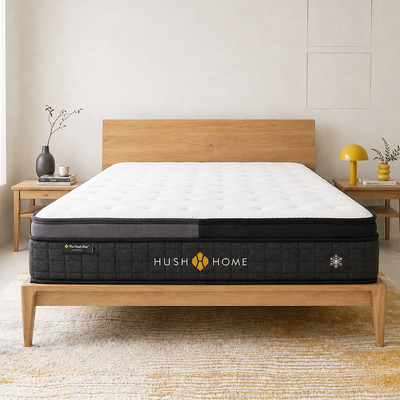
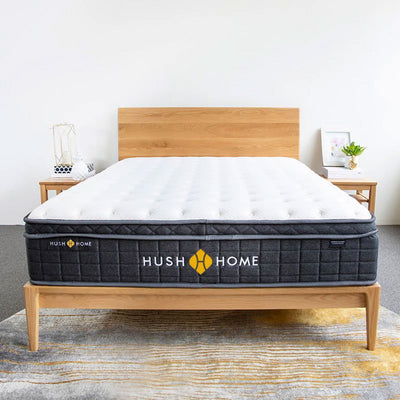
Hush Home's current mattress range provides a useful example of why neither construction method should be treated as universally superior.
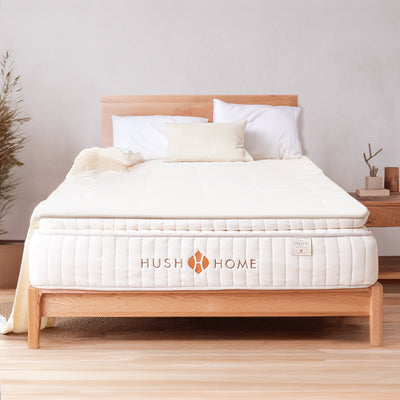
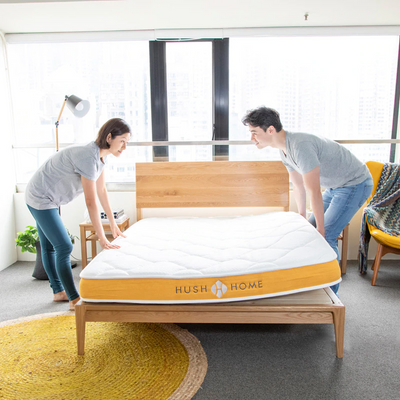
The current Hush Mattress™ product page identifies hand tufting as one of the mattress's construction features. The mattress combines foam comfort layers with pocket coils, and the tufted finish helps form its characteristic surface and hold the upholstered build together.

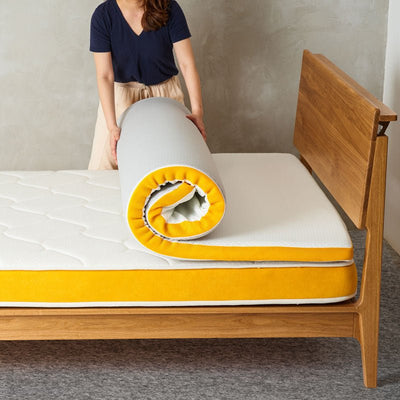
The current Organic Mattress™ page states that each mattress is hand-tufted in small batches. Its construction uses natural latex, organic cotton, bamboo fibre, coconut fibre, mini-coils and a pocket-coil support system. In a mattress with substantial natural-material upholstery, mechanical tufting is a logical way to help keep the build compressed and aligned.

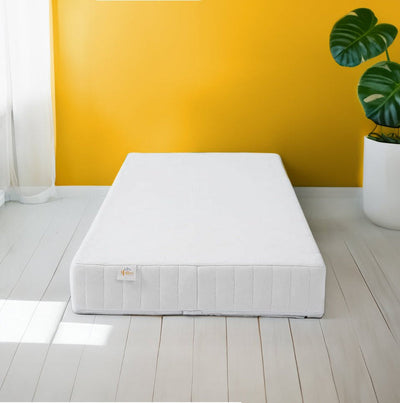
Hush Duo demonstrates the opposite design need. Its current Hong Kong product page describes an Ice Silk surface with an open-cell foam quilted layer, while the internal Comfort and Support Inserts are removable and rearrangeable through a zippered cover.
Permanent full-depth tufting through those removable inserts would defeat the purpose of the modular system. In this case, quilting and a removable cover suit the design better. That does not make Hush Duo a lower-quality construction; it means the mattress solves a different engineering problem.

Instead of asking which finish is better, ask whether the construction makes sense for the mattress materials and design.
A tufted mattress may be especially relevant if you want a traditional upholstered feel, substantial natural-fibre layers, visible craftsmanship and a deeply anchored construction.
A quilted mattress may appeal if you prefer a smoother surface, foam-based comfort layers, a removable cover, modular internal components or a design that does not need deep upholstery anchoring.
Whichever construction you prefer, judge the complete mattress: firmness, pressure relief, support, motion isolation, edge stability and temperature comfort all matter more than the surface technique alone.
False. Some premium mattresses use tufting because it suits thick natural upholstery. Others use quilted or smooth covers because foam, latex, removable covers or modular components require a different construction.
False. Quilting describes how the surface cover and padding are stitched together. It does not tell you the quality of the foam, springs, fabric, stitching or overall mattress.
Not necessarily. Tuft spacing and tension must suit the upholstery design. Counting visible tufts without knowing what they anchor or how the mattress is built tells you very little by itself.
False. Tufting can influence surface tension, but overall firmness depends on the entire construction—including springs, foams, latex, upholstery thickness and zoning.
False. Some are decorative or shallow surface treatments. Ask how the fastening is constructed if genuine through-tufting is important to you.
Its main purpose is to compress and mechanically anchor upholstery layers so they stay better aligned and are less free to shift. It is particularly useful in traditionally upholstered mattresses containing substantial natural fibres.
Not automatically. Hand tufting can allow skilled individual placement and tensioning, while automated processes can deliver consistent repeatability. Judge the result together with the mattress materials and overall construction.
No. The need for tufting depends more on the upholstery construction than on the mere presence of pocket coils. A pocket-spring mattress with thick loose natural fibres may benefit from tufting, while a foam-heavy hybrid with securely bonded or enclosed layers may use quilting instead.
Tufting can help control upholstery movement and settlement, which can support structural consistency in mattresses designed around that method. But there is no universal lifespan multiplier for all tufted mattresses. Material quality, spring durability, foam breakdown, stitching, loading, care and usage all matter.
Usually yes, provided the mattress and topper are compatible and the topper remains stable. A topper can make the tuft depressions less noticeable, but it also changes the surface feel and does not repair a mattress with genuine structural sagging.
The depressions can collect dust or debris more readily than a perfectly smooth panel, so careful vacuuming around tuft points may help if the manufacturer's care instructions permit it. Do not pull, cut or saturate the tufts during cleaning.
No. Quilting usually stitches the cover to surface cushioning. Tufting creates deeper anchor points that mechanically compress and secure upholstery. They can both help stabilise materials, but they work at different depths and create different surfaces.
Mattress tufting is more than the row of buttons or dimples you see on the surface. In traditional construction, it is a mechanical system for compressing and anchoring upholstery so the layers remain better aligned as the mattress is used.
Quilting works closer to the surface, stitching the cover to cushioning material to create a stable, padded top panel. It is not an inferior imitation of tufting; it is a different construction method suited to different mattress designs.
When comparing mattresses, the most useful question is not “Does it have tufts?” but “Why did the manufacturer choose this construction, what exactly is being held together, and does the finished mattress feel right for me?”