
What Is Sleep Efficiency? How Is It Calculated and What Is a Good Percentage?
13 Oct 2026
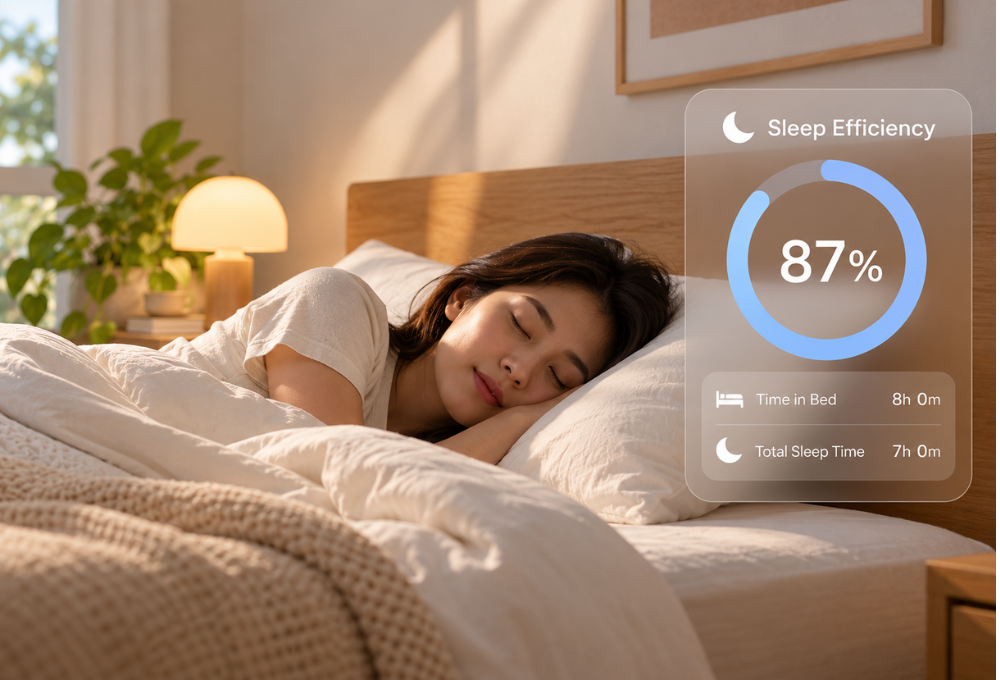
Sleep efficiency is the percentage of a sleep period that you actually spend asleep. The standard calculation is total sleep time divided by time in bed, multiplied by 100. For example, if you spend eight hours in bed and sleep for seven hours, your sleep efficiency is 87.5%.
Around 85% or higher is a widely used reference point for reasonably consolidated adult sleep; 90% or higher usually indicates relatively little recorded wakefulness. Neither figure is a universal medical pass mark. A high percentage does not prove that you slept long enough, reached a particular sleep stage or woke feeling refreshed.
Sleep efficiency describes sleep continuity and the proportion of a sleep opportunity spent asleep. It does not directly measure how restorative your sleep feels. Two people can report exactly the same percentage yet differ greatly in their total sleep time, sleep stages and daytime alertness.
Sleep experts consider sleep efficiency alongside other measures, particularly how long it takes to fall asleep, how often you wake, how long you remain awake after initially falling asleep and whether you feel rested. The National Sleep Foundation treats these as complementary indicators—not four names for the same thing.
Total sleep time is the amount of time you were actually asleep during the sleep period. It excludes minutes spent trying to fall asleep and minutes awake during the night. Seven hours of sleep means 420 minutes of estimated sleep, not simply seven hours between bedtime and morning.
In the conventional formula, time in bed is the period used as the denominator, often measured from getting into bed for the night until getting out of bed in the morning. However, researchers and sleep clinics do not always define that period identically. Some approaches focus more specifically on the window in which you are attempting to sleep.
This matters if you read, scroll on your phone or chat in bed for a long time before trying to sleep. Those activities may be included in a literal time-in-bed measure but not in a sleep-opportunity-focused measure. When comparing nights, use the same definition rather than mixing methods.
The most commonly used formula is:
Sleep Efficiency (%) = Total Sleep Time ÷ Time in Bed × 100
Convert both measurements into the same unit—usually minutes—before dividing. Do not divide hours by minutes. The total sleep time must be equal to or less than the corresponding sleep window when the same definitions are used.
Time in bed = 8 hours = 480 minutes. Total sleep time = 7 hours = 420 minutes. Sleep efficiency = 420 ÷ 480 × 100 = 87.5%. You spent 60 minutes of the eight-hour period awake, whether before falling asleep, during the night or after the last awakening.
Time in bed = 480 minutes. Total sleep time = 6 hours 30 minutes = 390 minutes. Sleep efficiency = 390 ÷ 480 × 100 = 81.25%, or about 81.3%. This is below the commonly used 85% reference point, although a single night does not establish an ongoing sleep problem.
The waking time within a sleep period can come from three places: sleep onset latency (the time spent trying to fall asleep), wake after sleep onset or WASO (wakefulness after first falling asleep), and time awake after your final morning awakening before ending the sleep window. Sleep diaries sometimes capture these separately, making the total easier to understand.
For example, imagine 15 minutes to fall asleep, 35 minutes awake across nighttime awakenings and 10 minutes awake before getting up. These add up to 60 minutes of wakefulness. Within an eight-hour sleep window, that leaves seven hours asleep and an estimated 87.5% sleep efficiency.
For general adult education, 85% is a useful benchmark, rather than a rule everyone must satisfy every night. Clinical insomnia programmes also use ranges around 85–90% to guide treatment decisions, but those are context-specific treatment thresholds—not a personal health diagnosis from a single smartwatch reading.
Below 85% — This is below a common benchmark and may reflect longer sleep-onset time, repeated awakenings, an extended awake period in bed or differences in tracking methods. Look at several nights and how you feel rather than treating it as an automatic failure.
Around 85–90% — Often consistent with reasonably consolidated sleep for many adults. You may still have short awakenings; that is not, by itself, unusual. Check total hours slept and whether you feel rested.
Above 90% — Usually indicates that most of the recorded sleep window was spent asleep. It is not automatically superior if you achieved that percentage by allowing yourself too little time to sleep or if a device missed awake periods.
There is no single ideal percentage that overrides age, health, sleep need, medications, shift schedules and measurement method. Trends across several comparable nights are generally more informative than comparing one reading with someone else's.
Yes. Imagine someone who spends five and a half hours in bed and sleeps for five hours. Their sleep efficiency is about 90.9%—yet many adults would still be getting less sleep than generally recommended. For healthy adults, the American Academy of Sleep Medicine and Sleep Research Society recommend seven or more hours of sleep per night on a regular basis.
A high score also cannot tell you whether you snored, experienced breathing-related sleep disruption, felt unrefreshed or had enough restorative sleep. Sleep efficiency answers one narrow question: how much of the recorded interval was spent asleep.
Sleep duration counts the number of hours and minutes spent asleep. Sleep efficiency expresses that sleeping time as a percentage of the measured interval. To interpret sleep health sensibly, you need both the quantity and the proportion.
Sleep latency is the time between trying to sleep and actually falling asleep. A longer sleep latency can reduce efficiency, but efficiency may also be reduced by waking later in the night or remaining awake early in the morning.
Deep sleep and rapid eye movement (REM) sleep refer to stages within sleep. Efficiency does not reveal how much time you spent in those stages. Someone can have high efficiency without knowing their actual sleep-stage breakdown, especially when the numbers come from a consumer device.
Sleep quality is broader: it includes how easily you fall asleep, interruptions, restfulness and daytime functioning. A device's combined “sleep score” may mix several proprietary factors, and two brands may calculate it differently. Do not treat an app's overall score as if it were the sleep-efficiency formula.
For a more useful picture, keep a diary for one to two weeks rather than judging one unusual night. Each morning, record your approximate bedtime or sleep-attempt time, estimated time to fall asleep, waking periods during the night, final wake-up time, time out of bed and how rested you feel. Rough estimates are acceptable; you do not have to watch the clock throughout the night.
Calculate each night's total sleep time and sleep window in minutes. For a combined period, a practical overall rate is: total minutes asleep across the nights ÷ total sleep-window minutes across those nights × 100. This keeps longer and shorter nights in their proper proportion.
A simple diary can also show which part of sleep is most troublesome: taking a long time to fall asleep, repeated nighttime waking or waking earlier than intended. That information is often more actionable than the headline percentage alone.
Consumer devices estimate sleep from signals such as movement and heart rate rather than routinely measuring brain activity as laboratory polysomnography does. That means they can misclassify quiet wakefulness as sleep, miss brief awakenings or estimate the total sleep time differently from a clinical test.
A systematic review and meta-analysis of wearable studies found that estimates of total sleep time, sleep efficiency and wakefulness can differ from polysomnography and vary between devices. Use the same device and settings to look for broad trends, and do not use the percentage alone to diagnose insomnia or sleep apnoea.
Going to bed before you feel sleepy, late caffeine, worry, bright screens or an inconsistent routine may leave you awake at the start of the night. This lengthens sleep onset latency and reduces the proportion of the sleep window spent asleep.
Noise, uncomfortable room temperature, physical discomfort, a partner's movement, alcohol near bedtime or certain health conditions may interrupt sleep. Note whether you wake briefly and fall asleep again or stay awake for long stretches; those patterns can affect efficiency differently.
If you stay in bed for an extended period after your final awakening or regularly spend a long time in bed without sleeping, the conventional time-in-bed calculation can produce a lower percentage. That does not mean you should immediately reduce sleep opportunity just to make the number look better.
Choose a realistic schedule you can follow most days and leave enough opportunity for the sleep duration you need. Regularity can help support a stable sleep-wake rhythm, but do not force an earlier bedtime when you are not sleepy simply to fit a calculation.
Create a repeatable transition away from work, bright screens and stimulating activities. Quiet reading away from the bed, gentle relaxation or a calming routine can help you notice when you are ready to try sleeping.
Caffeine and nicotine are stimulants that can interfere with sleep. Alcohol may make you feel drowsy initially but can contribute to lighter or more disrupted sleep later in the night. If you regularly wake at night, your evening habits are worth reviewing.
In Hong Kong, traffic noise, light and warm or humid nights may make a calm bedroom especially valuable. Consider suitable curtains, temperature control, breathable bedding and ways to limit disruptive sound. Aim for a comfortable environment rather than assuming one exact temperature suits everyone.
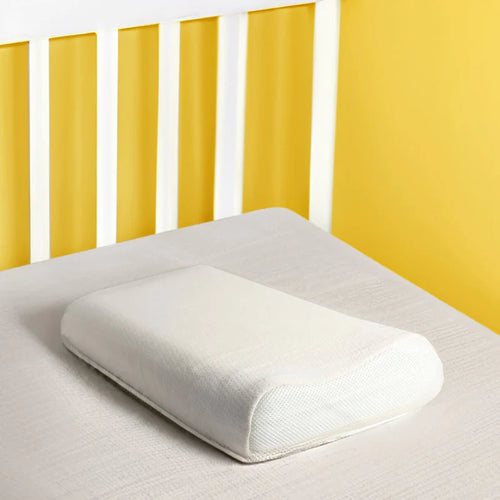
If you repeatedly wake because your pillow feels too high, the mattress creates pressure points or bedding becomes uncomfortable, those are practical issues to investigate. Adjusting support, pillow height or bedding may improve comfort, but no mattress or pillow can promise a specific sleep-efficiency percentage or treat an underlying sleep disorder.
If trouble falling asleep, frequent awakenings, loud snoring, breathing pauses or daytime sleepiness persist, speak with a healthcare professional. Cognitive behavioural therapy for insomnia (CBT-I) is an evidence-based first-line treatment for chronic insomnia; structured sleep-restriction methods are not something to copy from a percentage chart without appropriate guidance.
Good sleep starts with habits and an environment that suit you. If your sleep diary shows repeated awakenings connected with discomfort rather than an unexplained medical symptom, it may be useful to review mattress support, pillow height, bedding breathability and bedroom temperature before assuming the solution is simply a more expensive product.
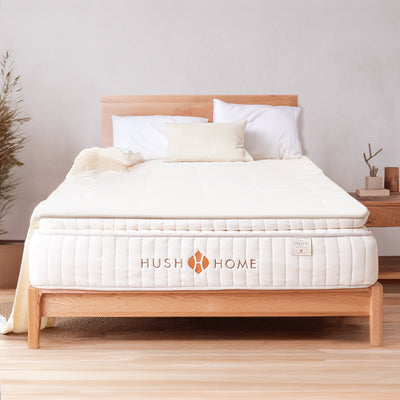
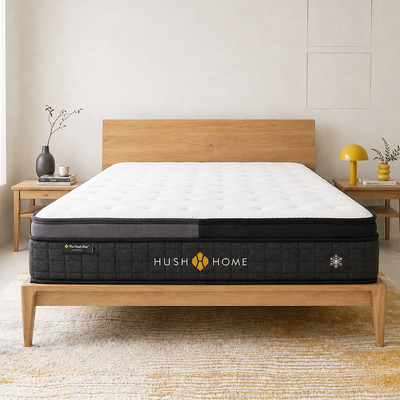
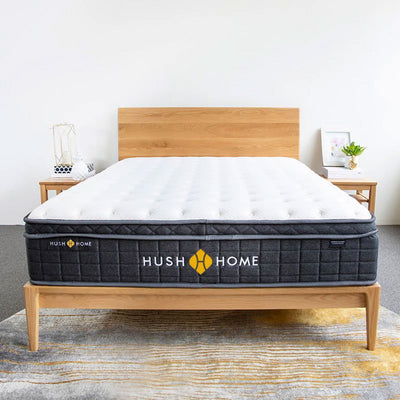
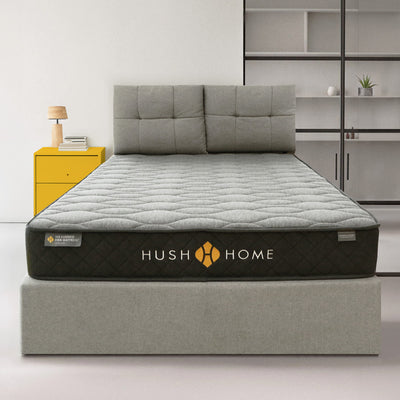
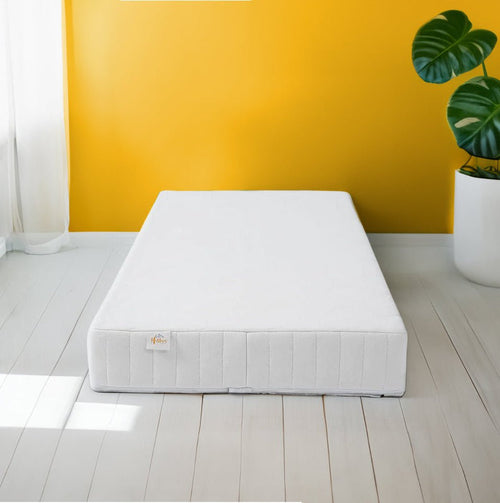
For example, Hush Home's Mattress Match Quiz can help narrow down mattress options by your preferences, while its Pillow Height Guide explains how sleep position and mattress firmness affect pillow fit. If you are considering the Hush Mattress™ or the Miracle Pillow™, treat these as comfort choices—not products proven to deliver a particular efficiency score.
Not necessarily. Brief awakenings can occur during normal sleep, and consumer devices may not detect them perfectly. A consistently high number matters less than having enough sleep and feeling reasonably rested.
False. Five hours asleep out of five and a half hours in bed gives around 90.9% efficiency. The ratio can look strong even when the total sleep is short.
No. Devices use different sensors, rules and proprietary algorithms, so their estimates of waking and sleeping may differ. Trends within one device are more practical than expecting exact agreement across brands.
A more suitable mattress can address a comfort mismatch, but low efficiency can also relate to schedule, stress, noise, medication or an underlying health problem. Start by identifying the reason for waking rather than treating the mattress as a universal cure.
Around 85% or higher is a common adult benchmark; 90% or higher often reflects relatively little wakefulness. These are reference points, not absolute medical cutoffs.
It is below a commonly used benchmark, but one result is not a diagnosis. Check how much sleep you got, whether the measurement was accurate, your daytime symptoms and whether the pattern repeats.
Not always. The person with 85% may sleep more hours and feel better than someone with 90% who has cut their sleep opportunity too short.
Use a sleep diary to estimate the total time actually asleep and the corresponding time in bed, convert both to minutes, then divide sleep time by time in bed and multiply by 100.
Yes. Time spent awake while trying to fall asleep is not included in total sleep time, so it lowers the percentage if it falls inside the measured sleep window.
The waking minutes can lower efficiency when they fall within the defined overnight sleep interval. Whether time physically out of bed is counted depends on the diary or research method, so be consistent.
A literal time-in-bed method may include it. Some researchers prefer measuring the period when you are actually attempting to sleep. Note which approach you use and do not mix it across nights.
They can provide estimates and trends, but agreement with laboratory sleep measurements varies by device and person. They should not be used alone to diagnose a sleep disorder.
No. Efficiency measures how much of the sleep interval was spent asleep; deep-sleep percentage estimates how much of the sleep was in a particular sleep stage.
Yes. An extremely high estimate does not guarantee enough total sleep or feeling restored, and some trackers may miss brief awake periods.
Do not shorten sleep opportunity simply to improve the score. Carefully managed sleep-restriction techniques are part of CBT-I for certain insomnia patients, but may be inappropriate without professional guidance.
Sleep patterns and awakenings can change with age, but there is no single universal score that determines health for every age group. Interpret the number alongside symptoms and total sleep time.
Improved comfort may help if a specific mismatch is disturbing your sleep, but there is no guarantee of a measurable increase. Persistent sleep disruption may have causes unrelated to bedding.
Seek medical advice if sleep difficulties repeatedly affect daytime functioning, or if you have loud snoring, breathing pauses, marked sleepiness or other concerning symptoms. Do not diagnose yourself from an app score.
Sleep efficiency tells you how much of a measured sleep period was spent asleep. Calculate it with total sleep time ÷ time in bed × 100; about 85% or more is a common reference point, not a perfect-sleep certificate. The more helpful goal is enough sleep, manageable interruptions and waking up reasonably rested—not maximising a single number.