
Sleep Mask Guide: Does an Eye Mask Help You Sleep?
17 Sep 2026
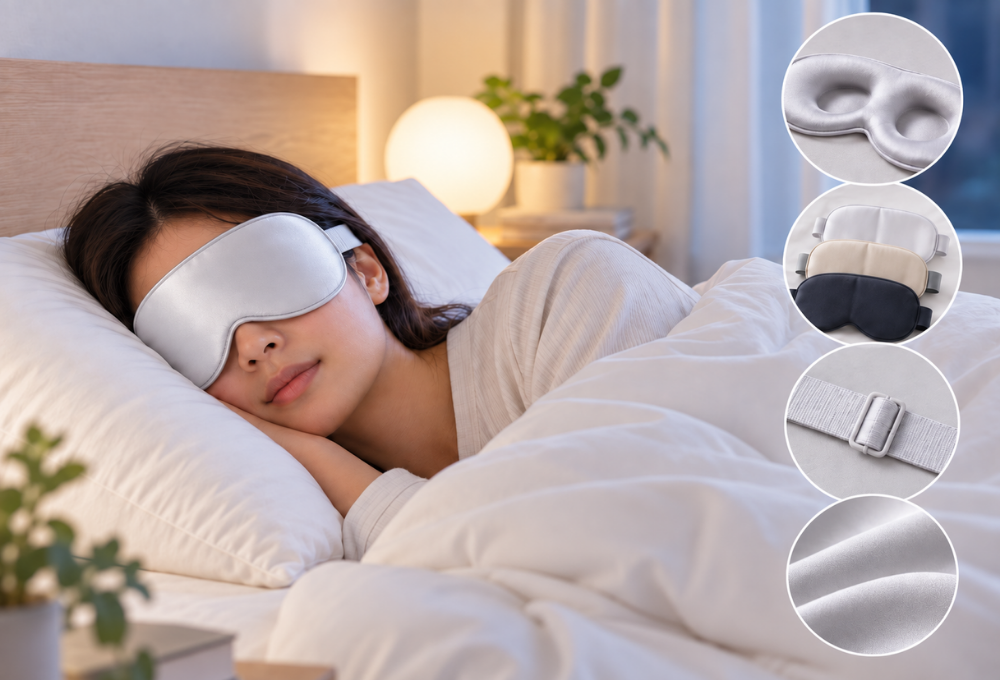
A sleep mask can help if unwanted light is interfering with your sleep. By covering the eyes and reducing ambient light, an eye mask creates a darker sleep environment without requiring you to change the whole room.
That can be especially useful if you live with bright streetlights outside, have thin curtains or blinds, sleep after sunrise, work night shifts, travel frequently, share a room with someone who stays awake later, or simply prefer a very dark bedroom.
A sleep mask is not a treatment for insomnia or another sleep disorder. It can be a simple way to remove light as one potential source of sleep disruption.
KEY TAKEAWAY
A sleep mask is most useful when unwanted light is the problem. Choose one that blocks light effectively, stays in place without feeling tight and uses a material you are comfortable wearing for several hours.
Light is one of the environmental signals involved in regulating the body's circadian rhythm—the roughly 24-hour cycle that influences when you feel awake and when you become sleepy.
At night, darkness supports the body's normal nighttime signalling, including melatonin production. Artificial light and early morning daylight can therefore make a sleep environment less dark than you would ideally like.
A sleep mask works in a very straightforward way: it physically blocks light from reaching your eyes while you sleep.
Unlike blackout curtains, it also moves with you. That makes an eye mask particularly convenient for hotels, planes or bedrooms where changing the window coverings is not practical.
There is some evidence that blocking light with an eye mask can improve certain aspects of sleep or next-day functioning, although the research is still relatively limited.
A 2023 study asked healthy adults to sleep at home with an eye mask and compared the results with a control condition. Participants showed small improvements in next-day alertness and their ability to encode new information after sleeping with the light-blocking mask.
Other randomised studies in hospital settings have found improvements in measures of sleep when patients used eye masks, sometimes together with earplugs. However, hospital environments are very different from ordinary bedrooms, so these findings should not automatically be applied to everyone sleeping at home.
There has also been academic debate about how meaningful some of the reported improvements are. A subsequent reanalysis of the 2023 home study argued that the evidence for improvements in learning and alertness was not entirely consistent.
In Hong Kong, light from neighbouring buildings, illuminated signs, traffic and streetlights can remain visible long after bedtime.
Blackout curtains are one solution, but they are not always practical in rented apartments or small bedrooms. A sleep mask provides a much simpler alternative.
If you need to sleep during daylight hours, creating darkness can be particularly challenging. A well-fitting sleep mask can block daylight even when the room itself remains relatively bright.
For more practical daytime-sleep strategies, see our Top Sleep Tips for Shift Workers in Hong Kong.
Hotel curtains vary enormously, and aircraft cabins may remain partially illuminated even when you want to sleep. A sleep mask is therefore one of the easiest sleep accessories to keep in your hand luggage.
Some people are simply more bothered by small sources of light than others. An alarm clock display, hallway light or partner using a bedside lamp may be enough to become distracting.
For these sleepers, an eye mask can provide a more consistent environment.
They solve the same problem in different ways.
| 选项选项 | Main Advantages | Main Trade-Off |
|---|---|---|
| Sleep mask | Blocks light directly from your eyes, is portable, useful for travel and requires no installation. | Some sleepers may find contact with the face uncomfortable. |
| Blackout curtains | Darken the whole room and do not touch the face. | They are not portable and usually require installation. |
If you already have an extremely dark bedroom, you may notice very little difference from adding a sleep mask. If light leaks around your curtains or you regularly sleep somewhere unfamiliar, a mask can be much more useful.
You can also use both if you prefer a particularly dark sleep environment.
Not all eye masks feel the same. The most important characteristics are usually light blocking, fit, material and pressure around the eyes.
A sleep mask should cover enough of the area around your eyes that light does not easily enter around the nose or sides. A mask that looks attractive but leaves large gaps underneath may defeat its main purpose.
Common sleep mask materials include silk, cotton, polyester, microfiber and padded or contoured constructions.
There is no universally best material—the most useful mask is one you are comfortable keeping on all night.
A silk eye mask is not automatically better at blocking light than every cotton or synthetic mask. Its main advantage is feel.
Smooth silk creates less surface friction against the face than many rougher textiles, which can make it comfortable around the delicate eye area.
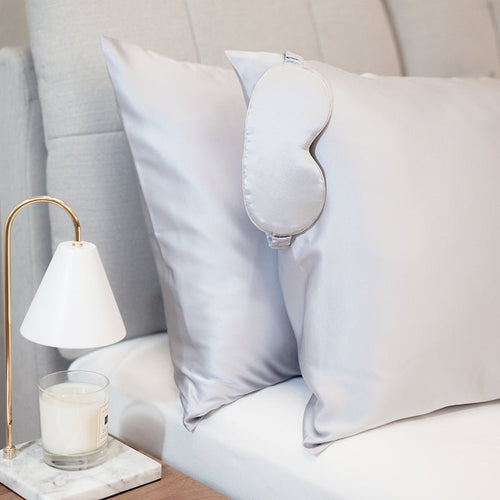
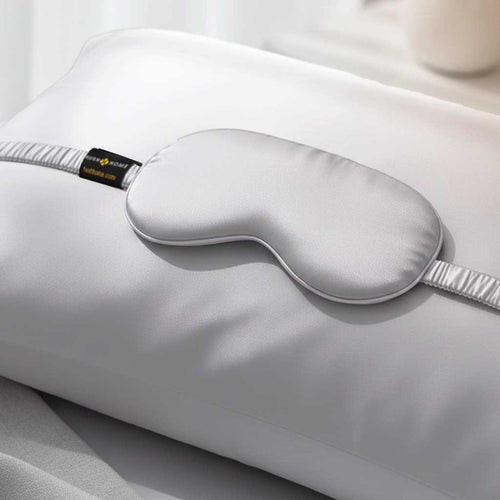
Hush Home's Mulberry Silk Eye Mask™, for example, uses 100% 22-momme mulberry silk and an elastic headband. The silk is also certified to OEKO-TEX® STANDARD 100.
If your main priority is simply maximum darkness, however, fit and coverage may matter more than whether the mask is made from silk.
A sleep mask should feel secure but not tight.
It needs enough tension to remain in place when you change sleeping position, but it should not create uncomfortable pressure around your eyes or head.
Signs that your eye mask may be too tight include obvious pressure around the eyes, headaches or discomfort, deep marks that remain after waking, or difficulty relaxing because you can constantly feel the strap.
If it repeatedly falls off, the opposite may be true: the mask may be too loose or simply the wrong shape for your face.
Yes, but profile and strap placement matter.
A bulky mask or large buckle positioned at the side of the head may become uncomfortable when pressed into a pillow.
Side sleepers may therefore prefer low-profile masks, soft straps, minimal hardware around the temples and smooth materials.
Back sleepers generally have more freedom because there is less direct pressure on the side of the mask.
Ideally, very little.
Some people are perfectly comfortable with a soft fabric sitting across the eyelids, while others prefer a contoured design that leaves more space around the eyes.
The goal is not to compress the eyes. It is simply to block light comfortably. If a mask causes pain, irritation or visual symptoms after you remove it, stop using it.
A sleep mask sits directly against your face for several hours at a time, so it should be cleaned regularly.
How often depends on how much you perspire, your skincare routine, the mask material and how frequently you use it.
Always follow the manufacturer's care instructions. Silk, in particular, generally requires gentler washing than standard cotton or polyester.
If you use facial creams or oils at night, you may want to wash your mask more frequently because those products can transfer onto the fabric.
No.
A sleep mask can reduce light, but it cannot compensate for consistently going to bed too late, insufficient sleep time, excessive caffeine, an uncomfortable bedroom, excessive noise or an untreated sleep disorder.
Think of it as one part of your sleep environment, alongside your mattress, pillow, bedding, room temperature and noise level.
If you are unsure how much time you should actually allow for sleep, see our recommended sleep duration by age guide. For broader sleep-habit advice, read 9 Tips to Beat Insomnia and Get Better Sleep.
If you regularly struggle to fall asleep, stay asleep or feel rested despite allowing enough time for sleep, it is worth discussing the problem with a healthcare professional rather than relying only on accessories.
For sleepers who prefer a soft silk mask, the Hush Home Mulberry Silk Eye Mask™ is designed to create a darker sleep environment while feeling smooth against the face.
Its current specifications include 100% 22-momme mulberry silk, a soft elastic headband, a one-size design, Silver Grey colour and OEKO-TEX® STANDARD 100-certified silk.
The 22-momme specification describes the weight and density of the silk fabric rather than a thread count.
They can help when unwanted light is interfering with your sleep. Some studies have reported improvements in sleep-related outcomes or next-day alertness, but evidence remains limited and results are not identical across studies. Their most direct benefit is creating darkness.
For most people, a comfortable and properly fitted sleep mask can be used nightly. Keep it clean and make sure it does not place excessive pressure on your eyes or head.
Possibly, particularly if light is one of the things keeping you awake. But a sleep mask will not necessarily shorten sleep onset if your bedroom is already dark or another issue is causing the difficulty.
They can be particularly useful because shift workers may need to sleep while daylight is entering the bedroom. A sleep mask offers a portable way to create darkness without relying entirely on blackout curtains.
Silk masks are worth considering if you value a particularly smooth, soft fabric against your face. They are not automatically better at blocking light, so fit and coverage should still be considered.
Darkness is involved in normal melatonin signalling, and a sleep mask can reduce light reaching your eyes. However, you should not think of an eye mask as a melatonin treatment or assume that every person will experience a measurable increase.
A soft mask can lightly touch the eyelids if it feels comfortable. If you dislike this sensation, consider a contoured eye mask that creates space around the eyes.
A sleep mask is most useful when your bedroom is not as dark as you would like it to be.
It is inexpensive, portable and simple: rather than changing your sleep biology directly, it removes one common environmental stimulus—light.
Choose one that blocks light effectively, stays in place without feeling tight and uses a material you are comfortable wearing for several hours.
And if you enjoy a particularly smooth feel against your face, a silk option such as the Hush Home Mulberry Silk Eye Mask™ is worth considering.