




Soft vs Medium vs Firm Pillows: How Firm Should Your Pillow Be?
24 Sep 2026
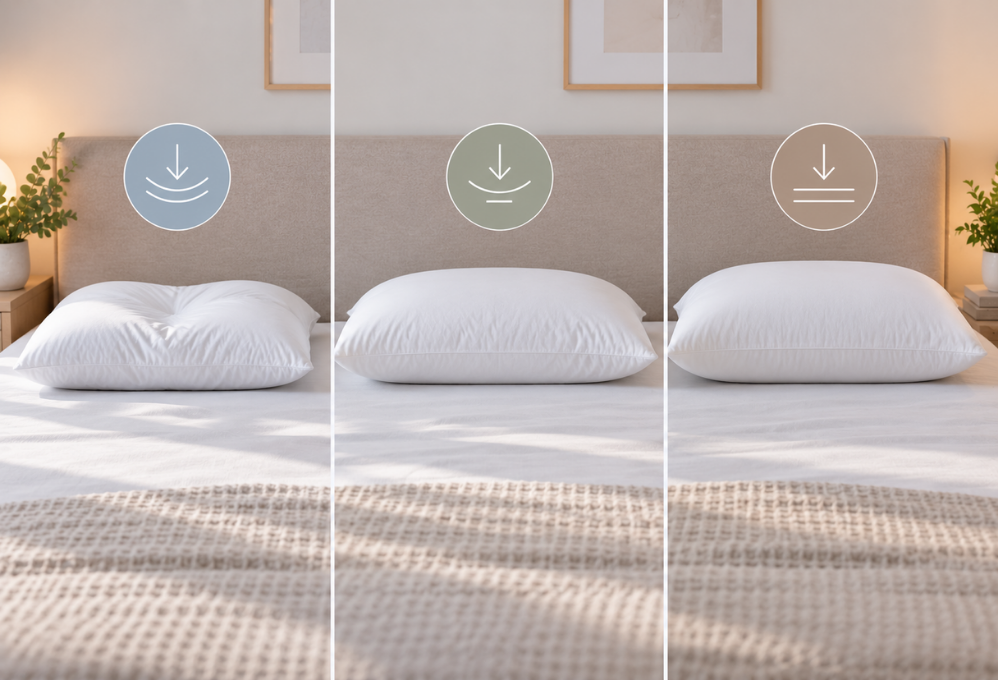
If two pillows are the same height, the softer one and the firmer one can feel completely different once you lie down.
A soft pillow usually compresses more easily and allows the head to sink further into the surface. A firm pillow resists compression more strongly and tends to hold the head higher relative to its uncompressed height. A medium pillow sits somewhere between those two behaviours.
That does not mean firm is automatically more supportive or soft is automatically more comfortable. The right firmness depends on how the pillow interacts with your sleeping position, body size, shoulder width, mattress, pillow height and personal pressure preference.
QUICK ANSWER
There is no universal best pillow firmness. For many sleepers, medium support is a sensible starting point because it provides some cushioning without allowing excessive collapse. Side sleepers often need more resistance to compression, while stomach sleepers frequently prefer softer or lower-profile pillows. Back sleepers commonly fall somewhere in the middle.
However, these are only starting tendencies. A broad-shouldered side sleeper on a firm mattress may need a firmer or more structured pillow than a small-framed side sleeper on a soft mattress. A very soft pillow with generous fill may also support more effectively than a thin firm pillow.
The Hong Kong Consumer Council's 2026 pillow guidance makes the same broader point: avoid an excessively hard pillow because reduced contact area can concentrate pressure, but make sure a softer pillow still provides enough support.
Pillow firmness describes how resistant the pillow feels when weight is applied. In practical terms, it is how easily your head sinks into the pillow and how strongly the pillow pushes back.
A soft pillow compresses easily and usually creates a plush, enveloping feel. A medium pillow allows some sinkage but retains more structure. A firm pillow compresses less and feels more resistant underneath the head and neck.
These labels are relative rather than universal measurements. One brand's "medium" may feel similar to another brand's "firm", and different materials create different sensations even when manufacturers use the same firmness word.
That is why it is more useful to understand compression behaviour than to shop by the word "firm" alone.
Firmness and support overlap, but they are not identical.
Firmness is the immediate feel and resistance to compression. Support is whether the pillow keeps your head and neck in a workable position for your body and sleep posture over time.
A very firm pillow can still provide poor support if it is too high and tilts your head upward. A soft pillow can still provide good support if it has enough fill, rebounds well and settles at the correct effective height.
Think of firmness as one ingredient of support rather than the final verdict on whether a pillow is "good".
Pillow height, or loft, tells you how thick the pillow is before or while it is being used. Firmness tells you how much that height changes under load.
A 15 cm soft microfiber pillow may compress to a much lower effective height than a 12 cm dense memory foam pillow. That means the taller pillow can sometimes support lower than the shorter one.
This is why pillow height and firmness should always be evaluated together. For a more detailed fitting process, see Hush Home's Pillow Height Guide.
A soft pillow lets the head sink more deeply and usually creates more surface cushioning around the head and face.
Softness can be useful when you dislike a strong pushing sensation from the pillow, prefer a fluffy hotel-style feel or need the pillow to compress significantly in a lower-loft sleeping position.
The main risk is excessive collapse. If the pillow compresses until your head effectively reaches the mattress, the neck may lose the support you intended to get from the pillow.
Soft therefore does not mean unsupportive - but a soft pillow needs enough fill, structure or rebound to stop at an appropriate effective height.
A medium pillow aims to balance cushioning with resistance. The head sinks into the surface, but the pillow still maintains noticeable support underneath.
This middle ground is why medium support often works as a practical starting point for back sleepers, combination sleepers and anyone who is unsure how much resistance they prefer.
But "medium" is not automatically neutral for every person. Body weight, mattress firmness and pillow construction still change how much the pillow compresses.
A firm pillow resists compression more strongly. It usually maintains more of its original shape and effective height when your head rests on it.
That can be useful for sleepers who need to fill a larger head-to-mattress gap, particularly some side sleepers, or for people who dislike the sensation of sinking deeply into a pillow.
However, firmer is not automatically better. If the pillow does not allow enough surface give, the contact area under the head may be smaller and pressure can feel concentrated. If a firm pillow is also too high, it can push the head away from a comfortable position.
Side sleepers often need more resistance to compression than stomach sleepers because the shoulder creates a larger gap between the head and mattress.
For many side sleepers, medium-firm or firm support can help stop the pillow from collapsing too far. But the correct firmness depends on shoulder width, body size, mattress sinkage and pillow height.
A soft side-sleeper pillow can still work if it starts with enough loft and retains sufficient effective height after compression. Conversely, a very firm side-sleeper pillow can still be wrong if it is too tall.
Back sleepers usually need enough support to prevent the head from sinking too far backward, but not so much resistance or height that the head is pushed noticeably forward.
Medium support is therefore a common starting point. Some people prefer softer cushioning around the back of the head, while others prefer a firmer, more stable surface.
The test is alignment and comfort rather than the label. If your chin feels pushed strongly toward your chest, the pillow may be too high, too firm or both. If your head drops backward and the neck feels unsupported, it may be too low, too soft or both.
Stomach sleeping usually requires the least head lift because the neck is already rotated to one side.
A soft, low-profile pillow - or sometimes no head pillow at all - may therefore be more comfortable than a tall, resistant pillow. The goal is to avoid adding unnecessary extension through the neck.
Do not interpret this as "all stomach sleepers need the softest pillow available." A very soft pillow with excessive fill can still be too tall, while a thin firmer pillow may sit lower overall.
Combination sleepers need to think about firmness as a compromise across more than one position.
A very soft pillow may work on the back or stomach but collapse too much when you roll onto your side. A very firm pillow may hold side-sleeping height well but feel intrusive when you move onto your back.
That is why medium support, adjustable firmness or a construction with both cushioning and a supportive core can be useful for combination sleepers.
The same pillow does not compress equally under every sleeper.
A larger or heavier sleeper may compress a soft pillow further and therefore benefit from more resistance or more fill. A smaller sleeper may not compress a firm pillow enough for the surface to contour comfortably.
The Consumer Council's 2026 testing also found that pillow support performance varied with physique and sleep position. This reinforces why firmness should be matched to the sleeper rather than treated as a universal quality score.
The pillow does not work independently from the mattress.
On a soft mattress, your shoulder and torso may sink deeper. During side sleeping, this can reduce the gap the pillow needs to fill. A very firm, high pillow that worked on your previous mattress can suddenly feel too aggressive.
On a firmer mattress, your body generally stays higher relative to the surface, so a pillow may need to preserve more effective height.
Hong Kong Consumer Council testing has specifically noted that mattress firmness affects pillow support height. This is one reason you should reassess your pillow after changing mattresses.
Different fill materials have characteristic behaviours, but no material has one fixed firmness.
Memory foam can range from soft and slow-sinking to dense and quite firm depending on formulation, thickness and construction. Solid foam generally feels more stable than loose shredded foam.
Microfiber often creates a softer, fluffier feel and can compress substantially, but fill quantity and chamber construction can make it much more supportive than the material name suggests.
Down is often very soft and mouldable, while feather content can add more structure. Fill quantity, fill power and chamber design all influence how firmly the pillow supports.
Latex often feels buoyant and responsive rather than slow-sinking. It can be manufactured in softer or firmer versions, so "latex" alone is not a firmness rating.
A pillow needs enough give to distribute pressure around the head and enough structure to stop excessive sinking.
An extremely hard surface may feel supportive at first because it barely moves, but that does not guarantee comfort. If only a small area of the head contacts the pillow, the pressure can feel concentrated.
At the opposite extreme, an extremely soft pillow may feel plush initially but allow the head to sink so far that support disappears.
The best balance is therefore not maximum firmness. It is enough pressure relief plus enough resistance for your body and sleep position.
Possible signs include your head sinking much lower than expected, repeatedly folding or bunching the pillow because it feels flat, feeling that your neck has no support, or waking and immediately wanting to place a hand or arm under the pillow for extra height.
For a side sleeper, another clue is the head visibly tilting downward toward the mattress because the pillow compresses too far.
Before replacing the pillow, check whether the problem is actually firmness or simply insufficient fill. An adjustable-fill pillow may be fixable by adding more material.
A pillow may be too firm if it feels like it is pushing back aggressively rather than allowing the head to settle, if you notice concentrated pressure around the back or side of the head, or if you frequently move off the centre of the pillow to escape the pressure.
Another sign is that the pillow hardly compresses and leaves your head visibly tilted because its full height remains underneath you.
The Hong Kong Physiotherapy Association guidance quoted by the Consumer Council advises avoiding pillows that are excessively hard because reduced head contact can increase pressure on a smaller area.
Yes. Surface feel and structural support can come from different layers.
A pillow can have a soft microfiber or down-like outer chamber surrounding a more supportive foam centre. It can therefore feel plush against the face while resisting complete collapse underneath.
This is why simple "soft versus firm" labels can miss how multi-layer pillows actually behave.
Adjustable firmness is most useful when you are not yet sure how much resistance you prefer, when your needs change between sleep positions, or when you want to fine-tune both height and feel.
Adjustment can come from flipping a two-sided pillow, adding or removing fill, swapping internal layers or changing which chamber faces upward.
The benefit is not that adjustable pillows are automatically better. It is that they give you more correction range if your first setup is wrong.
The evidence does not support a simple rule that everyone with neck pain should use the firmest pillow possible.
A 2021 systematic review and meta-analysis found that pillow design characteristics can influence neck pain and waking symptoms, but pillow height and shape appear important and results vary by pillow type. Earlier comparative research also found that an ideal neck pillow was described as soft and not too high while still providing firmer support under the cervical curve.
The practical lesson is that support can be targeted rather than making the entire pillow uniformly hard.
If you have persistent, severe or worsening neck pain, numbness, weakness, arm symptoms or pain after an injury, seek assessment from a qualified healthcare professional rather than relying only on a pillow change.
Hush Home's current adult pillow range covers several different firmness behaviours rather than one single "best" level.
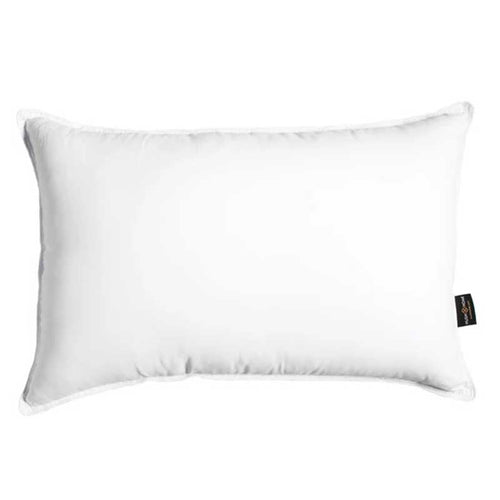
The Loft Pillow™ is Hush Home's softest-feeling option. It uses down-like microfiber for a plush, compressible hotel-pillow feel and comes in two fixed heights: 12 cm and 15 cm.
It suits sleepers who actively prefer softness and do not want the more resistant feel of dense foam. Because it compresses more easily, choosing the correct height is particularly important.
The OnePillow™ combines two soft microfiber outer chambers with an adjustable middle layer of interlocking memory foam. Hush Home currently describes the middle layer as providing medium support.
This creates a useful example of why surface softness and support are not opposites: the pillow can feel fluffy against the head while the centre resists complete flattening.
Its fill-based height adjustment also lets you change how full and resistant the pillow feels to some extent.
The Miracle Pillow™ is the clearest Hush Home option for sleepers who are uncertain about firmness because its two-sided construction provides two different feels.
The soft side uses light, lofty microfiber at the surface, while the firmer side uses conforming memory foam. The pillow also has removable inner memory foam layers that create 12, 14, 16 and 18 cm height settings.
That allows firmness and height to be considered separately. If the firm side feels good but the pillow is too high, you can reduce the height without giving up the firmer surface feel.
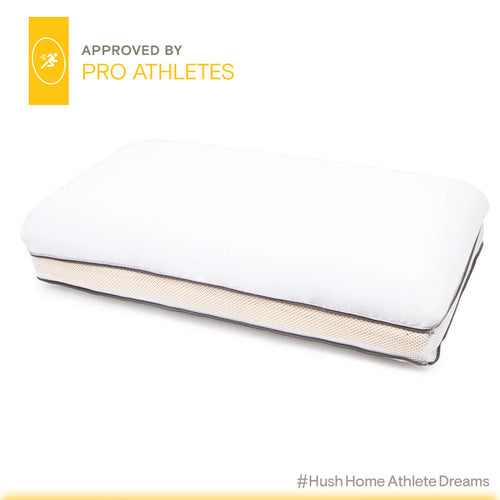
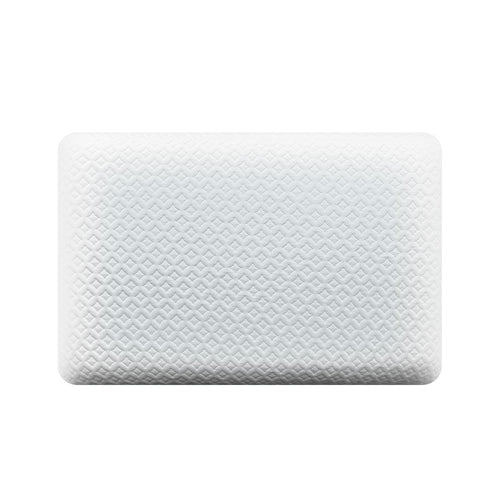
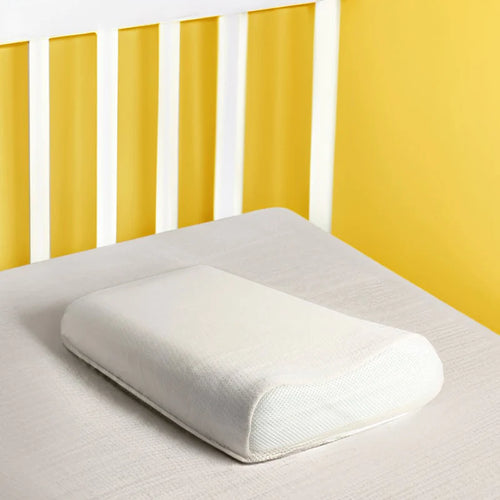
The Essence Memory Foam Pillow™ uses one fixed 12 cm memory foam core. Hush Home currently describes its support as medium-hard.
It is the simplest Hush option for someone who already knows they prefer a structured memory foam feel and does not need adjustable firmness or multiple heights.
All current Hush Home adult pillows include a 30-night Home Trial and 1-year HushCare warranty, subject to the latest published terms.
| Sleeper Type | Useful Starting Point |
|---|---|
| Side sleeper, broad shoulders or firm mattress | Consider medium-firm to firm support, but verify the effective height after compression. |
| Side sleeper, smaller frame or soft mattress | Medium support may be enough; do not assume maximum firmness is necessary. |
| Back sleeper | Medium is a practical starting point, then move softer or firmer based on whether you prefer more cushioning or more stability. |
| Stomach sleeper | Soft to medium and low profile often works more easily than a tall firm pillow. |
| Combination sleeper | Medium or adjustable firmness provides more flexibility across positions. |
| Pressure-sensitive sleeper | Prioritise enough surface give and contact area rather than choosing the hardest pillow for "support". |
These are starting points, not prescriptions. Your body, mattress and comfort preference can move you in a different direction.
Do not judge a pillow by squeezing it with your hand for five seconds. Your head applies weight over a larger area and for much longer.
If possible, test the pillow in your normal sleeping position on a mattress with a similar firmness to the one you use at home.
Notice three things: how far your head sinks, whether pressure feels concentrated anywhere, and whether your head and neck feel naturally supported without being pushed into position.
If testing at home, give yourself several nights unless the pillow is clearly uncomfortable. Foam, fill distribution and your own expectations can all take some time to settle.
A pillow can be very firm and still be the wrong height or shape for you.
Soft outer layers can coexist with a supportive centre, and generous fill can maintain effective height.
Compare how pillows behave under your head, not only their uncompressed showroom shape.
Body size, shoulder width and mattress firmness also affect how much resistance you need.
Research does not support one universal hardest-is-best rule. Height, shape, contact pressure and targeted neck support matter too.
Foam density, firmness and durability are related in some products but are not interchangeable terms. A high-density foam can still be formulated to feel relatively soft.
A new mattress changes body sinkage and can change how your existing pillow feels.
Not automatically. A pillow should provide enough support without creating excessive pressure or forcing the head into an awkward angle. The best firmness depends on height, shape, sleep position, body size and mattress firmness. Persistent neck pain should be assessed rather than managed only by choosing a harder pillow.
Not necessarily. The issue is whether the pillow retains enough effective height after compression to fill the shoulder gap. A soft, high-fill pillow can work, while a soft, underfilled pillow may collapse too far.
Medium support is a common starting point because it balances cushioning and stability. The pillow should support the neck without pushing the head excessively forward or allowing it to drop too far backward.
Soft to medium support with a low effective height often works more easily because stomach sleeping usually needs less head lift. But overall height remains just as important as firmness.
Yes. An excessively firm pillow may not allow enough contact area and can create concentrated pressure. It may also hold the head too high if the pillow is thick. The Consumer Council's 2026 guidance specifically advises avoiding pillows that are excessively hard.
Yes. If a pillow collapses until the head loses appropriate support, softness becomes a problem. A soft pillow should still have enough fill, rebound or internal structure to maintain a suitable effective height.
No. Memory foam can be formulated in different firmnesses. Solid memory foam tends to feel more structured than loose shredded foam, but foam density, formulation, thickness and construction all influence the final feel.
It can be a reasonable starting point for many side and back sleepers, but there is no universal safest firmness. If you are genuinely unsure, an adjustable-height or adjustable-firmness pillow gives you more room to correct the fit after sleeping on it.
It can. Fill can flatten, foam can soften, and some materials can change with repeated compression. Consumer Council testing has observed changes in pillow height and hardness after durability testing in some models. If your pillow feels very different from when it was new, reassess both its effective height and support.
Not necessarily. Each person has a different body size, sleep position, mattress interaction and comfort preference. There is no reason two people sharing the same bed must use the same pillow model or firmness.
Test both sides at the same height first. Choose the side that lets your head settle naturally without excessive sinking or pressure. Only after identifying your preferred feel should you adjust the overall height, because changing both firmness and height at once makes it harder to know what actually improved the fit.
The best pillow firmness is not the softest, hardest or most expensive option. It is the amount of resistance that lets your head settle comfortably while preserving enough effective support for your body and sleep position.
Start by separating three questions: Is the pillow the right height? Does it compress too much or too little? Does the surface distribute pressure comfortably? Once you separate height, firmness and support, it becomes much easier to understand why a pillow feels wrong.
At Hush Home, the current range covers distinct firmness preferences: Loft Pillow™ for a soft fluffy feel, OnePillow™ for soft outer cushioning with medium support, Miracle Pillow™ for sleepers who want to choose between softer and firmer surfaces as well as multiple heights, and Essence Memory Foam Pillow™ for a fixed medium-hard memory foam feel.