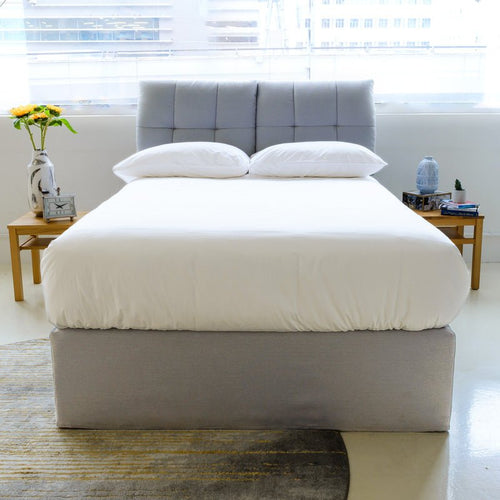







Platform Bed vs Slatted Bed Frame: Which Is Better?
24 Sep 2026
Platform bed or slatted bed frame—which is better for your mattress?
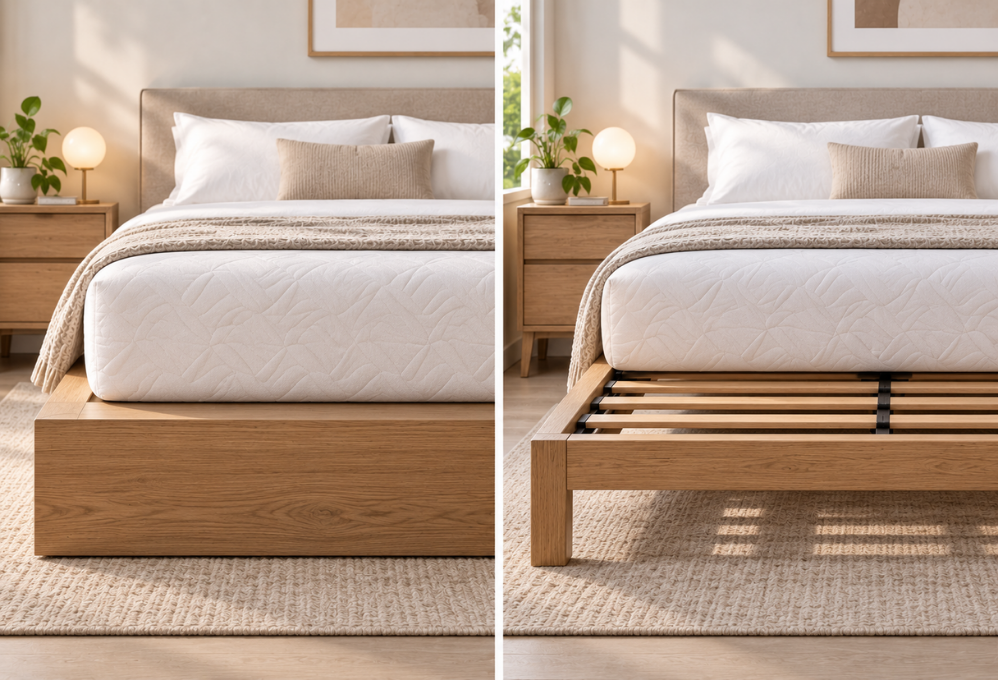
The most accurate answer is that this is not quite an apples-to-apples comparison. A platform bed is a type of bed frame with an integrated mattress-support surface. That surface can itself be solid, slatted, latticed or made from another rigid structure. In other words, a slatted bed can also be a platform bed.
For practical buying decisions, the more useful comparison is therefore between a solid or continuous platform base and a rigid slatted base. That is the comparison used throughout this guide unless otherwise stated.
QUICK ANSWER
Neither is universally better.
A solid platform is a strong choice when you want a flat, continuous and highly uniform support surface, especially when the mattress manufacturer allows or recommends one. It also removes the issue of slat gaps and has fewer separate support pieces that can move against one another.
A rigid slatted base is a strong choice when you want good support with more open space for airflow beneath the mattress. It can also be lighter and easier to dismantle or service. But the slats must be strong enough, correctly spaced and adequately supported in the centre.
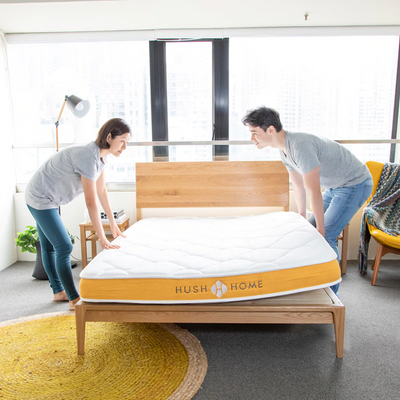
For Hush Home mattresses, the current guidance is straightforward: use a flat, stable surface. Hush currently accepts a flat platform, box spring or slatted base, with slats spaced no more than 7 cm apart.
| 特色 | Solid Platform | Rigid Slatted Base |
|---|---|---|
| Support surface | Continuous and highly uniform | Repeated support points with gaps between slats |
| Underside airflow | More limited | Generally better because air can move through the gaps |
| Foundation flex | Minimal when properly built | Minimal with rigid slats; more noticeable with sprung or flexible slats |
| Slat-spacing issue | 没有任何 | Must meet the mattress manufacturer’s maximum-gap requirement |
| Potential noise points | Fewer individual support pieces | More joints and slat contact points, although a well-built frame can still be quiet |
| Repairability | Depends on platform construction | Individual damaged slats may sometimes be replaceable |
| Best choice | Whichever flat, stable system meets your mattress requirements and suits your room, storage and ventilation needs | |
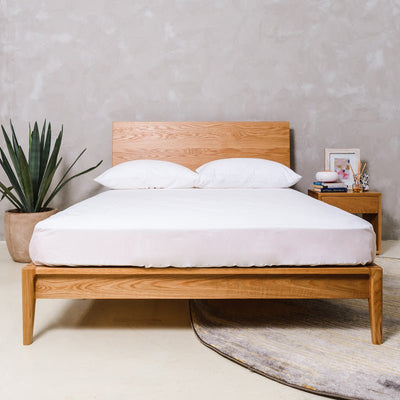
A platform bed is a bed frame with an integrated foundation that allows the mattress to sit directly on the frame without requiring a separate traditional box spring underneath.
The important detail is that “platform” describes the overall support concept, not necessarily one single surface material. A platform can be a solid board, multiple rigid panels, wooden slats, metal slats or a grid.
This is why a retailer can correctly describe a bed as both “platform” and “slatted”. Those terms are not mutually exclusive.
A slatted base supports the mattress on a series of parallel strips running across the width of the bed. Slats are commonly made from wood or metal and can be rigid or flexible.
Rigid slats are designed primarily to provide stable support. Closely spaced rigid slats can create a support surface that behaves quite similarly to a platform while leaving ventilation gaps between the boards.
Sprung or flexible slats are intentionally curved or designed to flex under load. They add another responsive layer beneath the mattress and can therefore change how the complete sleep system feels.
Rigid and sprung slats are not the same foundation. Do not assume that advice about rigid slats automatically applies to sprung slats. If your mattress manufacturer asks for a flat and stable foundation, confirm whether a flexible slatted system is acceptable.
The fundamental difference is continuity.
A solid platform supports almost the entire underside of the mattress. A slatted base supports the mattress along a series of separate lines, with open gaps in between.
That does not automatically make the platform better. If slats are strong, flat, closely spaced and well supported, the mattress can still receive stable and even support.
Problems tend to arise when slats are too widely spaced, bowed, broken, flexible when they should be rigid or inadequately supported across a wide bed.
A continuous platform has an inherent advantage in support continuity because there are no gaps between support points. That can be useful for mattresses that require a very flat, rigid foundation.
However, a properly designed rigid slatted base can also provide excellent support. The engineering questions are how wide the slats are, how large the gaps are, how stiff the slats are, whether they remain level and how the centre of the bed is reinforced.
For larger beds such as Queen and King sizes, centre support becomes particularly important because the span across the bed is wider. A good base should not sag in the middle simply because the mattress and sleepers place more load there.
There is no universal slat gap that is correct for every mattress.
Different foam, latex, hybrid and spring mattresses can have different foundation requirements. A gap that one manufacturer accepts may be too wide for another. Always check the warranty and care instructions for the exact mattress you own or plan to buy.
Hush Home-specific guidance: Hush Home currently recommends that slats used under its mattresses be no more than 7 cm apart. This is a Hush-specific requirement, not a universal rule for every mattress sold in Hong Kong.
Also check slat width and support. Ten very narrow slats with acceptable gaps are not necessarily equivalent to a more substantial, well-braced base.
Yes, particularly when the base itself flexes.
A rigid solid platform contributes very little additional give beneath the mattress, so more of the perceived softness or firmness comes from the mattress itself.
Closely spaced rigid slats can behave similarly. But sprung or curved slats intentionally move under load, so the complete bed system may feel more flexible than the same mattress on a rigid platform.
Do not use this as a DIY method to fix the wrong mattress firmness. A bed base should first meet structural and warranty requirements. If the mattress itself is unsuitable, changing to an unsupported or excessively flexible foundation is not a reliable substitute for choosing the correct mattress.
A slatted base generally provides more direct underside airflow because air can move through the gaps between slats.
A continuous platform blocks more of the mattress underside, so airflow through the bottom surface is naturally more limited.
That does not mean a platform bed automatically makes a mattress hot or causes mould. Heat and moisture depend on the whole system: mattress construction, bedding, room temperature, humidity, ventilation, air-conditioning and how much moisture enters the bed overnight.
It can matter more because moisture management is more relevant in a humid environment.
Hong Kong Observatory 1991–2020 climate normals show an annual mean relative humidity of 78%, with monthly averages reaching 82–83% from March through June. Those are outdoor Observatory climate normals, not a claim that every air-conditioned bedroom stays at the same humidity.
In that context, the open underside of a slatted base can be useful. But a platform bed can still work very well in Hong Kong if the room is reasonably ventilated, moisture is controlled and the mattress is cared for according to manufacturer instructions.
If a bedroom has recurring condensation, leaks or persistently excessive humidity, changing the bed base alone will not solve the underlying moisture problem.
For local mattress-care advice, see How to Protect Your Mattress: 5 Tips for Hong Kong.
Memory foam needs sufficiently even support so softer foam layers are not repeatedly pushed into large gaps underneath.
A flat platform is therefore straightforward when permitted by the mattress brand. A rigid slatted base can also work very well if slats are close enough together and do not bow excessively.
Do not assume that all foam mattresses need a completely solid board. Many manufacturers accept properly spaced slats. The mattress-specific requirement should decide the issue.
Both can work, provided the base is stable and compatible.
A rigid platform gives the mattress a continuous surface beneath its support core. Rigid slats provide support at repeated intervals and can add airflow. The key is preventing large unsupported gaps, bowed components or movement that the mattress was not designed to accommodate.
Hush Home uses pocket coils in several mattresses and currently permits both its flat Solid Wood Bed™ platform and its rigid-slatted Hydraulic Storage Bed™ as suitable foundations.
Heavier mattresses place more continuous load on the foundation, so the quality of the frame and centre support becomes especially important.
A solid platform can provide very uniform support, but the platform itself must be adequately braced and thick enough for the design. A slatted system can also support a heavy mattress if the slats, rails and centre beam are engineered for the load.
Do not infer weight capacity from appearance alone. Ask the manufacturer how the stated load limit is defined and whether it includes the mattress as well as sleepers.
The mattress itself usually has the largest influence on how much partner movement you feel, but the foundation can contribute.
A rigid continuous platform introduces very little flex beneath the mattress. A rigid slatted base can also remain highly stable. By contrast, flexible slats or a loose slatted system can add movement under load, while poorly secured slats can shift or make noise.
Hush currently describes its Solid Wood Bed™ flat platform as designed to work with Hush mattresses for improved motion isolation. Treat that as a Hush product-design claim rather than a universal statement that every platform bed isolates motion better than every slatted bed.
A solid platform has fewer individual slats and contact points, so there are fewer separate pieces that can rub or shift. That can reduce one common source of squeaking.
But a well-built slatted base can also be quiet. Noise usually comes from movement: loose bolts, slats rubbing against their supports, a centre beam shifting, the headboard contacting the wall or the entire frame rocking on an uneven floor.
A noisy slatted bed does not prove that slats are inherently bad, just as a quiet platform does not prove every platform is well made.
If an older frame is developing new movement or noise, see 5 Signs You Need to Replace Your Bed Frame.
There is no reliable universal winner.
A substantial solid platform has fewer individual support pieces and can be extremely durable when correctly braced. However, a thin panel with inadequate centre support can still bow or fail.
Slats introduce more individual components, but this can also make repairs easier because a damaged slat may sometimes be replaceable without replacing the entire bed.
Durability depends on slat material, thickness, span, spacing, centre support and how securely the slats are retained.
A slatted system can have an advantage if the slats remove individually and the remaining frame breaks down into smaller parts.
A continuous platform may use large rigid panels. Depending on the design, those panels can be awkward in lifts, corridors and tight corners even when the bed frame itself is dismantled.
However, construction varies widely. Ask for the dimensions of the largest component or package before ordering if access is tight.
Moving House in HK? How to Measure Your Lift for a New Mattress provides a more detailed access checklist once published.
The support surface alone does not determine storage capacity.
A platform bed can be raised on legs with open storage underneath, built with drawers or combined with an enclosed lift-up compartment. A slatted base can sit over the same kinds of storage systems.
Hush Home illustrates this difference well. The Solid Wood Bed™ uses a flat platform and provides about 7 inches of open clearance beneath the frame. The Hydraulic Storage Bed™ uses rigid wooden slats over an enclosed 30 cm-high storage compartment.
For a very small Hong Kong bedroom, the storage architecture may matter more than whether the mattress rests on a solid panel or slats.
Potentially, yes.
Mattress warranties commonly require an appropriate support base. If the foundation is broken, bowed, unstable or uses gaps wider than the manufacturer permits, resulting mattress damage may not be covered.
This is one of the strongest reasons not to choose a bed base solely on aesthetics. Check the mattress requirements first, then choose a frame that satisfies them.
For Hush Home mattresses, the current FAQ recommends a flat, stable surface and slat gaps no greater than 7 cm. HushCare terms also exclude damage associated with an improper base or foundation.
Sometimes, but do not assume this is automatically an upgrade.
Adding a bunkie board or other approved rigid panel can create a more continuous support surface when the original slats are too widely spaced or when a mattress requires more uniform support.
However, an added panel can reduce underside airflow, add weight and change the way the frame carries load. It may also create a warranty issue if the mattress or bed-frame manufacturer does not approve the modification.
Confirm both mattress and bed-frame requirements before modifying the foundation.
No.
A platform bed integrates the mattress support into the frame. A traditional box spring is a separate foundation containing springs or other flexible components and is normally placed on another supporting frame.
Modern mattresses often do not require a traditional box spring, but the correct foundation depends on the mattress manufacturer. Do not add one simply because older beds commonly used them.
Hush Home currently offers a useful real-world comparison because its two main adult bed frames use different support systems.
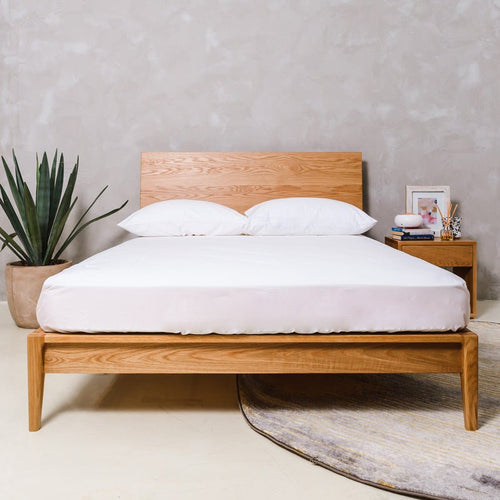
The Solid Wood Bed™ uses a flat platform base. Hush positions this as a stable foundation designed to work with its mattresses.
The bed is made from North American oak hardwood, is double kiln dried and provides approximately 7 inches of open clearance beneath the frame.
This setup is most relevant if you prioritise a rigid, continuous support surface, natural solid-wood styling and open under-bed clearance.
The Hydraulic Storage Bed™ uses sturdy wooden slats above an enclosed storage compartment.
Hush specifically highlights the airflow and breathability of this slatted base, while the hydraulic mechanism gives access to storage beneath most of the mattress footprint.
This setup is most relevant if you prioritise enclosed storage and underside mattress airflow while still using a stable rigid base.
Neither Hush option should be described as universally better. Both are designed as flat, stable foundations that satisfy Hush’s own mattress-support requirements in different ways.
Choose a solid platform if your priorities are maximum continuity of support, minimal flex underneath the mattress, fewer individual support pieces and a foundation specifically approved by your mattress manufacturer.
Choose rigid slats if your priorities are underside airflow, a potentially lighter or more modular base, easier individual-part replacement and a mattress that is approved for the slat spacing used.
Be more cautious with flexible or sprung slats if your mattress is designed specifically for a flat, rigid foundation. Confirm compatibility rather than assuming all slats are equivalent.
For a broader frame-selection checklist covering materials, dimensions, storage and room planning, see Hush Home’s Bed Frame Buying Guide.
False. Platform beds can use solid panels, slats, grids or other integrated support structures.
False. Rigid slats may add very little flex. Sprung slats can add movement, but whether that feels better depends on the mattress and sleeper.
Not necessarily. A rigid platform removes foundation flex, but the size of the perceived difference depends on what base you are replacing and how the mattress is constructed.
False. Slats improve underside airflow, but mould risk still depends on moisture, humidity, ventilation, spills, condensation and mattress care.
Not as a universal rule. The goal is to meet the mattress manufacturer’s support requirement while maintaining a sound, well-ventilated structure. More material is not automatically better if the base is poorly designed.
False. Thin or poorly supported panels can bow, especially over wide spans. Platform construction still needs proper bracing and centre support.
False. Rigid slats, sprung slats, flat wooden boards, curved laminated slats and metal slats can behave very differently.
No. A solid platform provides continuous support, while properly designed rigid slats can also provide excellent support with more underside airflow. The correct choice depends on the mattress manufacturer’s requirements, slat spacing, centre support and overall frame stability.
Usually not, because the platform itself is designed to act as the mattress foundation. However, always follow the mattress and bed-frame manufacturer’s instructions.
Generally yes. The gaps between slats create more open area beneath the mattress than a continuous solid platform. This can support ventilation, but it does not guarantee lower sleep temperature or prevent mould on its own.
It can if you are replacing a flexible foundation, because the new base removes some of the give underneath the mattress. If you are replacing closely spaced rigid slats, the difference may be small.
Use the mattress manufacturer’s requirement rather than a generic number. Hush Home currently permits slats no more than 7 cm apart for its mattresses, but another brand may specify a different maximum gap.
Not universally. Sprung slats add flex and can alter the feel of the mattress; rigid slats provide a more stable foundation. Choose based on mattress compatibility and the feel you want rather than assuming one construction is higher quality.
Only if both the mattress and bed-frame requirements allow it. A board can reduce large gaps and create more continuous support, but it can also reduce airflow, add weight and change load distribution. An approved bunkie board may be a better solution when specifically recommended.
They have more potential contact points, but a properly constructed slatted base can still be quiet. Squeaks usually come from movement between slats, joints, bolts, supports or the floor rather than from the concept of slats itself.
Slats have an airflow advantage, so they can be useful where underside ventilation is a priority. But a platform base can also work well when indoor humidity, condensation and mattress care are properly managed. Do not rely on bed-base design alone to solve a damp-room problem.
It can be, provided the mattress manufacturer approves a rigid flat foundation. Properly spaced rigid slats can also work. Hush Home currently permits both its flat platform and rigid slatted bed-frame designs for its pocket-coil mattresses.
Large beds usually benefit from properly engineered centre support because the span is wider and the total mattress-and-sleeper load is greater. Follow the bed-frame design and mattress requirements rather than improvising a centre leg or beam.
An inadequate foundation can contribute to uneven mattress support. Widely spaced, bowed or broken slats, a sagging platform or insufficient centre support can allow the mattress to deform in ways it was not designed to. Inspect the base whenever new sagging appears.
The best foundation is not simply “platform” or “slats”. It is a flat, stable, correctly supported base that matches your mattress manufacturer’s requirements and works for your room.
A solid platform gives you the most continuous support surface and minimises foundation flex. Rigid slats provide similarly stable support when properly designed, while giving the mattress more open airflow underneath. Flexible or sprung slats are a separate category because they intentionally move and can change mattress feel.
For Hong Kong homes, do not ignore humidity, bedroom size, storage and delivery access. A technically excellent base still needs to work in the space you actually live in.
At Hush Home, the Solid Wood Bed™ and Hydraulic Storage Bed™ demonstrate that both approaches can work: one uses a flat platform, while the other uses stable rigid wood slats over a large storage compartment. Choose according to the combination of support, airflow, storage and design that matters most to you.