

















Top Signs You Need to Replace Your Bed Frame
27 Aug 2026

A bed frame does more than hold your mattress off the floor. It keeps the mattress supported on a stable, level foundation, helps distribute weight through the bed structure and can affect how the mattress feels in daily use.
You do not need to replace a bed frame simply because it is old or makes an occasional noise. The more important warning signs are structural: recurring looseness, bowed or broken supports, cracks, significant corrosion, or a frame that can no longer keep the mattress properly supported.
KEY TAKEAWAY
Replace or professionally repair a bed frame when its structural parts are damaged, unstable or no longer support the mattress correctly. A squeak by itself is not enough to prove the frame has failed; first check bolts, joints, slats, centre supports and contact points.
A stable bed frame should not noticeably rock, shift or twist during normal use. If bolts or fittings repeatedly loosen after being tightened, inspect the joints, screw holes and connecting hardware rather than assuming another quick tightening will solve the problem permanently.
Sometimes the fix is simple: a loose bolt, missing washer or poorly seated slat can create movement. Replacement becomes more sensible when the connection points themselves are damaged, stripped, cracked or no longer hold securely.
If the mattress appears to dip in the middle, remove it and inspect the frame before blaming the mattress. Look along the slats, centre beam and side rails from a low angle. They should appear straight and properly seated rather than visibly bowed, cracked or displaced.
Also check any centre support legs. They should sit firmly on the floor and remain vertical. A missing, leaning or poorly adjusted centre support can leave part of the mattress without the intended foundation underneath it.
Damage near joints, load-bearing rails, support brackets or slat attachment points deserves particular attention because these areas carry repeated loads every night.
Look for cracks, splits, severe warping or softened areas, particularly around joints and other load-bearing sections.
Check for bent members, cracked welds, loose connections and significant rust or corrosion around structural joints.
Hong Kong's humid climate can make moisture management particularly important. Keep the area around and underneath the bed ventilated, and deal with leaks, condensation or persistent dampness promptly.
Safety note: If a load-bearing part is cracked, broken or visibly unstable, stop using the bed until it has been repaired or replaced. A structural failure can damage the mattress and may create an injury risk.
A mattress depends on the foundation underneath it. If part of the frame has dropped, bowed or shifted, the mattress may no longer rest on an even surface. Over time, that can change how the mattress carries weight and may contribute to uneven wear.
If you notice an indentation or slope, check the mattress and frame separately. Place the mattress on a suitable flat support if possible and inspect the bed base on its own. This helps distinguish a mattress problem from a foundation problem.
A frame can still look acceptable while being unsuitable for the mattress sitting on top of it. Different mattresses may require particular types of foundations, centre support, slat spacing or overall load capacity.
This becomes especially relevant if you have changed mattress size or mattress type but kept an older frame. Before buying a new bed frame, check the mattress manufacturer's current support requirements rather than assuming every slatted or platform base will work equally well.
Not necessarily. Creaking can come from loose bolts, wood-to-wood friction, a slat moving in its holder, the headboard touching a wall, the mattress rubbing against the frame or even the floor underneath the bed.
Before replacing the frame, tighten accessible hardware, check whether every slat is correctly seated and identify where the sound is coming from.
Replacement becomes more justified when noise is accompanied by structural symptoms such as movement, damaged joints, cracks or bent supports.
An unstable or sagging frame can change how a mattress is supported and therefore change how the sleep surface feels. However, back pain has many possible causes, and soreness after waking is not enough to diagnose a bed-frame problem.
If discomfort is new, first inspect both the mattress and the frame for obvious support problems. Persistent, severe or unexplained pain should be discussed with an appropriate healthcare professional rather than treated as a furniture problem alone.
There is no universal replacement schedule. A well-built frame can remain serviceable for many years, while a poorly supported or damaged frame may need attention much sooner. Material quality, construction, assembly, room humidity, moving the frame between homes and everyday use all affect longevity.
THE BETTER RULE
Condition matters more than age. Inspect the frame when you rotate or deep-clean your mattress, after moving home, or whenever you notice new movement, noise or uneven support.
Remove the bedding and, if practical, lift the mattress off the frame.
Check bolts, screws, brackets and joints for looseness or visible damage.
Look along the slats, centre beam and side rails for cracks, bowing or displacement.
Confirm that centre support legs sit firmly and vertically on the floor.
Check for moisture damage, mould, rust or corrosion around hidden and load-bearing areas.
Reassemble the bed and check whether it remains level and stable when gentle pressure is applied at different points.
If replacement is the right decision, choose a frame that fits the mattress size correctly, provides the support required by the mattress manufacturer and suits how you use the bedroom.
In Hong Kong, access, storage and humidity resistance can be especially practical considerations.
Hush Home's Solid Wood Bed™ is made from 100% sustainable top-graded North American hardwood and is double kiln dried to help protect the wood against Hong Kong's humidity and air-conditioning.
It is a straightforward option for shoppers who prefer the look and feel of a natural hardwood frame.
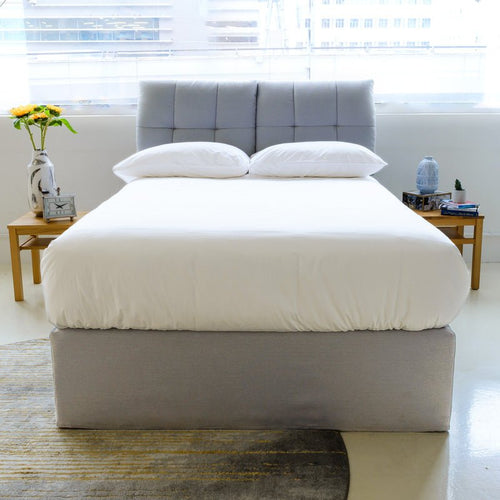
Hush Home's Hydraulic Storage Bed™ combines sturdy wood slats with upholstered finishing and easy-access hidden storage beneath the mattress.
Its hand-tufted headboard also gives it a softer, more upholstered bedroom look, making it useful when storage efficiency is a priority.
A bed frame does not need replacing simply because it has reached a certain birthday. Replace or repair it when it can no longer remain stable, level and structurally sound, or when it no longer provides the support your mattress requires.
If the frame is noisy but otherwise secure, troubleshoot first. If it is cracked, badly bowed, repeatedly loose or structurally compromised, treating the foundation as part of the sleep system can help protect both the mattress and the people using it.
Not always. First check loose hardware, slats, wall contact and other friction points. Replacement is more appropriate when the noise is accompanied by movement, damaged joints, cracks or bent structural parts.
A damaged or uneven frame can change how the mattress is supported and may contribute to uneven wear. Check both the mattress and foundation if you notice new sagging or an uneven sleep surface.
Not necessarily. You can keep an existing frame if it is structurally sound, the correct size and meets the new mattress's support requirements. Inspect it before installing the new mattress.
Neither is automatically better. What matters is that the foundation is stable, appropriately sized and compatible with the mattress manufacturer's requirements. A well-designed slatted base and a suitable platform base can both provide effective mattress support.
Remove the mattress and inspect the frame on its own. Check whether the slats, centre beam or side rails are bowed. If possible, place the mattress temporarily on another suitable flat support and compare how it sits and feels.