


Zoned Support vs Dual Firmness: What's the Difference in a Mattress?
30 Oct 2026
Quick Answer
Zoned support and dual firmness solve different problems. Zoned support varies the mattress's cushioning or resistance at different body regions, often from shoulders to lower back and hips along the length of the bed. Dual firmness gives the left and right sleepers different overall feels on one shared mattress. One concerns where a person's body meets the mattress; the other concerns which sleeper is using each side. A mattress can have either feature, both, or neither.
For a person sleeping alone, well-designed support, pressure relief and overall comfort matter more than obtaining a 'dual' label. For partners who genuinely prefer different firmness levels, a left/right adjustable design may address a problem that body zoning alone cannot solve. Neither feature is a shortcut to buying the firmest mattress or claiming to treat back pain.
The simplest way to understand the difference is to imagine two directions across a bed: head to foot and left to right. These describe the common design intent, not a universal manufacturing rule. Ask the retailer for the exact internal diagram and a clear explanation of how the zones or sides are built.
| Question | Zoned support | Dual firmness |
|---|---|---|
| Direction | Across body regions, often head to foot | Left versus right sleeper |
| Main purpose | Vary resistance or cushioning by body area | Allow two people different whole-side feels |
| How it works | Different coil/foam zones | Split layers, inserts or air chambers |
| Who may value it | Solo sleepers and couples | Especially couples with different preferences |
| Can it be adjusted? | Often fixed in the support core | Depends on design; some adjustable later |
| What the number means | Five or seven mapped support regions | Two sides; each may offer multiple profiles |
| Hush example | Organic Mattress™: 7-zone core | Hush Duo Mattress™: 4 profiles per side plus 5-zone base |
A 5-zone mattress does not automatically provide five selectable firmness levels, and a dual-firmness mattress does not automatically have a zoned support core. Advertised numbers describe different things. Look at the physical construction and what can actually be changed after purchase.
A manufacturer may vary coil resistance, spring configuration or foam design across sections of a mattress. One area may allow a shoulder to settle more easily, while another offers more resistance beneath the lumbar or pelvis area. The intention is to balance cushioning with stable support, but the actual effect depends on the complete mattress, body dimensions, preferred position and the bed base.
Common product descriptions mention three, five or seven zones. The number simply counts the manufacturer's mapped regions; it does not create an industry ranking where seven automatically beats five. A seven-zone layout with unsuitable comfort layers may feel less comfortable to you than a simpler design. Likewise, a zoning diagram alone is not proof that the support matches every body height.
Consider where your shoulders and hips land when you use your usual pillow. A tall and short sleeper may rest over somewhat different portions of the same fixed zones. Test the positions you actually use and allow time for the layers to settle before judging. Avoid pressing one point with a hand and treating that as proof of whole-body support.
In a true left/right dual-firmness design, one partner can use a softer or more cushioning side while the other uses a firmer side. The product may achieve this through different foams, reversible inserts, modular components or adjustable air chambers. The degree of independence depends on its construction; 'dual' is not enough to tell you whether either side can be changed later.
Think of two different user needs: one sleeper wants less pressure at the shoulder, while the other dislikes feeling that their pelvis sinks. A shared medium setting might be acceptable, but it cannot intentionally give each partner a different whole-side feel. A genuine side-by-side design can be useful when the preferences are stable or change at different rates.
Dual firmness should not be confused with independent head and foot elevation. An electric adjustable base changes the position of the bed, whereas a firmness insert or air setting changes the surface feel. Some products provide both, but one feature does not imply the other.
Yes. In that case, both sleepers share a support system with body-region zoning, while the comfort or firmness on each half can be configured separately. The two features operate at different levels of the design. You still need to ask where the zones are located, what part can be adjusted and whether the surface feels continuous across the middle.
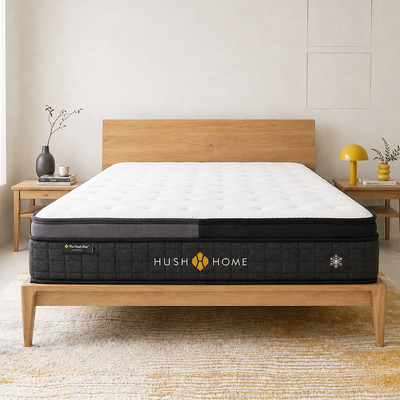
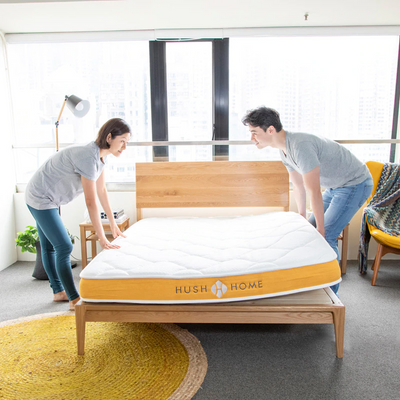
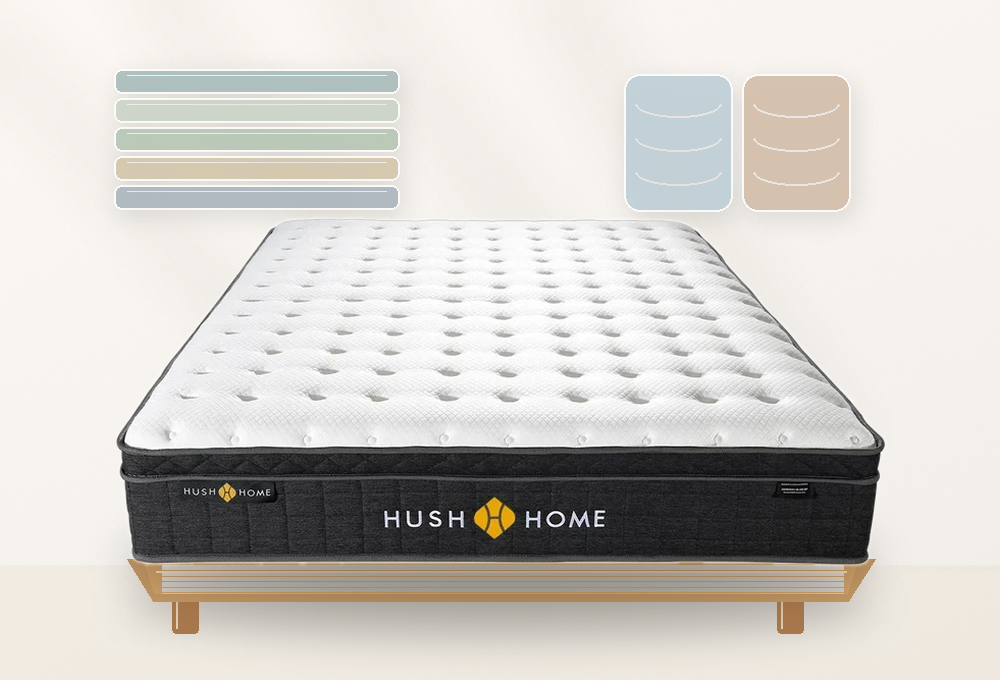
Hush Duo Mattress™ is a concrete example. Hush lists a 5-zone pocket-coil support base and independently configurable left/right comfort and support inserts. Each side offers four published firmness profiles, from medium-soft through firm, while the mattress has one continuous outer cover. The 'five zones' are not five firmness choices: the two numbers refer to support regions and per-side configurations respectively.
Hush Duo Mattress™ — Configurations and Construction

A five-zone core and a seven-zone core can both be designed around body regions, but zone count alone does not specify coil quality, firmness balance or comfort performance. To compare them, ask which sections are firmer, how the shoulder and hip areas differ and whether the cushioning above the core changes that effect. Firmness scores across brands are also not necessarily measured on equivalent scales.
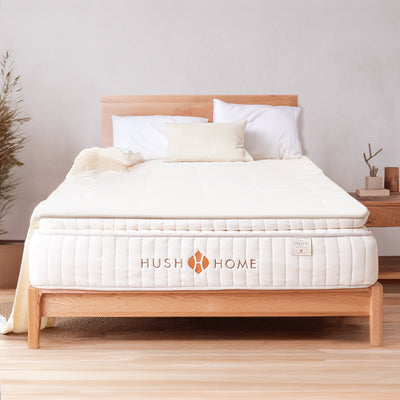
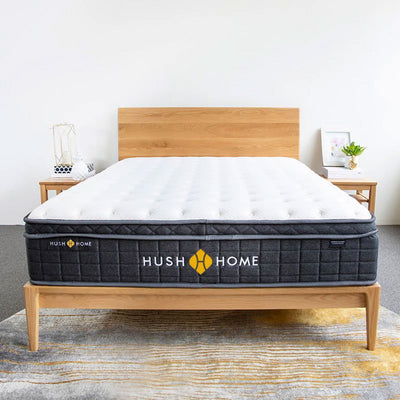
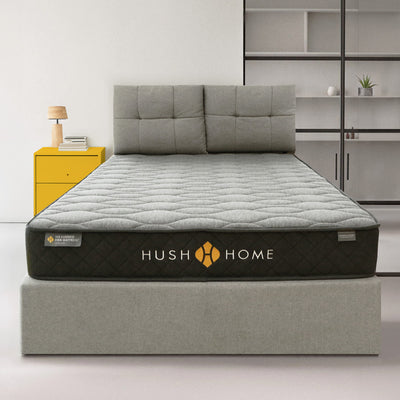
Within Hush Home, Organic Mattress™ uses a published seven-zone pocket-coil system within its natural-latex hybrid construction. Hush Mattress™ is described in the comparison range as a zoned pocket-coil hybrid. Those descriptions concern body-region support, not a promise that two partners can independently choose their overall firmness. To obtain separate preferences in one shared mattress, compare a dedicated dual-firmness construction such as Duo.
Organic Mattress™ — Seven-Zone Hybrid Design

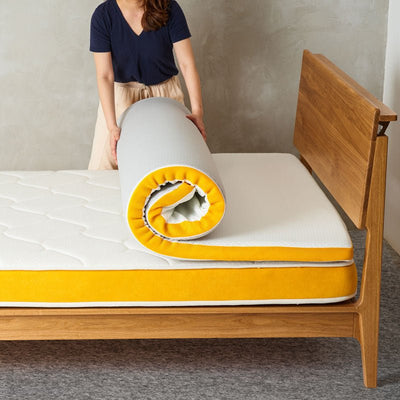
These three designs are easy to confuse. A reversible mattress can have one firmness on its top face and another on its bottom face; when you flip the whole mattress, both sleepers change together. Loft Mattress™ is Hush's reversible low-profile example. That is not independent left/right comfort for a couple.
A split king commonly uses two separate mattresses placed side by side, so each may have its own firmness and sometimes its own adjustable base. It can create a physical centre seam or gap. A dual-firmness mattress may use one outer cover over separately configured internals, as Duo does, but some other dual designs are still divided at the surface. Ask to inspect the actual centre join before buying.
A central split also does not guarantee perfect motion isolation. Movement transfer depends on the coils, cushioning, frame and what happens when one partner changes position. Similarly, a zoned core can be quite responsive without preventing all movement between partners. Test both comfort and disturbance separately.
Loft Mattress™ — Reversible Comfort
This guide explains mattress design features, not clinical effectiveness. Counts of zones or firmness profiles do not by themselves establish medical benefit.
It can be one useful design feature, but there is no basis for treating a zone count as a clinical diagnosis or cure. The comfort layers, overall firmness, body shape, sleeping position and foundation all matter. A design with firmer lumbar support can still feel too firm at the shoulder or unsuitable overall for a particular sleeper.
Clinical research on firmness suggests that an extremely hard surface is not automatically best for chronic nonspecific lower-back pain, but those studies do not independently compare the Hush five-zone and seven-zone mattresses. If pain persists, worsens or is accompanied by concerning symptoms, seek medical guidance rather than changing mattresses based on marketing alone.
Kovacs et al. — Mattress Firmness and Low-Back Pain Trial
Begin with correct dimensions, comfortable surface firmness, pressure relief and stable support. Zoned support may be worth comparing if your body feels different levels of pressure in different places. Independent left/right firmness is usually unnecessary unless you have a specific use for different halves.
Start with whether each of you can get an acceptable feel on the same bed. If not, compare independently configurable left and right sides, the centre seam, ease of adjustment and long-term availability of replacement components. Zoned support can complement a dual design, but it does not substitute for the partner-specific adjustment.
Look for a product where the comfort setting can genuinely be modified after delivery, and check what the published programme allows. Hush Duo's 365-night comfort guarantee covers up to two complimentary additional inserts within its terms; this is an insert-adjustment benefit, not a 365-night refund or mattress-return trial.
First lie in your usual position on the actual model, with a suitable pillow and enough time to settle. Notice shoulder and hip pressure, lower-back comfort and how easily you turn. Second, if the mattress claims zones, ask which body regions each zone supports and how it aligns with your height. Third, if it claims dual firmness, have both partners independently try their intended sides and compare the centre seam.
Next, try moving on one side while the other person remains still to assess movement disturbance. Finally, read the written trial, insert replacement, warranty and bed-base requirements. A few showroom minutes are informative but do not prove overnight results, and none of these observations is a clinical spinal assessment.
Best Mattress for Couples With Different Firmness Preferences
No. Zoned support varies support across body regions, commonly from head to foot; dual firmness gives the left and right halves different overall feels. They address different needs and can coexist.
Not necessarily. Five zones describe five areas of support distribution. The number of user-selectable firmness profiles is a separate specification. Hush Duo lists five support zones and four firmness choices per side.
No. Zone count alone does not establish quality, pressure relief or suitability. Compare the actual layout, comfort layers and your experience in your usual sleeping position.
Yes. Hush Duo is an example: a five-zone pocket-coil base plus independently configurable left and right inserts. The support zones and adjustable sides work at different levels of the construction.
Not if flipping the entire mattress changes the feel for both sleepers together. Reversible firmness is a top-versus-bottom choice; dual firmness for couples is a left-versus-right choice.
No. Some designs use separate mattresses, but others divide the internal layers under one continuous cover. Hush Duo uses the latter approach. Check the specific product, especially its central surface and available sizes.
Neither label proves a treatment effect. A comfortable mattress can be one part of a suitable sleeping environment, but persistent pain needs appropriate assessment. Do not choose by zone count or a firmness number alone.
Yes. Its inserts can be rearranged at home, with four published firmness profiles for each side. The separate 365-night comfort programme allows up to two additional inserts under its terms, but does not offer a refund trial.
You may not need independent left/right adjustment. Compare the mattress's overall support, comfort, motion isolation, dimensions, price and purchase terms first. Buying more features is not automatically better value.
Remember the two directions: body-region zoning and partner-by-partner firmness. Zoned support can be useful even for one sleeper; dual firmness becomes more relevant when two people need different overall feels. Hush Organic illustrates seven-zone support, while Hush Duo demonstrates how a five-zone support system can coexist with four firmness choices for each side. Evaluate the real mattress rather than assuming a bigger number means better support.