
Do Weighted Blankets Help with ADHD?
28 Aug 2026

Weighted blankets may help some people with ADHD feel calmer at bedtime or sleep a little better, particularly if they find firm, even pressure relaxing. However, a weighted blanket does not treat ADHD itself, and the scientific evidence is still developing.
The most useful way to think about a weighted blanket is as a sensory and sleep-comfort tool. Some people enjoy the steady pressure and find it easier to settle down. Others may find the same weight too warm, heavy or restrictive.
KEY TAKEAWAY
Weighted blankets may modestly improve some aspects of sleep for people with ADHD, but they are not a treatment for ADHD. The strongest ADHD-specific evidence so far comes from children with diagnosed ADHD and sleep problems, where researchers found small improvements in sleep duration and sleep efficiency.
Personal preference matters. A weighted blanket is most likely to be useful when the person actually enjoys firm pressure and can use the blanket safely.
Weighted blankets apply steady pressure across the body. This is often described as deep pressure or deep-pressure stimulation.
The pressure provides tactile and proprioceptive sensory input — information that helps the brain register body position, movement and pressure.
Some people find this sensation calming, grounding or similar to being firmly hugged. For someone who feels physically restless at bedtime, that consistent pressure may make winding down feel easier.
What the research does not yet prove: the exact neurological mechanism is not fully established. Claims that weighted blankets reliably “switch off” the sympathetic nervous system, increase serotonin, increase melatonin or lower cortisol should be treated cautiously.
One small laboratory study in healthy young adults did find a higher rise in pre-sleep melatonin while using a weighted blanket, but it did not show better sleep duration, and the researchers stated that the clinical importance of the result remains uncertain.
One of the strongest studies so far was a randomized crossover trial involving 94 children aged 6–14 with ADHD and verified sleep problems.
Compared with a lighter control blanket, the weighted blanket produced small but statistically significant improvements in:
About 7.7 minutes longer.
About 0.82% higher.
About 2.8 minutes less.
A later 16-week analysis found that children who continued using and accepting the weighted blanket were more likely to report improvements in sleep problems. This suggests that whether the individual actually likes using the blanket may be an important part of whether it helps.
Researchers are continuing to study weighted blankets in children with ADHD, which itself shows that the evidence is not yet settled.
There is currently not strong evidence that a weighted blanket directly reduces the core symptoms of ADHD, such as inattention, impulsivity or hyperactivity.
Where it may help is more indirectly.
Sleep problems are common among people with ADHD. If someone sleeps poorly, daytime concentration, mood and self-regulation can also become more difficult.
So if a weighted blanket helps a particular person feel more comfortable at bedtime or sleep slightly better, that may support their overall routine. That is different from saying that the blanket itself treats ADHD.
Many people with ADHD describe difficulty “switching off” at night, frequent movement or a preference for stronger sensory input.
A weighted blanket can provide a more constant physical sensation than an ordinary duvet. For someone who likes firm pressure, that may create a sense of containment or grounding while they wind down.
You personally enjoy firm pressure and find the steady sensation relaxing or grounding.
You dislike pressure, feel claustrophobic, have limited mobility or become hot easily.
The effect is highly individual.
Sensory differences are common in ADHD, but there is no reliable rule that a particular percentage of adults with ADHD has “Sensory Processing Disorder.”
Some people may be especially sensitive to:
Others may actively seek stronger sensory input such as movement, pressure or firm touch.
For someone who finds deep pressure soothing, a weighted blanket may become a useful part of a bedtime routine. It should not be described as a universal “sensory filter,” because sensory preferences vary considerably from person to person.
| Feature | Standard Blanket | Weighted Blanket |
|---|---|---|
| Main purpose | Warmth and everyday bedding comfort. | Comfort plus additional steady pressure. |
| Sensory input | Relatively light. | Stronger, more even pressure. |
| ADHD evidence | No specific ADHD role. | Limited but promising evidence for some sleep outcomes. |
| Treats ADHD? | No. | No. |
| Best suited to | General sleep use. | People who personally find added pressure calming. |
| Main consideration | Fabric and warmth. | Weight, mobility, temperature and safe removal. |
You may have heard of the 10% rule, where the blanket is chosen at around 10% of the user's body weight.
Current occupational-therapy guidance recommends following the manufacturer's instructions and considering factors such as body size, mobility and the person's ability to remove the blanket themselves.
For children, guidance commonly advises that a weighted blanket should not exceed approximately 10% of body weight.
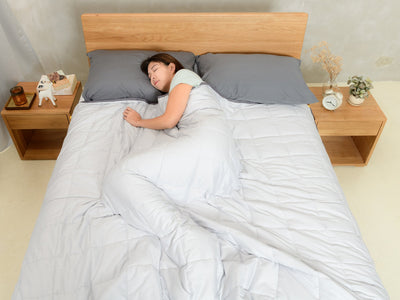
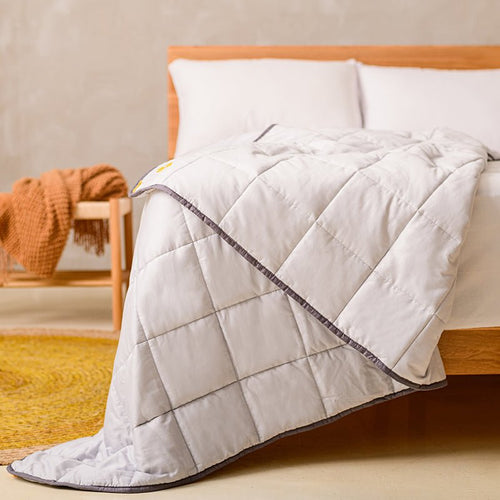
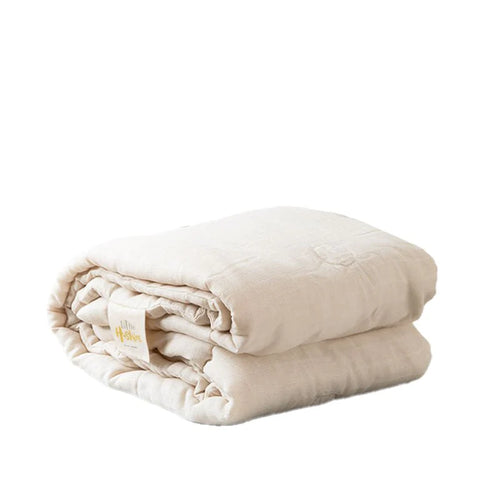
The current Hush Home Weighted Blanket™ weighs 7 kg / 15 lb and measures 150 × 200 cm. It uses glass beads and breathable fabric layers to distribute weight across the blanket.
Because it comes in one weight, consider whether 7 kg feels manageable and comfortable for the intended user rather than assuming it will suit everyone.
For adults who can move freely and remove the blanket independently, some people choose to use weighted blankets for extended periods.
For children, professional guidance is more cautious.
Guidance based on recommendations from the Royal College of Occupational Therapists advises that children should:
Some current NHS guidance also recommends removing the weighted blanket once the child has fallen asleep rather than leaving it in place overnight.
People with conditions affecting breathing, circulation, temperature regulation, mobility or alertness should seek appropriate professional advice before using one.
Having ADHD does not automatically make a weighted blanket either safe or unsafe.
The key questions are whether the child:
Safety first: weighted blankets should never cover the face or neck and should never be used as a restraint.
If a child has additional medical, developmental, breathing or mobility needs, speak with an occupational therapist or healthcare professional before using weighted equipment.
It can be, depending on the person and the bedroom.
Any additional bedding can affect heat comfort. Air-conditioning, room humidity, blanket construction and the individual's temperature sensitivity all matter.
The Hush Weighted Blanket™ uses glass beads together with breathable fabric layers and is designed to improve airflow.
In Hong Kong, using it in an air-conditioned room and pairing it with breathable bedding may feel more comfortable than layering it underneath a heavy duvet.
You have ADHD and also experience difficulty settling down, physical restlessness or sleep disruption — and you personally enjoy firm pressure.
Pressure makes you uncomfortable, you become hot easily, you cannot remove the blanket independently or you have a health condition that could make weighted bedding unsafe.
The goal is not to force yourself to adapt to a weighted blanket. Sensory comfort is personal.
No. Weighted blankets do not cure ADHD and should not replace medication, behavioural support or other treatment recommended by a qualified professional.
Possibly for some individuals, but current ADHD-specific research does not clearly support that claim.
In the randomized trial of 94 children with ADHD, weighted blankets improved some measures of sleep but did not significantly reduce sleep-onset latency.
Possibly, but evidence specifically studying adults with ADHD is still limited.
Broader research in people with psychiatric conditions suggests weighted blankets may help some people with anxiety or sleep difficulties, but the studies include mixed populations and cannot be applied directly to every adult with ADHD.
No. Around 10% is commonly used as a safety and sizing guideline, especially for children, rather than a proven therapeutic formula.
Comfort, mobility and the ability to remove the blanket safely are also important.
Current occupational-therapy and NHS guidance recommends caution. Children should be supervised, must be able to remove the blanket themselves, and some guidance recommends removing it once the child falls asleep.
A weighted blanket is not a treatment for ADHD, but it may be a useful sensory or sleep-comfort tool for some people with ADHD.
The strongest ADHD-specific research so far suggests modest improvements in certain sleep measures among children who also have sleep problems. It does not show that weighted blankets eliminate racing thoughts, cure restlessness or reliably make people fall asleep faster.
The best indication that a weighted blanket may suit you is much simpler: you find firm, even pressure comfortable and relaxing.
If you want to try one, prioritize an appropriate weight, comfortable temperature, free movement and the ability to remove the blanket easily.
Ready to see whether steady pressure suits your sleep routine? Explore the Hush Weighted Blanket™.